

then in this case the number of electrons localized within the bounds of the full
super atom (which includes N loc and N deloc ) is none else than N, the total number of
electrons in the molecule.
On the other hand, the number of electrons shared between the super-atom S and
an atom k outside of S is given by the sum of the delocalization indices of every
atom within S to that atom [21]:
d X super ; X k
À
Á ¼
X
n super
i ¼ 1
i 2 X super
d X i ; X k
ð
Þ;
ð3:19Þ
leading to off-diagonal entries of ½δ(Ω super ,Ω k ) between the super-atom and the kth
atom in the molecule.
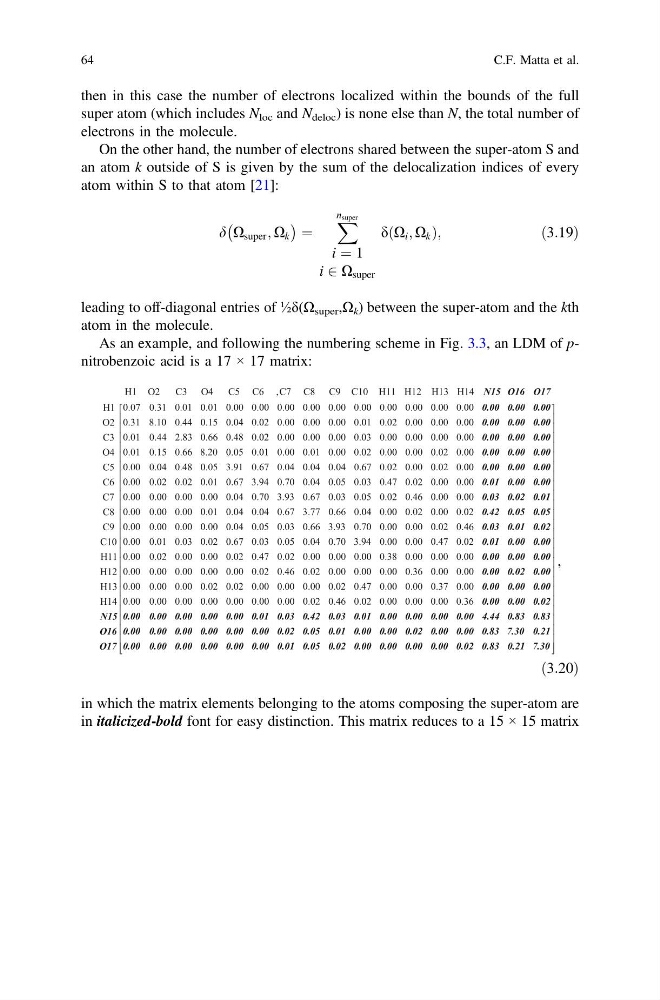
As an example, and following the numbering scheme in Fig. 3.3, an LDM of pnitrobenzoic acid is a 17 × 17 matrix:
ð3:20Þ
in which the matrix elements belonging to the atoms composing the super-atom are
in italicized-bold font for easy distinction. This matrix reduces to a 15 × 15 matrix
64
C.F. Matta et al.
super atom (which includes N loc and N deloc ) is none else than N, the total number of
electrons in the molecule.
On the other hand, the number of electrons shared between the super-atom S and
an atom k outside of S is given by the sum of the delocalization indices of every
atom within S to that atom [21]:
d X super ; X k
À
Á ¼
X
n super
i ¼ 1
i 2 X super
d X i ; X k
ð
Þ;
ð3:19Þ
leading to off-diagonal entries of ½δ(Ω super ,Ω k ) between the super-atom and the kth
atom in the molecule.
As an example, and following the numbering scheme in Fig. 3.3, an LDM of pnitrobenzoic acid is a 17 × 17 matrix:
ð3:20Þ
in which the matrix elements belonging to the atoms composing the super-atom are
in italicized-bold font for easy distinction. This matrix reduces to a 15 × 15 matrix
64
C.F. Matta et al.