

basins were found but some of the bonding population contributes to the V(O)
basins. Nevertheless, it is not possible to evaluate the bond order using the total
population of V(O) basins since the latter encompass also the oxygen lone pairs.
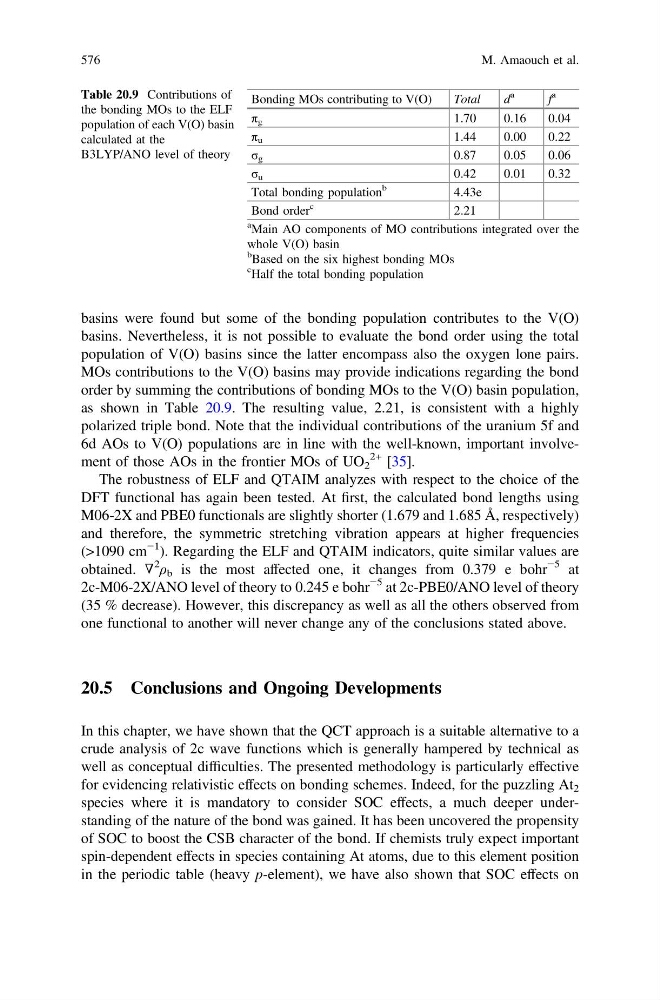
MOs contributions to the V(O) basins may provide indications regarding the bond
order by summing the contributions of bonding MOs to the V(O) basin population,
as shown in Table 20.9. The resulting value, 2.21, is consistent with a highly
polarized triple bond. Note that the individual contributions of the uranium 5f and
6d AOs to V(O) populations are in line with the well-known, important involvement of those AOs in the frontier MOs of UO 2
2+ [35].
The robustness of ELF and QTAIM analyzes with respect to the choice of the
DFT functional has again been tested. At first, the calculated bond lengths using
M06-2X and PBE0 functionals are slightly shorter (1.679 and 1.685 Å, respectively)
and therefore, the symmetric stretching vibration appears at higher frequencies
(>1090 cm
−1 ). Regarding the ELF and QTAIM indicators, quite similar values are
obtained. ∇
2
ρ b is the most affected one, it changes from 0.379 e bohr
−5 at
2c-M06-2X/ANO level of theory to 0.245 e bohr
−5 at 2c-PBE0/ANO level of theory
(35 % decrease). However, this discrepancy as well as all the others observed from
one functional to another will never change any of the conclusions stated above.
20.5 Conclusions and Ongoing Developments
In this chapter, we have shown that the QCT approach is a suitable alternative to a
crude analysis of 2c wave functions which is generally hampered by technical as
well as conceptual difficulties. The presented methodology is particularly effective
for evidencing relativistic effects on bonding schemes. Indeed, for the puzzling At 2
species where it is mandatory to consider SOC effects, a much deeper understanding of the nature of the bond was gained. It has been uncovered the propensity
of SOC to boost the CSB character of the bond. If chemists truly expect important
spin-dependent effects in species containing At atoms, due to this element position
in the periodic table (heavy p-element), we have also shown that SOC effects on
Table 20.9 Contributions of
the bonding MOs to the ELF
population of each V(O) basin
calculated at the
B3LYP/ANO level of theory
Bonding MOs contributing to V(O)
Total
d
a
f
a
π g
1.70
0.16
0.04
π u
1.44
0.00
0.22
σ g
0.87
0.05
0.06
σ u
0.42
0.01
0.32
Total bonding population
b
4.43e
Bond order
c
2.21
a Main AO components of MO contributions integrated over the
whole V(O) basin
b
Based on the six highest bonding MOs
c Half the total bonding population
576
M. Amaouch et al.
basins. Nevertheless, it is not possible to evaluate the bond order using the total
population of V(O) basins since the latter encompass also the oxygen lone pairs.
MOs contributions to the V(O) basins may provide indications regarding the bond
order by summing the contributions of bonding MOs to the V(O) basin population,
as shown in Table 20.9. The resulting value, 2.21, is consistent with a highly
polarized triple bond. Note that the individual contributions of the uranium 5f and
6d AOs to V(O) populations are in line with the well-known, important involvement of those AOs in the frontier MOs of UO 2
2+ [35].
The robustness of ELF and QTAIM analyzes with respect to the choice of the
DFT functional has again been tested. At first, the calculated bond lengths using
M06-2X and PBE0 functionals are slightly shorter (1.679 and 1.685 Å, respectively)
and therefore, the symmetric stretching vibration appears at higher frequencies
(>1090 cm
−1 ). Regarding the ELF and QTAIM indicators, quite similar values are
obtained. ∇
2
ρ b is the most affected one, it changes from 0.379 e bohr
−5 at
2c-M06-2X/ANO level of theory to 0.245 e bohr
−5 at 2c-PBE0/ANO level of theory
(35 % decrease). However, this discrepancy as well as all the others observed from
one functional to another will never change any of the conclusions stated above.
20.5 Conclusions and Ongoing Developments
In this chapter, we have shown that the QCT approach is a suitable alternative to a
crude analysis of 2c wave functions which is generally hampered by technical as
well as conceptual difficulties. The presented methodology is particularly effective
for evidencing relativistic effects on bonding schemes. Indeed, for the puzzling At 2
species where it is mandatory to consider SOC effects, a much deeper understanding of the nature of the bond was gained. It has been uncovered the propensity
of SOC to boost the CSB character of the bond. If chemists truly expect important
spin-dependent effects in species containing At atoms, due to this element position
in the periodic table (heavy p-element), we have also shown that SOC effects on
Table 20.9 Contributions of
the bonding MOs to the ELF
population of each V(O) basin
calculated at the
B3LYP/ANO level of theory
Bonding MOs contributing to V(O)
Total
d
a
f
a
π g
1.70
0.16
0.04
π u
1.44
0.00
0.22
σ g
0.87
0.05
0.06
σ u
0.42
0.01
0.32
Total bonding population
b
4.43e
Bond order
c
2.21
a Main AO components of MO contributions integrated over the
whole V(O) basin
b
Based on the six highest bonding MOs
c Half the total bonding population
576
M. Amaouch et al.