

consistent with highly polar donor-acceptor U-O bond. This finding mirrors the
bonding scheme previously identified in Xe-O bonds for XeO 3 and XeO 4 complexes [19]. The QTAIM analyzes strengthen the conclusions drawn from the ELF
results.
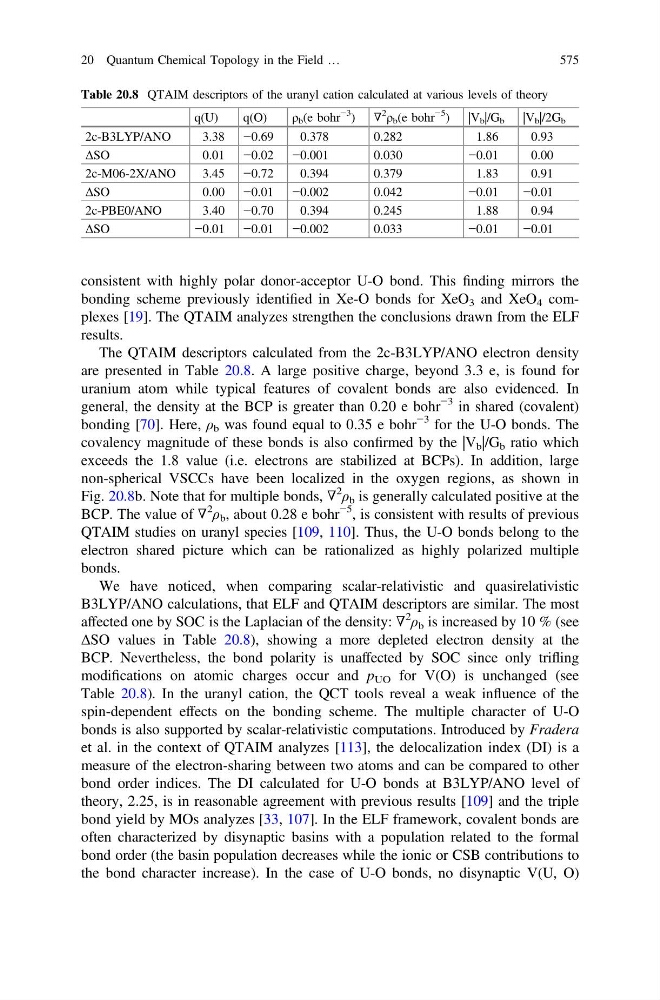
The QTAIM descriptors calculated from the 2c-B3LYP/ANO electron density
are presented in Table 20.8. A large positive charge, beyond 3.3 e, is found for
uranium atom while typical features of covalent bonds are also evidenced. In
general, the density at the BCP is greater than 0.20 e bohr
−3 in shared (covalent)
bonding [70]. Here, ρ b was found equal to 0.35 e bohr
−3 for the U-O bonds. The
covalency magnitude of these bonds is also confirmed by the |V b |/G b ratio which
exceeds the 1.8 value (i.e. electrons are stabilized at BCPs). In addition, large
non-spherical VSCCs have been localized in the oxygen regions, as shown in
Fig. 20.8b. Note that for multiple bonds, ∇
2
ρ b is generally calculated positive at the
BCP. The value of ∇
2
ρ b , about 0.28 e bohr
−5 , is consistent with results of previous
QTAIM studies on uranyl species [109, 110]. Thus, the U-O bonds belong to the
electron shared picture which can be rationalized as highly polarized multiple
bonds.
We have noticed, when comparing scalar-relativistic and quasirelativistic
B3LYP/ANO calculations, that ELF and QTAIM descriptors are similar. The most
affected one by SOC is the Laplacian of the density: ∇
2 ρ b is increased by 10 % (see
ΔSO values in Table 20.8), showing a more depleted electron density at the
BCP. Nevertheless, the bond polarity is unaffected by SOC since only trifling
modifications on atomic charges occur and p UO for V(O) is unchanged (see
Table 20.8). In the uranyl cation, the QCT tools reveal a weak influence of the
spin-dependent effects on the bonding scheme. The multiple character of U-O
bonds is also supported by scalar-relativistic computations. Introduced by Fradera
et al. in the context of QTAIM analyzes [113], the delocalization index (DI) is a
measure of the electron-sharing between two atoms and can be compared to other
bond order indices. The DI calculated for U-O bonds at B3LYP/ANO level of
theory, 2.25, is in reasonable agreement with previous results [109] and the triple
bond yield by MOs analyzes [33, 107]. In the ELF framework, covalent bonds are
often characterized by disynaptic basins with a population related to the formal
bond order (the basin population decreases while the ionic or CSB contributions to
the bond character increase). In the case of U-O bonds, no disynaptic V(U, O)
Table 20.8 QTAIM descriptors of the uranyl cation calculated at various levels of theory
q(U)
q(O)
ρ b (e bohr
−3
) ∇
2
ρ b (e bohr
−5
) |V b |/G b |V b |/2G b
2c-B3LYP/ANO
3.38 −0.69
0.378
0.282
1.86
0.93
ΔSO
0.01 −0.02 −0.001
0.030
−0.01
0.00
2c-M06-2X/ANO
3.45 −0.72
0.394
0.379
1.83
0.91
ΔSO
0.00 −0.01 −0.002
0.042
−0.01
−0.01
2c-PBE0/ANO
3.40 −0.70
0.394
0.245
1.88
0.94
ΔSO
−0.01 −0.01 −0.002
0.033
−0.01
−0.01
20 Quantum Chemical Topology in the Field …
575
bonding scheme previously identified in Xe-O bonds for XeO 3 and XeO 4 complexes [19]. The QTAIM analyzes strengthen the conclusions drawn from the ELF
results.
The QTAIM descriptors calculated from the 2c-B3LYP/ANO electron density
are presented in Table 20.8. A large positive charge, beyond 3.3 e, is found for
uranium atom while typical features of covalent bonds are also evidenced. In
general, the density at the BCP is greater than 0.20 e bohr
−3 in shared (covalent)
bonding [70]. Here, ρ b was found equal to 0.35 e bohr
−3 for the U-O bonds. The
covalency magnitude of these bonds is also confirmed by the |V b |/G b ratio which
exceeds the 1.8 value (i.e. electrons are stabilized at BCPs). In addition, large
non-spherical VSCCs have been localized in the oxygen regions, as shown in
Fig. 20.8b. Note that for multiple bonds, ∇
2
ρ b is generally calculated positive at the
BCP. The value of ∇
2
ρ b , about 0.28 e bohr
−5 , is consistent with results of previous
QTAIM studies on uranyl species [109, 110]. Thus, the U-O bonds belong to the
electron shared picture which can be rationalized as highly polarized multiple
bonds.
We have noticed, when comparing scalar-relativistic and quasirelativistic
B3LYP/ANO calculations, that ELF and QTAIM descriptors are similar. The most
affected one by SOC is the Laplacian of the density: ∇
2 ρ b is increased by 10 % (see
ΔSO values in Table 20.8), showing a more depleted electron density at the
BCP. Nevertheless, the bond polarity is unaffected by SOC since only trifling
modifications on atomic charges occur and p UO for V(O) is unchanged (see
Table 20.8). In the uranyl cation, the QCT tools reveal a weak influence of the
spin-dependent effects on the bonding scheme. The multiple character of U-O
bonds is also supported by scalar-relativistic computations. Introduced by Fradera
et al. in the context of QTAIM analyzes [113], the delocalization index (DI) is a
measure of the electron-sharing between two atoms and can be compared to other
bond order indices. The DI calculated for U-O bonds at B3LYP/ANO level of
theory, 2.25, is in reasonable agreement with previous results [109] and the triple
bond yield by MOs analyzes [33, 107]. In the ELF framework, covalent bonds are
often characterized by disynaptic basins with a population related to the formal
bond order (the basin population decreases while the ionic or CSB contributions to
the bond character increase). In the case of U-O bonds, no disynaptic V(U, O)
Table 20.8 QTAIM descriptors of the uranyl cation calculated at various levels of theory
q(U)
q(O)
ρ b (e bohr
−3
) ∇
2
ρ b (e bohr
−5
) |V b |/G b |V b |/2G b
2c-B3LYP/ANO
3.38 −0.69
0.378
0.282
1.86
0.93
ΔSO
0.01 −0.02 −0.001
0.030
−0.01
0.00
2c-M06-2X/ANO
3.45 −0.72
0.394
0.379
1.83
0.91
ΔSO
0.00 −0.01 −0.002
0.042
−0.01
−0.01
2c-PBE0/ANO
3.40 −0.70
0.394
0.245
1.88
0.94
ΔSO
−0.01 −0.01 −0.002
0.033
−0.01
−0.01
20 Quantum Chemical Topology in the Field …
575