

in UO 2
2+ have been limited to the scalar-relativistic framework, i.e. in the absence
of spin-dependent effects. Hence, applying to the bare uranyl cation our QCT
methodology, which takes into account SOC, stands for the earliest effort to tackle
this issue. The calculated bond length and harmonic frequencies at the
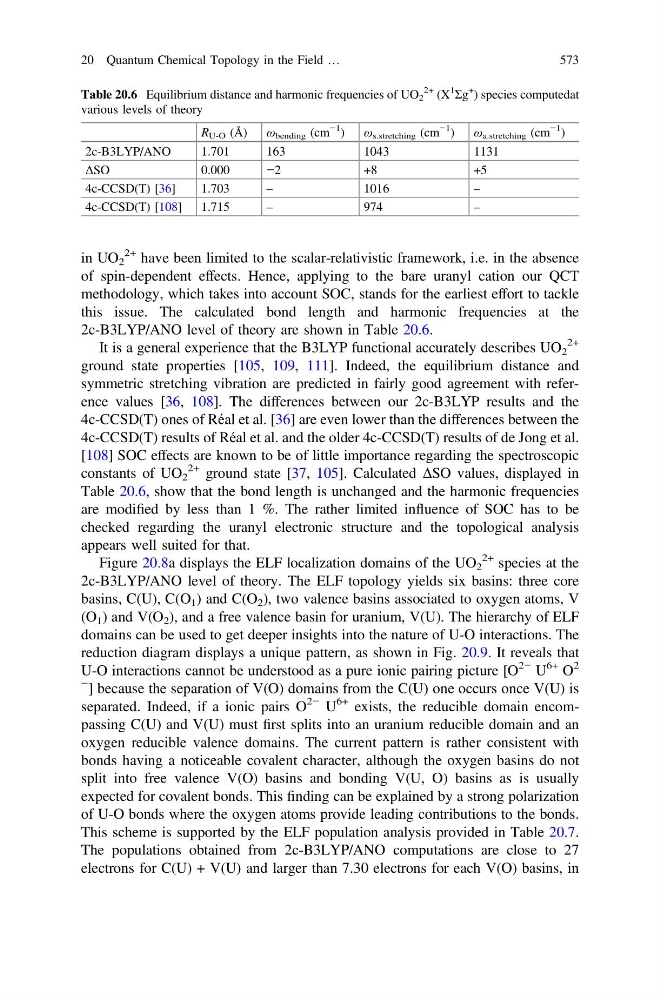
2c-B3LYP/ANO level of theory are shown in Table 20.6.
It is a general experience that the B3LYP functional accurately describes UO 2
2+
ground state properties [105, 109, 111]. Indeed, the equilibrium distance and
symmetric stretching vibration are predicted in fairly good agreement with reference values [36, 108]. The differences between our 2c-B3LYP results and the
4c-CCSD(T) ones of Réal et al. [36] are even lower than the differences between the
4c-CCSD(T) results of Réal et al. and the older 4c-CCSD(T) results of de Jong et al.
[108] SOC effects are known to be of little importance regarding the spectroscopic
constants of UO 2
2+ ground state [37, 105]. Calculated ΔSO values, displayed in
Table 20.6, show that the bond length is unchanged and the harmonic frequencies
are modified by less than 1 %. The rather limited influence of SOC has to be
checked regarding the uranyl electronic structure and the topological analysis
appears well suited for that.
Figure 20.8a displays the ELF localization domains of the UO 2
2+ species at the
2c-B3LYP/ANO level of theory. The ELF topology yields six basins: three core
basins, C(U), C(O 1 ) and C(O 2 ), two valence basins associated to oxygen atoms, V
(O 1 ) and V(O 2 ), and a free valence basin for uranium, V(U). The hierarchy of ELF
domains can be used to get deeper insights into the nature of U-O interactions. The
reduction diagram displays a unique pattern, as shown in Fig. 20.9. It reveals that
U-O interactions cannot be understood as a pure ionic pairing picture [O
2− U
6+ O
2
− ] because the separation of V(O) domains from the C(U) one occurs once V(U) is
separated. Indeed, if a ionic pairs O
2− U
6+ exists, the reducible domain encompassing C(U) and V(U) must first splits into an uranium reducible domain and an
oxygen reducible valence domains. The current pattern is rather consistent with
bonds having a noticeable covalent character, although the oxygen basins do not
split into free valence V(O) basins and bonding V(U, O) basins as is usually
expected for covalent bonds. This finding can be explained by a strong polarization
of U-O bonds where the oxygen atoms provide leading contributions to the bonds.
This scheme is supported by the ELF population analysis provided in Table 20.7.
The populations obtained from 2c-B3LYP/ANO computations are close to 27
electrons for C(U) + V(U) and larger than 7.30 electrons for each V(O) basins, in
Table 20.6 Equilibrium distance and harmonic frequencies of UO 2
2+ (X
1
Σg
+ ) species computedat
various levels of theory
R U-O (Å)
ω bending (cm
−1
)
ω s.stretching (cm
−1
)
ω a.stretching (cm
−1
)
2c-B3LYP/ANO
1.701
163
1043
1131
ΔSO
0.000
−2
+ 8
+ 5
4c-CCSD(T) [36]
1.703
–
1016
–
4c-CCSD(T) [108]
1.715
–
974
–
20 Quantum Chemical Topology in the Field …
573
2+ have been limited to the scalar-relativistic framework, i.e. in the absence
of spin-dependent effects. Hence, applying to the bare uranyl cation our QCT
methodology, which takes into account SOC, stands for the earliest effort to tackle
this issue. The calculated bond length and harmonic frequencies at the
2c-B3LYP/ANO level of theory are shown in Table 20.6.
It is a general experience that the B3LYP functional accurately describes UO 2
2+
ground state properties [105, 109, 111]. Indeed, the equilibrium distance and
symmetric stretching vibration are predicted in fairly good agreement with reference values [36, 108]. The differences between our 2c-B3LYP results and the
4c-CCSD(T) ones of Réal et al. [36] are even lower than the differences between the
4c-CCSD(T) results of Réal et al. and the older 4c-CCSD(T) results of de Jong et al.
[108] SOC effects are known to be of little importance regarding the spectroscopic
constants of UO 2
2+ ground state [37, 105]. Calculated ΔSO values, displayed in
Table 20.6, show that the bond length is unchanged and the harmonic frequencies
are modified by less than 1 %. The rather limited influence of SOC has to be
checked regarding the uranyl electronic structure and the topological analysis
appears well suited for that.
Figure 20.8a displays the ELF localization domains of the UO 2
2+ species at the
2c-B3LYP/ANO level of theory. The ELF topology yields six basins: three core
basins, C(U), C(O 1 ) and C(O 2 ), two valence basins associated to oxygen atoms, V
(O 1 ) and V(O 2 ), and a free valence basin for uranium, V(U). The hierarchy of ELF
domains can be used to get deeper insights into the nature of U-O interactions. The
reduction diagram displays a unique pattern, as shown in Fig. 20.9. It reveals that
U-O interactions cannot be understood as a pure ionic pairing picture [O
2− U
6+ O
2
− ] because the separation of V(O) domains from the C(U) one occurs once V(U) is
separated. Indeed, if a ionic pairs O
2− U
6+ exists, the reducible domain encompassing C(U) and V(U) must first splits into an uranium reducible domain and an
oxygen reducible valence domains. The current pattern is rather consistent with
bonds having a noticeable covalent character, although the oxygen basins do not
split into free valence V(O) basins and bonding V(U, O) basins as is usually
expected for covalent bonds. This finding can be explained by a strong polarization
of U-O bonds where the oxygen atoms provide leading contributions to the bonds.
This scheme is supported by the ELF population analysis provided in Table 20.7.
The populations obtained from 2c-B3LYP/ANO computations are close to 27
electrons for C(U) + V(U) and larger than 7.30 electrons for each V(O) basins, in
Table 20.6 Equilibrium distance and harmonic frequencies of UO 2
2+ (X
1
Σg
+ ) species computedat
various levels of theory
R U-O (Å)
ω bending (cm
−1
)
ω s.stretching (cm
−1
)
ω a.stretching (cm
−1
)
2c-B3LYP/ANO
1.701
163
1043
1131
ΔSO
0.000
−2
+ 8
+ 5
4c-CCSD(T) [36]
1.703
–
1016
–
4c-CCSD(T) [108]
1.715
–
974
–
20 Quantum Chemical Topology in the Field …
573