

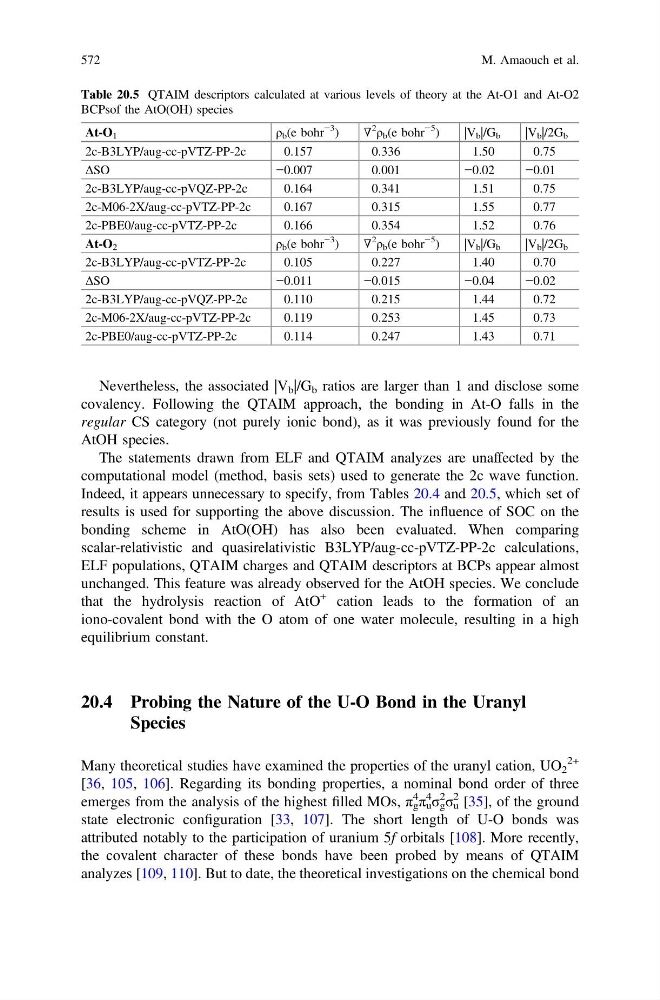
Nevertheless, the associated |V b |/G b ratios are larger than 1 and disclose some
covalency. Following the QTAIM approach, the bonding in At-O falls in the
regular CS category (not purely ionic bond), as it was previously found for the
AtOH species.
The statements drawn from ELF and QTAIM analyzes are unaffected by the
computational model (method, basis sets) used to generate the 2c wave function.
Indeed, it appears unnecessary to specify, from Tables 20.4 and 20.5, which set of
results is used for supporting the above discussion. The influence of SOC on the
bonding scheme in AtO(OH) has also been evaluated. When comparing
scalar-relativistic and quasirelativistic B3LYP/aug-cc-pVTZ-PP-2c calculations,
ELF populations, QTAIM charges and QTAIM descriptors at BCPs appear almost
unchanged. This feature was already observed for the AtOH species. We conclude
that the hydrolysis reaction of AtO
+ cation leads to the formation of an
iono-covalent bond with the O atom of one water molecule, resulting in a high
equilibrium constant.
20.4 Probing the Nature of the U-O Bond in the Uranyl
Species
Many theoretical studies have examined the properties of the uranyl cation, UO 2
2+
[36, 105, 106]. Regarding its bonding properties, a nominal bond order of three
emerges from the analysis of the highest filled MOs, π g
4
π u
4
σ g
2
σ u
2 [35], of the ground
state electronic configuration [33, 107]. The short length of U-O bonds was
attributed notably to the participation of uranium 5f orbitals [108]. More recently,
the covalent character of these bonds have been probed by means of QTAIM
analyzes [109, 110]. But to date, the theoretical investigations on the chemical bond
Table 20.5 QTAIM descriptors calculated at various levels of theory at the At-O1 and At-O2
BCPsof the AtO(OH) species
At-O 1
ρ b (e bohr
−3
)
∇
2
ρ b (e bohr
−5
)
|V b |/G b
|V b |/2G b
2c-B3LYP/aug-cc-pVTZ-PP-2c
0.157
0.336
1.50
0.75
ΔSO
−0.007
0.001
−0.02
−0.01
2c-B3LYP/aug-cc-pVQZ-PP-2c
0.164
0.341
1.51
0.75
2c-M06-2X/aug-cc-pVTZ-PP-2c
0.167
0.315
1.55
0.77
2c-PBE0/aug-cc-pVTZ-PP-2c
0.166
0.354
1.52
0.76
At-O 2
ρ b (e bohr
−3
)
∇
2
ρ b (e bohr
−5
)
|V b |/G b
|V b |/2G b
2c-B3LYP/aug-cc-pVTZ-PP-2c
0.105
0.227
1.40
0.70
ΔSO
−0.011
−0.015
−0.04
−0.02
2c-B3LYP/aug-cc-pVQZ-PP-2c
0.110
0.215
1.44
0.72
2c-M06-2X/aug-cc-pVTZ-PP-2c
0.119
0.253
1.45
0.73
2c-PBE0/aug-cc-pVTZ-PP-2c
0.114
0.247
1.43
0.71
572
M. Amaouch et al.
covalency. Following the QTAIM approach, the bonding in At-O falls in the
regular CS category (not purely ionic bond), as it was previously found for the
AtOH species.
The statements drawn from ELF and QTAIM analyzes are unaffected by the
computational model (method, basis sets) used to generate the 2c wave function.
Indeed, it appears unnecessary to specify, from Tables 20.4 and 20.5, which set of
results is used for supporting the above discussion. The influence of SOC on the
bonding scheme in AtO(OH) has also been evaluated. When comparing
scalar-relativistic and quasirelativistic B3LYP/aug-cc-pVTZ-PP-2c calculations,
ELF populations, QTAIM charges and QTAIM descriptors at BCPs appear almost
unchanged. This feature was already observed for the AtOH species. We conclude
that the hydrolysis reaction of AtO
+ cation leads to the formation of an
iono-covalent bond with the O atom of one water molecule, resulting in a high
equilibrium constant.
20.4 Probing the Nature of the U-O Bond in the Uranyl
Species
Many theoretical studies have examined the properties of the uranyl cation, UO 2
2+
[36, 105, 106]. Regarding its bonding properties, a nominal bond order of three
emerges from the analysis of the highest filled MOs, π g
4
π u
4
σ g
2
σ u
2 [35], of the ground
state electronic configuration [33, 107]. The short length of U-O bonds was
attributed notably to the participation of uranium 5f orbitals [108]. More recently,
the covalent character of these bonds have been probed by means of QTAIM
analyzes [109, 110]. But to date, the theoretical investigations on the chemical bond
Table 20.5 QTAIM descriptors calculated at various levels of theory at the At-O1 and At-O2
BCPsof the AtO(OH) species
At-O 1
ρ b (e bohr
−3
)
∇
2
ρ b (e bohr
−5
)
|V b |/G b
|V b |/2G b
2c-B3LYP/aug-cc-pVTZ-PP-2c
0.157
0.336
1.50
0.75
ΔSO
−0.007
0.001
−0.02
−0.01
2c-B3LYP/aug-cc-pVQZ-PP-2c
0.164
0.341
1.51
0.75
2c-M06-2X/aug-cc-pVTZ-PP-2c
0.167
0.315
1.55
0.77
2c-PBE0/aug-cc-pVTZ-PP-2c
0.166
0.354
1.52
0.76
At-O 2
ρ b (e bohr
−3
)
∇
2
ρ b (e bohr
−5
)
|V b |/G b
|V b |/2G b
2c-B3LYP/aug-cc-pVTZ-PP-2c
0.105
0.227
1.40
0.70
ΔSO
−0.011
−0.015
−0.04
−0.02
2c-B3LYP/aug-cc-pVQZ-PP-2c
0.110
0.215
1.44
0.72
2c-M06-2X/aug-cc-pVTZ-PP-2c
0.119
0.253
1.45
0.73
2c-PBE0/aug-cc-pVTZ-PP-2c
0.114
0.247
1.43
0.71
572
M. Amaouch et al.