

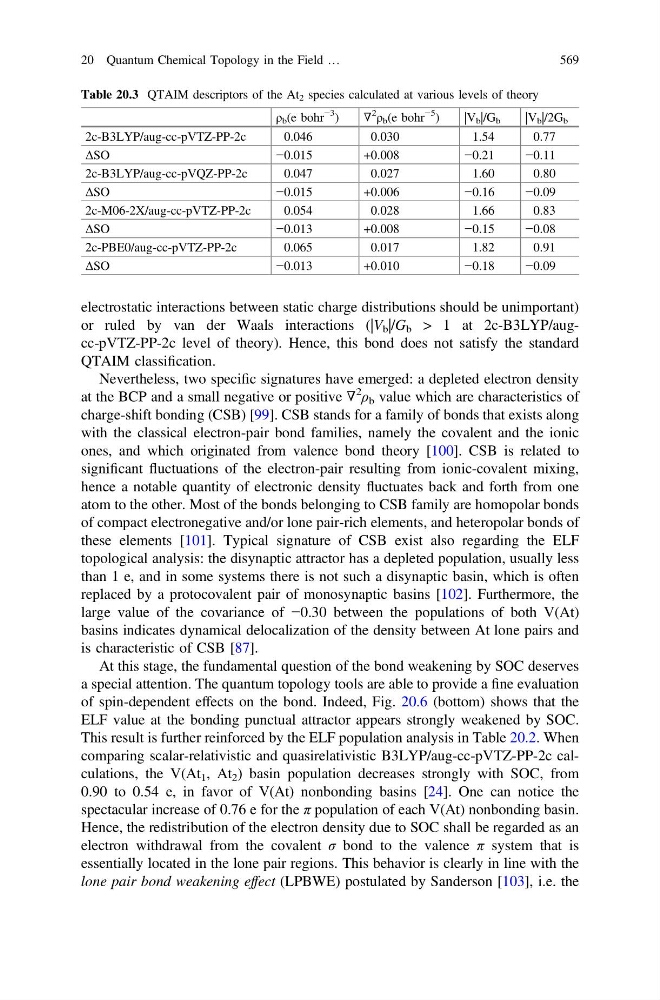
electrostatic interactions between static charge distributions should be unimportant)
or ruled by van der Waals interactions (|V b |/G b > 1 at 2c-B3LYP/augcc-pVTZ-PP-2c level of theory). Hence, this bond does not satisfy the standard
QTAIM classification.
Nevertheless, two specific signatures have emerged: a depleted electron density
at the BCP and a small negative or positive ∇
2
ρ b value which are characteristics of
charge-shift bonding (CSB) [99]. CSB stands for a family of bonds that exists along
with the classical electron-pair bond families, namely the covalent and the ionic
ones, and which originated from valence bond theory [100]. CSB is related to
significant fluctuations of the electron-pair resulting from ionic-covalent mixing,
hence a notable quantity of electronic density fluctuates back and forth from one
atom to the other. Most of the bonds belonging to CSB family are homopolar bonds
of compact electronegative and/or lone pair-rich elements, and heteropolar bonds of
these elements [101]. Typical signature of CSB exist also regarding the ELF
topological analysis: the disynaptic attractor has a depleted population, usually less
than 1 e, and in some systems there is not such a disynaptic basin, which is often
replaced by a protocovalent pair of monosynaptic basins [102]. Furthermore, the
large value of the covariance of −0.30 between the populations of both V(At)
basins indicates dynamical delocalization of the density between At lone pairs and
is characteristic of CSB [87].
At this stage, the fundamental question of the bond weakening by SOC deserves
a special attention. The quantum topology tools are able to provide a fine evaluation
of spin-dependent effects on the bond. Indeed, Fig. 20.6 (bottom) shows that the
ELF value at the bonding punctual attractor appears strongly weakened by SOC.
This result is further reinforced by the ELF population analysis in Table 20.2. When
comparing scalar-relativistic and quasirelativistic B3LYP/aug-cc-pVTZ-PP-2c calculations, the V(At 1 , At 2 ) basin population decreases strongly with SOC, from
0.90 to 0.54 e, in favor of V(At) nonbonding basins [24]. One can notice the
spectacular increase of 0.76 e for the π population of each V(At) nonbonding basin.
Hence, the redistribution of the electron density due to SOC shall be regarded as an
electron withdrawal from the covalent σ bond to the valence π system that is
essentially located in the lone pair regions. This behavior is clearly in line with the
lone pair bond weakening effect (LPBWE) postulated by Sanderson [103], i.e. the
Table 20.3 QTAIM descriptors of the At 2 species calculated at various levels of theory
ρ b (e bohr
−3
)
∇
2
ρ b (e bohr
−5
)
|V b |/G b
|V b |/2G b
2c-B3LYP/aug-cc-pVTZ-PP-2c
0.046
0.030
1.54
0.77
ΔSO
−0.015
+0.008
−0.21
−0.11
2c-B3LYP/aug-cc-pVQZ-PP-2c
0.047
0.027
1.60
0.80
ΔSO
−0.015
+0.006
−0.16
−0.09
2c-M06-2X/aug-cc-pVTZ-PP-2c
0.054
0.028
1.66
0.83
ΔSO
−0.013
+0.008
−0.15
−0.08
2c-PBE0/aug-cc-pVTZ-PP-2c
0.065
0.017
1.82
0.91
ΔSO
−0.013
+0.010
−0.18
−0.09
20 Quantum Chemical Topology in the Field …
569
or ruled by van der Waals interactions (|V b |/G b > 1 at 2c-B3LYP/augcc-pVTZ-PP-2c level of theory). Hence, this bond does not satisfy the standard
QTAIM classification.
Nevertheless, two specific signatures have emerged: a depleted electron density
at the BCP and a small negative or positive ∇
2
ρ b value which are characteristics of
charge-shift bonding (CSB) [99]. CSB stands for a family of bonds that exists along
with the classical electron-pair bond families, namely the covalent and the ionic
ones, and which originated from valence bond theory [100]. CSB is related to
significant fluctuations of the electron-pair resulting from ionic-covalent mixing,
hence a notable quantity of electronic density fluctuates back and forth from one
atom to the other. Most of the bonds belonging to CSB family are homopolar bonds
of compact electronegative and/or lone pair-rich elements, and heteropolar bonds of
these elements [101]. Typical signature of CSB exist also regarding the ELF
topological analysis: the disynaptic attractor has a depleted population, usually less
than 1 e, and in some systems there is not such a disynaptic basin, which is often
replaced by a protocovalent pair of monosynaptic basins [102]. Furthermore, the
large value of the covariance of −0.30 between the populations of both V(At)
basins indicates dynamical delocalization of the density between At lone pairs and
is characteristic of CSB [87].
At this stage, the fundamental question of the bond weakening by SOC deserves
a special attention. The quantum topology tools are able to provide a fine evaluation
of spin-dependent effects on the bond. Indeed, Fig. 20.6 (bottom) shows that the
ELF value at the bonding punctual attractor appears strongly weakened by SOC.
This result is further reinforced by the ELF population analysis in Table 20.2. When
comparing scalar-relativistic and quasirelativistic B3LYP/aug-cc-pVTZ-PP-2c calculations, the V(At 1 , At 2 ) basin population decreases strongly with SOC, from
0.90 to 0.54 e, in favor of V(At) nonbonding basins [24]. One can notice the
spectacular increase of 0.76 e for the π population of each V(At) nonbonding basin.
Hence, the redistribution of the electron density due to SOC shall be regarded as an
electron withdrawal from the covalent σ bond to the valence π system that is
essentially located in the lone pair regions. This behavior is clearly in line with the
lone pair bond weakening effect (LPBWE) postulated by Sanderson [103], i.e. the
Table 20.3 QTAIM descriptors of the At 2 species calculated at various levels of theory
ρ b (e bohr
−3
)
∇
2
ρ b (e bohr
−5
)
|V b |/G b
|V b |/2G b
2c-B3LYP/aug-cc-pVTZ-PP-2c
0.046
0.030
1.54
0.77
ΔSO
−0.015
+0.008
−0.21
−0.11
2c-B3LYP/aug-cc-pVQZ-PP-2c
0.047
0.027
1.60
0.80
ΔSO
−0.015
+0.006
−0.16
−0.09
2c-M06-2X/aug-cc-pVTZ-PP-2c
0.054
0.028
1.66
0.83
ΔSO
−0.013
+0.008
−0.15
−0.08
2c-PBE0/aug-cc-pVTZ-PP-2c
0.065
0.017
1.82
0.91
ΔSO
−0.013
+0.010
−0.18
−0.09
20 Quantum Chemical Topology in the Field …
569