

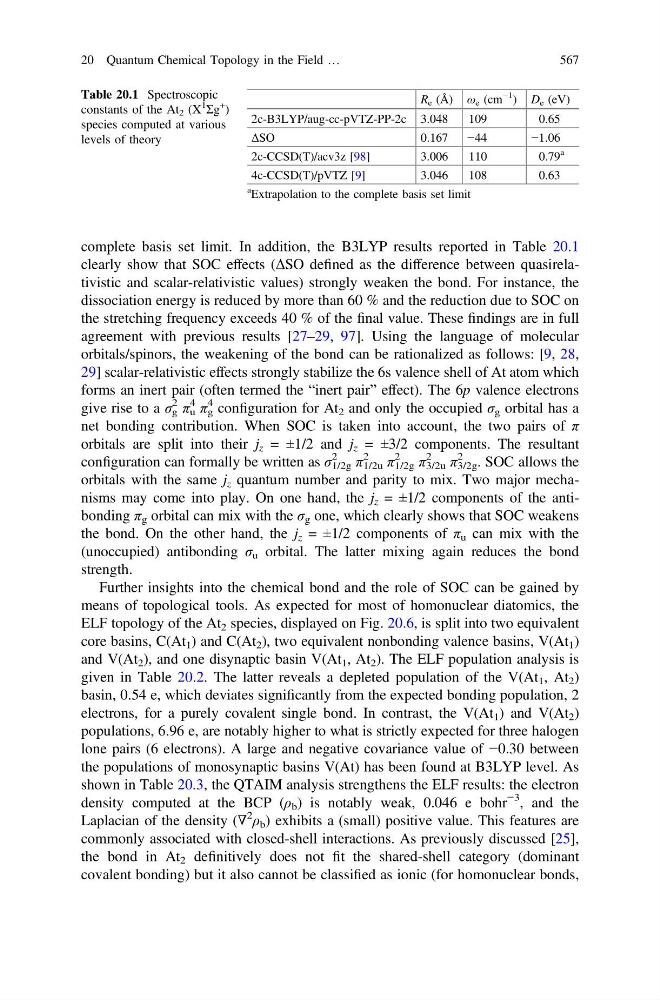
complete basis set limit. In addition, the B3LYP results reported in Table 20.1
clearly show that SOC effects (ΔSO defined as the difference between quasirelativistic and scalar-relativistic values) strongly weaken the bond. For instance, the
dissociation energy is reduced by more than 60 % and the reduction due to SOC on
the stretching frequency exceeds 40 % of the final value. These findings are in full
agreement with previous results [27–29, 97]. Using the language of molecular
orbitals/spinors, the weakening of the bond can be rationalized as follows: [9, 28,
29] scalar-relativistic effects strongly stabilize the 6s valence shell of At atom which
forms an inert pair (often termed the “inert pair” effect). The 6p valence electrons
give rise to a σ g
2
π u
4
π g
4 configuration for At 2 and only the occupied σ g orbital has a
net bonding contribution. When SOC is taken into account, the two pairs of π
orbitals are split into their j z = ±1/2 and j z = ±3/2 components. The resultant
configuration can formally be written as σ 1/2g
2
π 1/2u
2
π 1/2g
2
π 3/2u
2
π 3/2g
2 . SOC allows the
orbitals with the same j z quantum number and parity to mix. Two major mechanisms may come into play. On one hand, the j z = ±1/2 components of the antibonding π g orbital can mix with the σ g one, which clearly shows that SOC weakens
the bond. On the other hand, the j z = ±1/2 components of π u can mix with the
(unoccupied) antibonding σ u orbital. The latter mixing again reduces the bond
strength.
Further insights into the chemical bond and the role of SOC can be gained by
means of topological tools. As expected for most of homonuclear diatomics, the
ELF topology of the At 2 species, displayed on Fig. 20.6, is split into two equivalent
core basins, C(At 1 ) and C(At 2 ), two equivalent nonbonding valence basins, V(At 1 )
and V(At 2 ), and one disynaptic basin V(At 1 , At 2 ). The ELF population analysis is
given in Table 20.2. The latter reveals a depleted population of the V(At 1 , At 2 )
basin, 0.54 e, which deviates significantly from the expected bonding population, 2
electrons, for a purely covalent single bond. In contrast, the V(At 1 ) and V(At 2 )
populations, 6.96 e, are notably higher to what is strictly expected for three halogen
lone pairs (6 electrons). A large and negative covariance value of −0.30 between
the populations of monosynaptic basins V(At) has been found at B3LYP level. As
shown in Table 20.3, the QTAIM analysis strengthens the ELF results: the electron
density computed at the BCP (ρ b ) is notably weak, 0.046 e bohr
−3 , and the
Laplacian of the density (∇
2
ρ b ) exhibits a (small) positive value. This features are
commonly associated with closed-shell interactions. As previously discussed [25],
the bond in At 2 definitively does not fit the shared-shell category (dominant
covalent bonding) but it also cannot be classified as ionic (for homonuclear bonds,
Table 20.1 Spectroscopic
constants of the At 2 (X
1
Σg
+ )
species computed at various
levels of theory
R e (Å) ω e (cm
−1
) D e (eV)
2c-B3LYP/aug-cc-pVTZ-PP-2c 3.048
109
0.65
ΔSO
0.167
−44
−1.06
2c-CCSD(T)/acv3z [98]
3.006
110
0.79
a
4c-CCSD(T)/pVTZ [9]
3.046
108
0.63
a
Extrapolation to the complete basis set limit
20 Quantum Chemical Topology in the Field …
567
clearly show that SOC effects (ΔSO defined as the difference between quasirelativistic and scalar-relativistic values) strongly weaken the bond. For instance, the
dissociation energy is reduced by more than 60 % and the reduction due to SOC on
the stretching frequency exceeds 40 % of the final value. These findings are in full
agreement with previous results [27–29, 97]. Using the language of molecular
orbitals/spinors, the weakening of the bond can be rationalized as follows: [9, 28,
29] scalar-relativistic effects strongly stabilize the 6s valence shell of At atom which
forms an inert pair (often termed the “inert pair” effect). The 6p valence electrons
give rise to a σ g
2
π u
4
π g
4 configuration for At 2 and only the occupied σ g orbital has a
net bonding contribution. When SOC is taken into account, the two pairs of π
orbitals are split into their j z = ±1/2 and j z = ±3/2 components. The resultant
configuration can formally be written as σ 1/2g
2
π 1/2u
2
π 1/2g
2
π 3/2u
2
π 3/2g
2 . SOC allows the
orbitals with the same j z quantum number and parity to mix. Two major mechanisms may come into play. On one hand, the j z = ±1/2 components of the antibonding π g orbital can mix with the σ g one, which clearly shows that SOC weakens
the bond. On the other hand, the j z = ±1/2 components of π u can mix with the
(unoccupied) antibonding σ u orbital. The latter mixing again reduces the bond
strength.
Further insights into the chemical bond and the role of SOC can be gained by
means of topological tools. As expected for most of homonuclear diatomics, the
ELF topology of the At 2 species, displayed on Fig. 20.6, is split into two equivalent
core basins, C(At 1 ) and C(At 2 ), two equivalent nonbonding valence basins, V(At 1 )
and V(At 2 ), and one disynaptic basin V(At 1 , At 2 ). The ELF population analysis is
given in Table 20.2. The latter reveals a depleted population of the V(At 1 , At 2 )
basin, 0.54 e, which deviates significantly from the expected bonding population, 2
electrons, for a purely covalent single bond. In contrast, the V(At 1 ) and V(At 2 )
populations, 6.96 e, are notably higher to what is strictly expected for three halogen
lone pairs (6 electrons). A large and negative covariance value of −0.30 between
the populations of monosynaptic basins V(At) has been found at B3LYP level. As
shown in Table 20.3, the QTAIM analysis strengthens the ELF results: the electron
density computed at the BCP (ρ b ) is notably weak, 0.046 e bohr
−3 , and the
Laplacian of the density (∇
2
ρ b ) exhibits a (small) positive value. This features are
commonly associated with closed-shell interactions. As previously discussed [25],
the bond in At 2 definitively does not fit the shared-shell category (dominant
covalent bonding) but it also cannot be classified as ionic (for homonuclear bonds,
Table 20.1 Spectroscopic
constants of the At 2 (X
1
Σg
+ )
species computed at various
levels of theory
R e (Å) ω e (cm
−1
) D e (eV)
2c-B3LYP/aug-cc-pVTZ-PP-2c 3.048
109
0.65
ΔSO
0.167
−44
−1.06
2c-CCSD(T)/acv3z [98]
3.006
110
0.79
a
4c-CCSD(T)/pVTZ [9]
3.046
108
0.63
a
Extrapolation to the complete basis set limit
20 Quantum Chemical Topology in the Field …
567