

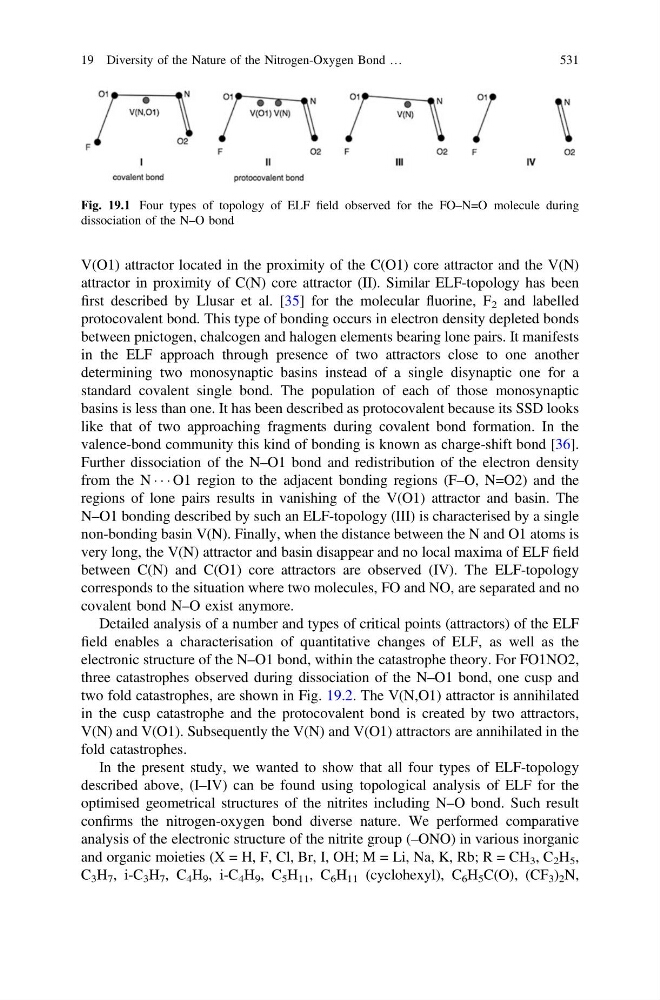
V(O1) attractor located in the proximity of the C(O1) core attractor and the V(N)
attractor in proximity of C(N) core attractor (II). Similar ELF-topology has been
first described by Llusar et al. [35] for the molecular fluorine, F 2 and labelled
protocovalent bond. This type of bonding occurs in electron density depleted bonds
between pnictogen, chalcogen and halogen elements bearing lone pairs. It manifests
in the ELF approach through presence of two attractors close to one another
determining two monosynaptic basins instead of a single disynaptic one for a
standard covalent single bond. The population of each of those monosynaptic
basins is less than one. It has been described as protocovalent because its SSD looks
like that of two approaching fragments during covalent bond formation. In the
valence-bond community this kind of bonding is known as charge-shift bond [36].
Further dissociation of the N–O1 bond and redistribution of the electron density
from the N Á Á Á O1 region to the adjacent bonding regions (F–O, N=O2) and the
regions of lone pairs results in vanishing of the V(O1) attractor and basin. The
N–O1 bonding described by such an ELF-topology (III) is characterised by a single
non-bonding basin V(N). Finally, when the distance between the N and O1 atoms is
very long, the V(N) attractor and basin disappear and no local maxima of ELF field
between C(N) and C(O1) core attractors are observed (IV). The ELF-topology
corresponds to the situation where two molecules, FO and NO, are separated and no
covalent bond N–O exist anymore.
Detailed analysis of a number and types of critical points (attractors) of the ELF
field enables a characterisation of quantitative changes of ELF, as well as the
electronic structure of the N–O1 bond, within the catastrophe theory. For FO1NO2,
three catastrophes observed during dissociation of the N–O1 bond, one cusp and
two fold catastrophes, are shown in Fig. 19.2. The V(N,O1) attractor is annihilated
in the cusp catastrophe and the protocovalent bond is created by two attractors,
V(N) and V(O1). Subsequently the V(N) and V(O1) attractors are annihilated in the
fold catastrophes.
In the present study, we wanted to show that all four types of ELF-topology
described above, (I–IV) can be found using topological analysis of ELF for the
optimised geometrical structures of the nitrites including N–O bond. Such result
confirms the nitrogen-oxygen bond diverse nature. We performed comparative
analysis of the electronic structure of the nitrite group (–ONO) in various inorganic
and organic moieties (X = H, F, Cl, Br, I, OH; M = Li, Na, K, Rb; R = CH 3 , C 2 H 5 ,
C 3 H 7 , i-C 3 H 7 , C 4 H 9 , i-C 4 H 9 , C 5 H 11 , C 6 H 11 (cyclohexyl), C 6 H 5 C(O), (CF 3 ) 2 N,
Fig. 19.1 Four types of topology of ELF field observed for the FO–N=O molecule during
dissociation of the N–O bond
19 Diversity of the Nature of the Nitrogen-Oxygen Bond …
531
attractor in proximity of C(N) core attractor (II). Similar ELF-topology has been
first described by Llusar et al. [35] for the molecular fluorine, F 2 and labelled
protocovalent bond. This type of bonding occurs in electron density depleted bonds
between pnictogen, chalcogen and halogen elements bearing lone pairs. It manifests
in the ELF approach through presence of two attractors close to one another
determining two monosynaptic basins instead of a single disynaptic one for a
standard covalent single bond. The population of each of those monosynaptic
basins is less than one. It has been described as protocovalent because its SSD looks
like that of two approaching fragments during covalent bond formation. In the
valence-bond community this kind of bonding is known as charge-shift bond [36].
Further dissociation of the N–O1 bond and redistribution of the electron density
from the N Á Á Á O1 region to the adjacent bonding regions (F–O, N=O2) and the
regions of lone pairs results in vanishing of the V(O1) attractor and basin. The
N–O1 bonding described by such an ELF-topology (III) is characterised by a single
non-bonding basin V(N). Finally, when the distance between the N and O1 atoms is
very long, the V(N) attractor and basin disappear and no local maxima of ELF field
between C(N) and C(O1) core attractors are observed (IV). The ELF-topology
corresponds to the situation where two molecules, FO and NO, are separated and no
covalent bond N–O exist anymore.
Detailed analysis of a number and types of critical points (attractors) of the ELF
field enables a characterisation of quantitative changes of ELF, as well as the
electronic structure of the N–O1 bond, within the catastrophe theory. For FO1NO2,
three catastrophes observed during dissociation of the N–O1 bond, one cusp and
two fold catastrophes, are shown in Fig. 19.2. The V(N,O1) attractor is annihilated
in the cusp catastrophe and the protocovalent bond is created by two attractors,
V(N) and V(O1). Subsequently the V(N) and V(O1) attractors are annihilated in the
fold catastrophes.
In the present study, we wanted to show that all four types of ELF-topology
described above, (I–IV) can be found using topological analysis of ELF for the
optimised geometrical structures of the nitrites including N–O bond. Such result
confirms the nitrogen-oxygen bond diverse nature. We performed comparative
analysis of the electronic structure of the nitrite group (–ONO) in various inorganic
and organic moieties (X = H, F, Cl, Br, I, OH; M = Li, Na, K, Rb; R = CH 3 , C 2 H 5 ,
C 3 H 7 , i-C 3 H 7 , C 4 H 9 , i-C 4 H 9 , C 5 H 11 , C 6 H 11 (cyclohexyl), C 6 H 5 C(O), (CF 3 ) 2 N,
Fig. 19.1 Four types of topology of ELF field observed for the FO–N=O molecule during
dissociation of the N–O bond
19 Diversity of the Nature of the Nitrogen-Oxygen Bond …
531