

18.7.2 Pnictogen Bonding
Pnictogen bonding is a weak non-covalent bonding involving group 15 elements as
electron density acceptors. Similar to halogens, the pnictogen atoms possess a
sigma-hole: a region of positive electrostatic potential in the direction of the bond,
which is attracted to a lone pair on a nucleophile with an outer negative electrostatic
potential [82, 83].
Pnictogen bonding is present in the complex between NH 3 and PH 3 (Fig. 18.10a)
[77] where the N atom is the donor of electron density. The sigma-hole gives rise to
the equilibrium geometries: the two molecules are oriented such that the P and N
atoms face one another directly, without the intermediacy of an H atom. This
attraction is due in part to the transfer of electron density from the lone pair of the N
atom to the σ* antibonding orbital of the P–H covalent bond. Unlike in hydrogen
bonds, the pertinent hydrogen is oriented about 180° away from the N (instead of
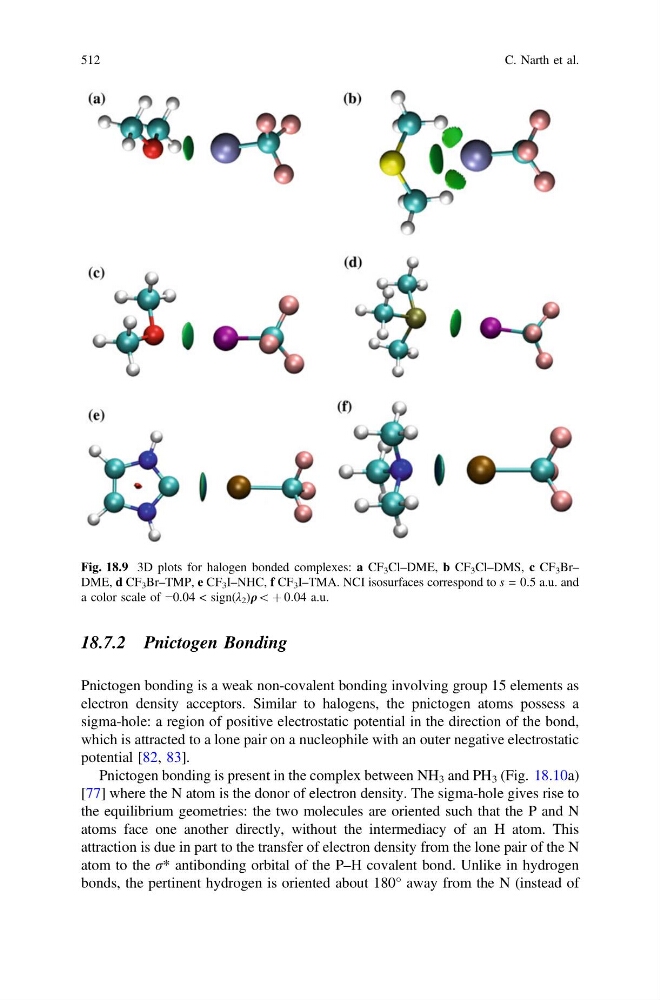
Fig. 18.9 3D plots for halogen bonded complexes: a CF 3 Cl–DME, b CF 3 Cl–DMS, c CF 3 Br–
DME, d CF 3 Br–TMP, e CF 3 I–NHC, f CF 3 I–TMA. NCI isosurfaces correspond to s = 0.5 a.u. and
a color scale of −0.04 < sign(λ 2 )q\ þ 0:04 a.u.
512
C. Narth et al.
Pnictogen bonding is a weak non-covalent bonding involving group 15 elements as
electron density acceptors. Similar to halogens, the pnictogen atoms possess a
sigma-hole: a region of positive electrostatic potential in the direction of the bond,
which is attracted to a lone pair on a nucleophile with an outer negative electrostatic
potential [82, 83].
Pnictogen bonding is present in the complex between NH 3 and PH 3 (Fig. 18.10a)
[77] where the N atom is the donor of electron density. The sigma-hole gives rise to
the equilibrium geometries: the two molecules are oriented such that the P and N
atoms face one another directly, without the intermediacy of an H atom. This
attraction is due in part to the transfer of electron density from the lone pair of the N
atom to the σ* antibonding orbital of the P–H covalent bond. Unlike in hydrogen
bonds, the pertinent hydrogen is oriented about 180° away from the N (instead of
Fig. 18.9 3D plots for halogen bonded complexes: a CF 3 Cl–DME, b CF 3 Cl–DMS, c CF 3 Br–
DME, d CF 3 Br–TMP, e CF 3 I–NHC, f CF 3 I–TMA. NCI isosurfaces correspond to s = 0.5 a.u. and
a color scale of −0.04 < sign(λ 2 )q\ þ 0:04 a.u.
512
C. Narth et al.