

program [67]. Both were capped with COCH 3 and NHCH 3 groups. Figure 18.6
displays low-gradient isosurfaces for cuboid regions at the center of these
polypeptides, colored according to the corresponding density values. For the βsheet, the lowest-density portions of the gradient isosurface arise from hydrophobic,
dispersion-dominated interactions, primarily involving the CH 2 groups of the glycines. The higher-density regions correspond to inter-residue hydrogen-bonds and
repulsive interactions between the adjacent C=O and N–H groups. For the α-helix,
the isosurface has a large, low-density region within the helix and between the
side-chain methyl groups. The higher-density portions of the isosurface correspond
to inter-residue hydrogen-bonds along the helix and repulsive interactions between
adjacent N–H groups.
We also considered the non-covalent interactions between nucleobases in the
B-form of double-strand, six-base-pair (TGTGTG) DNA. The structure was obtained
using the X3DNA program [68] with ideal geometry parameters [69]. Figure 18.6c
displays the low-gradient isosurface for a cuboid section in the center of the DNA
helix, colored according to the sign(λ 2 )ρ values. The calculated isosurface resembles
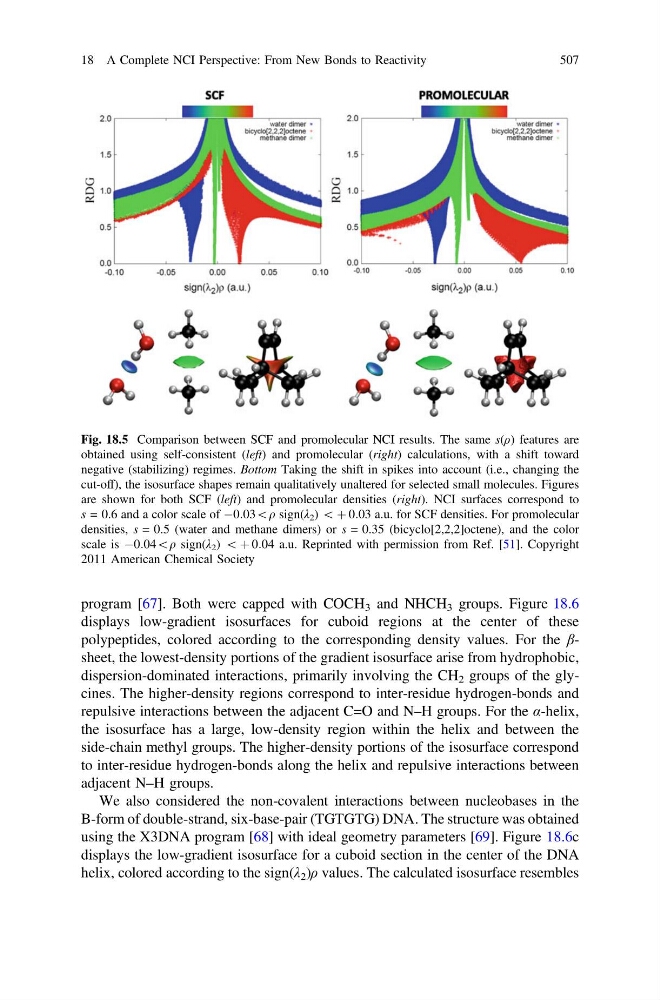
Fig. 18.5 Comparison between SCF and promolecular NCI results. The same s(ρ) features are
obtained using self-consistent (left) and promolecular (right) calculations, with a shift toward
negative (stabilizing) regimes. Bottom Taking the shift in spikes into account (i.e., changing the
cut-off), the isosurface shapes remain qualitatively unaltered for selected small molecules. Figures
are shown for both SCF (left) and promolecular densities (right). NCI surfaces correspond to
s = 0.6 and a color scale of À0:03\q sign(λ 2 ) \ þ 0:03 a.u. for SCF densities. For promolecular
densities, s = 0.5 (water and methane dimers) or s = 0.35 (bicyclo[2,2,2]octene), and the color
scale is À0:04\q sign(λ 2 ) \ þ 0:04 a.u. Reprinted with permission from Ref. [51]. Copyright
2011 American Chemical Society
18 A Complete NCI Perspective: From New Bonds to Reactivity
507
displays low-gradient isosurfaces for cuboid regions at the center of these
polypeptides, colored according to the corresponding density values. For the βsheet, the lowest-density portions of the gradient isosurface arise from hydrophobic,
dispersion-dominated interactions, primarily involving the CH 2 groups of the glycines. The higher-density regions correspond to inter-residue hydrogen-bonds and
repulsive interactions between the adjacent C=O and N–H groups. For the α-helix,
the isosurface has a large, low-density region within the helix and between the
side-chain methyl groups. The higher-density portions of the isosurface correspond
to inter-residue hydrogen-bonds along the helix and repulsive interactions between
adjacent N–H groups.
We also considered the non-covalent interactions between nucleobases in the
B-form of double-strand, six-base-pair (TGTGTG) DNA. The structure was obtained
using the X3DNA program [68] with ideal geometry parameters [69]. Figure 18.6c
displays the low-gradient isosurface for a cuboid section in the center of the DNA
helix, colored according to the sign(λ 2 )ρ values. The calculated isosurface resembles
Fig. 18.5 Comparison between SCF and promolecular NCI results. The same s(ρ) features are
obtained using self-consistent (left) and promolecular (right) calculations, with a shift toward
negative (stabilizing) regimes. Bottom Taking the shift in spikes into account (i.e., changing the
cut-off), the isosurface shapes remain qualitatively unaltered for selected small molecules. Figures
are shown for both SCF (left) and promolecular densities (right). NCI surfaces correspond to
s = 0.6 and a color scale of À0:03\q sign(λ 2 ) \ þ 0:03 a.u. for SCF densities. For promolecular
densities, s = 0.5 (water and methane dimers) or s = 0.35 (bicyclo[2,2,2]octene), and the color
scale is À0:04\q sign(λ 2 ) \ þ 0:04 a.u. Reprinted with permission from Ref. [51]. Copyright
2011 American Chemical Society
18 A Complete NCI Perspective: From New Bonds to Reactivity
507