

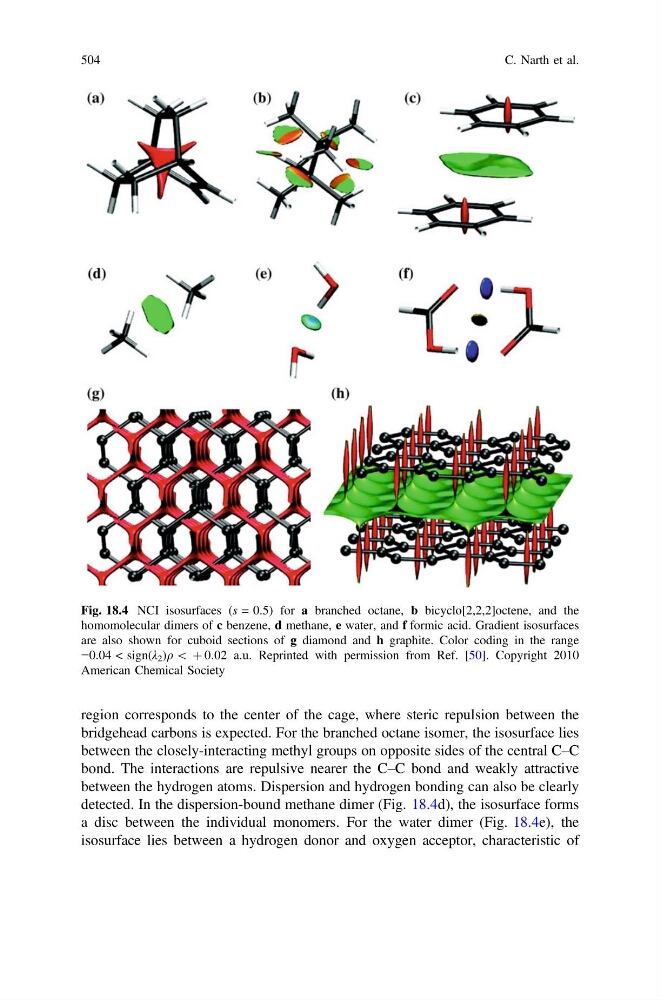
region corresponds to the center of the cage, where steric repulsion between the
bridgehead carbons is expected. For the branched octane isomer, the isosurface lies
between the closely-interacting methyl groups on opposite sides of the central C–C
bond. The interactions are repulsive nearer the C–C bond and weakly attractive
between the hydrogen atoms. Dispersion and hydrogen bonding can also be clearly
detected. In the dispersion-bound methane dimer (Fig. 18.4d), the isosurface forms
a disc between the individual monomers. For the water dimer (Fig. 18.4e), the
isosurface lies between a hydrogen donor and oxygen acceptor, characteristic of
Fig. 18.4 NCI isosurfaces (s = 0.5) for a branched octane, b bicyclo[2,2,2]octene, and the
homomolecular dimers of c benzene, d methane, e water, and f formic acid. Gradient isosurfaces
are also shown for cuboid sections of g diamond and h graphite. Color coding in the range
−0.04 < sign(λ 2 )q \ þ 0:02 a.u. Reprinted with permission from Ref. [50]. Copyright 2010
American Chemical Society
504
C. Narth et al.
bridgehead carbons is expected. For the branched octane isomer, the isosurface lies
between the closely-interacting methyl groups on opposite sides of the central C–C
bond. The interactions are repulsive nearer the C–C bond and weakly attractive
between the hydrogen atoms. Dispersion and hydrogen bonding can also be clearly
detected. In the dispersion-bound methane dimer (Fig. 18.4d), the isosurface forms
a disc between the individual monomers. For the water dimer (Fig. 18.4e), the
isosurface lies between a hydrogen donor and oxygen acceptor, characteristic of
Fig. 18.4 NCI isosurfaces (s = 0.5) for a branched octane, b bicyclo[2,2,2]octene, and the
homomolecular dimers of c benzene, d methane, e water, and f formic acid. Gradient isosurfaces
are also shown for cuboid sections of g diamond and h graphite. Color coding in the range
−0.04 < sign(λ 2 )q \ þ 0:02 a.u. Reprinted with permission from Ref. [50]. Copyright 2010
American Chemical Society
504
C. Narth et al.