

It emerges that a one-to-one inverse correlation seems to exist among the
directionality (and the strength) of specific non-covalent interactions and the
surface/volume ratio of the corresponding s isosurface. In particular, the stronger
the interaction is, the smaller and more disc-shaped the s surface appears in real
space (and the more negative the ρ sign(λ 2 ) values are).
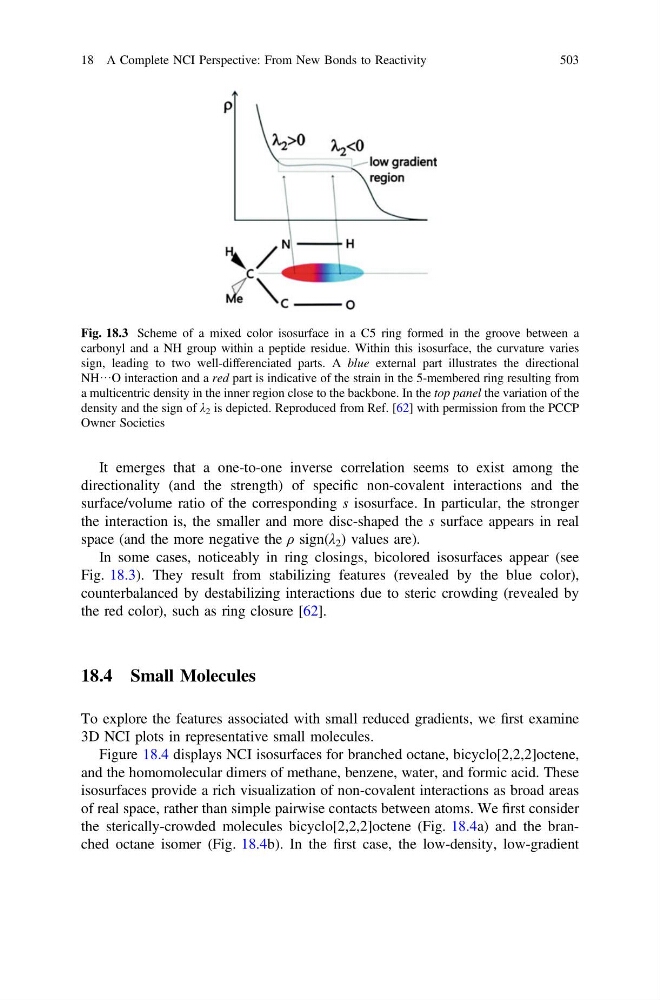
In some cases, noticeably in ring closings, bicolored isosurfaces appear (see
Fig. 18.3). They result from stabilizing features (revealed by the blue color),
counterbalanced by destabilizing interactions due to steric crowding (revealed by
the red color), such as ring closure [62].
18.4 Small Molecules
To explore the features associated with small reduced gradients, we first examine
3D NCI plots in representative small molecules.
Figure 18.4 displays NCI isosurfaces for branched octane, bicyclo[2,2,2]octene,
and the homomolecular dimers of methane, benzene, water, and formic acid. These
isosurfaces provide a rich visualization of non-covalent interactions as broad areas
of real space, rather than simple pairwise contacts between atoms. We first consider
the sterically-crowded molecules bicyclo[2,2,2]octene (Fig. 18.4a) and the branched octane isomer (Fig. 18.4b). In the first case, the low-density, low-gradient
Fig. 18.3 Scheme of a mixed color isosurface in a C5 ring formed in the groove between a
carbonyl and a NH group within a peptide residue. Within this isosurface, the curvature varies
sign, leading to two well-differenciated parts. A blue external part illustrates the directional
NH···O interaction and a red part is indicative of the strain in the 5-membered ring resulting from
a multicentric density in the inner region close to the backbone. In the top panel the variation of the
density and the sign of λ 2 is depicted. Reproduced from Ref. [62] with permission from the PCCP
Owner Societies
18 A Complete NCI Perspective: From New Bonds to Reactivity
503
directionality (and the strength) of specific non-covalent interactions and the
surface/volume ratio of the corresponding s isosurface. In particular, the stronger
the interaction is, the smaller and more disc-shaped the s surface appears in real
space (and the more negative the ρ sign(λ 2 ) values are).
In some cases, noticeably in ring closings, bicolored isosurfaces appear (see
Fig. 18.3). They result from stabilizing features (revealed by the blue color),
counterbalanced by destabilizing interactions due to steric crowding (revealed by
the red color), such as ring closure [62].
18.4 Small Molecules
To explore the features associated with small reduced gradients, we first examine
3D NCI plots in representative small molecules.
Figure 18.4 displays NCI isosurfaces for branched octane, bicyclo[2,2,2]octene,
and the homomolecular dimers of methane, benzene, water, and formic acid. These
isosurfaces provide a rich visualization of non-covalent interactions as broad areas
of real space, rather than simple pairwise contacts between atoms. We first consider
the sterically-crowded molecules bicyclo[2,2,2]octene (Fig. 18.4a) and the branched octane isomer (Fig. 18.4b). In the first case, the low-density, low-gradient
Fig. 18.3 Scheme of a mixed color isosurface in a C5 ring formed in the groove between a
carbonyl and a NH group within a peptide residue. Within this isosurface, the curvature varies
sign, leading to two well-differenciated parts. A blue external part illustrates the directional
NH···O interaction and a red part is indicative of the strain in the 5-membered ring resulting from
a multicentric density in the inner region close to the backbone. In the top panel the variation of the
density and the sign of λ 2 is depicted. Reproduced from Ref. [62] with permission from the PCCP
Owner Societies
18 A Complete NCI Perspective: From New Bonds to Reactivity
503