

18.2 NCI: Non-covalent Interaction Index
The electron density has a fundamental advantage over MO-based descriptors
because it is an experimentally accessible local function defined within the exact
many-body theory, also supported by the Hohenberg-Kohn theorem [49]. The
relationship between electron density and physical/chemical properties can be
understood from the Hohenberg-Kohn theorem, which asserts that a system’s
ground-state properties are a consequence of its electron density. Furthermore since
chemical reactions proceed by q(rÞ redistributions, methods that analyze qðrÞ
distributions should help to understand the electron structure of molecules and thus
chemical reactivity (see Sect. 18.8).
Our approach, introduced in the coming sections, uses the density and its
derivatives, allowing simultaneous analysis and visualization of all non-covalent
interaction types as real-space surfaces, thus adding an important tool to the chemist’s arsenal [50–52].
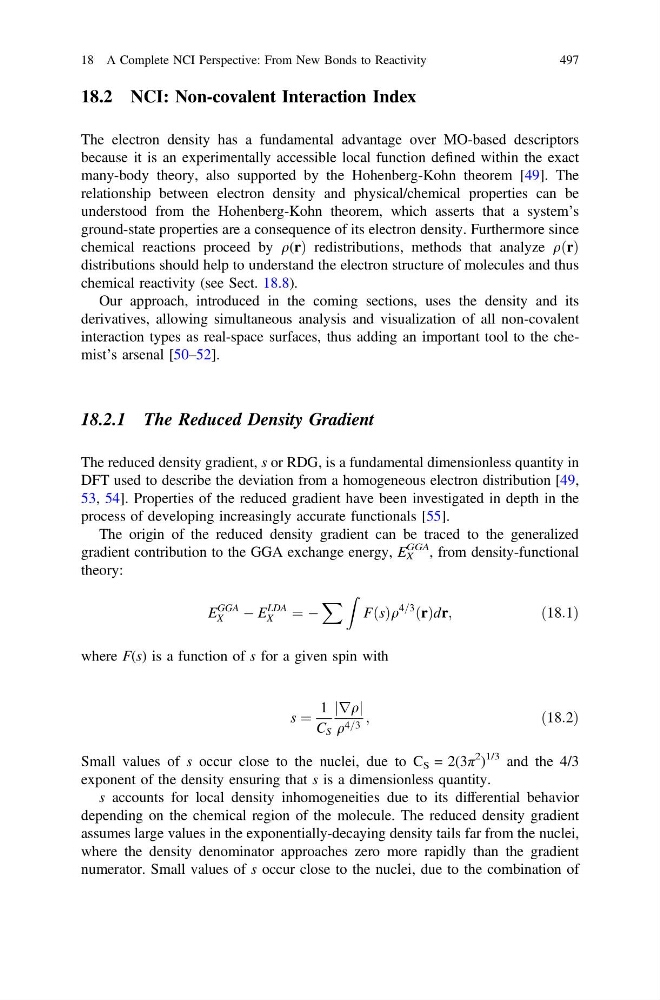
18.2.1 The Reduced Density Gradient
The reduced density gradient, s or RDG, is a fundamental dimensionless quantity in
DFT used to describe the deviation from a homogeneous electron distribution [49,
53, 54]. Properties of the reduced gradient have been investigated in depth in the
process of developing increasingly accurate functionals [55].
The origin of the reduced density gradient can be traced to the generalized
gradient contribution to the GGA exchange energy, E X
GGA , from density-functional
theory:
E
GGA
X
À E
LDA
X
¼ À
X Z
FðsÞq
4=3
ðrÞdr;
ð18:1Þ
where F(s) is a function of s for a given spin with
s ¼
1
C S
jrqj
q 4=3 ;
ð18:2Þ
Small values of s occur close to the nuclei, due to C S = 2(3π
2 )
1/3 and the 4/3
exponent of the density ensuring that s is a dimensionless quantity.
s accounts for local density inhomogeneities due to its differential behavior
depending on the chemical region of the molecule. The reduced density gradient
assumes large values in the exponentially-decaying density tails far from the nuclei,
where the density denominator approaches zero more rapidly than the gradient
numerator. Small values of s occur close to the nuclei, due to the combination of
18 A Complete NCI Perspective: From New Bonds to Reactivity
497
The electron density has a fundamental advantage over MO-based descriptors
because it is an experimentally accessible local function defined within the exact
many-body theory, also supported by the Hohenberg-Kohn theorem [49]. The
relationship between electron density and physical/chemical properties can be
understood from the Hohenberg-Kohn theorem, which asserts that a system’s
ground-state properties are a consequence of its electron density. Furthermore since
chemical reactions proceed by q(rÞ redistributions, methods that analyze qðrÞ
distributions should help to understand the electron structure of molecules and thus
chemical reactivity (see Sect. 18.8).
Our approach, introduced in the coming sections, uses the density and its
derivatives, allowing simultaneous analysis and visualization of all non-covalent
interaction types as real-space surfaces, thus adding an important tool to the chemist’s arsenal [50–52].
18.2.1 The Reduced Density Gradient
The reduced density gradient, s or RDG, is a fundamental dimensionless quantity in
DFT used to describe the deviation from a homogeneous electron distribution [49,
53, 54]. Properties of the reduced gradient have been investigated in depth in the
process of developing increasingly accurate functionals [55].
The origin of the reduced density gradient can be traced to the generalized
gradient contribution to the GGA exchange energy, E X
GGA , from density-functional
theory:
E
GGA
X
À E
LDA
X
¼ À
X Z
FðsÞq
4=3
ðrÞdr;
ð18:1Þ
where F(s) is a function of s for a given spin with
s ¼
1
C S
jrqj
q 4=3 ;
ð18:2Þ
Small values of s occur close to the nuclei, due to C S = 2(3π
2 )
1/3 and the 4/3
exponent of the density ensuring that s is a dimensionless quantity.
s accounts for local density inhomogeneities due to its differential behavior
depending on the chemical region of the molecule. The reduced density gradient
assumes large values in the exponentially-decaying density tails far from the nuclei,
where the density denominator approaches zero more rapidly than the gradient
numerator. Small values of s occur close to the nuclei, due to the combination of
18 A Complete NCI Perspective: From New Bonds to Reactivity
497