

strongly interacting with the empty beryllium orbitals in such a way that those pairs
appear as shared by the atoms involved in the beryllium bond. Phosphine complex
behaves similar to ammonia, whereas BeH 2 –SH 2 complex is different from the water
one: both hydrogens from H 2 S are not co-planar with BeH 2 , and lone pairs of sulfur
are split into two contributions: a V(Be,S) disynaptic basin and a monosynaptic V(S)
basin located over the BeH 2 plane. We will return later on this BeH 2 –SH 2 complex,
as CD analysis can provide more detailed information.
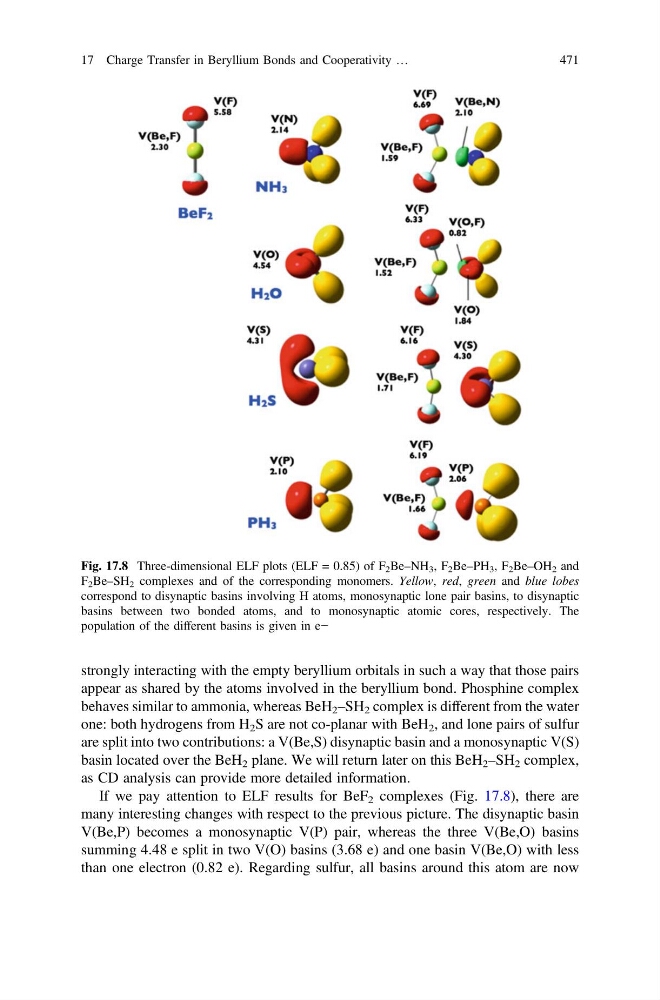
If we pay attention to ELF results for BeF 2 complexes (Fig. 17.8), there are
many interesting changes with respect to the previous picture. The disynaptic basin
V(Be,P) becomes a monosynaptic V(P) pair, whereas the three V(Be,O) basins
summing 4.48 e split in two V(O) basins (3.68 e) and one basin V(Be,O) with less
than one electron (0.82 e). Regarding sulfur, all basins around this atom are now
Fig. 17.8 Three-dimensional ELF plots (ELF = 0.85) of F 2 Be–NH 3 , F 2 Be–PH 3 , F 2 Be–OH 2 and
F 2 Be–SH 2 complexes and of the corresponding monomers. Yellow, red, green and blue lobes
correspond to disynaptic basins involving H atoms, monosynaptic lone pair basins, to disynaptic
basins between two bonded atoms, and to monosynaptic atomic cores, respectively. The
population of the different basins is given in e−
17 Charge Transfer in Beryllium Bonds and Cooperativity …
471
appear as shared by the atoms involved in the beryllium bond. Phosphine complex
behaves similar to ammonia, whereas BeH 2 –SH 2 complex is different from the water
one: both hydrogens from H 2 S are not co-planar with BeH 2 , and lone pairs of sulfur
are split into two contributions: a V(Be,S) disynaptic basin and a monosynaptic V(S)
basin located over the BeH 2 plane. We will return later on this BeH 2 –SH 2 complex,
as CD analysis can provide more detailed information.
If we pay attention to ELF results for BeF 2 complexes (Fig. 17.8), there are
many interesting changes with respect to the previous picture. The disynaptic basin
V(Be,P) becomes a monosynaptic V(P) pair, whereas the three V(Be,O) basins
summing 4.48 e split in two V(O) basins (3.68 e) and one basin V(Be,O) with less
than one electron (0.82 e). Regarding sulfur, all basins around this atom are now
Fig. 17.8 Three-dimensional ELF plots (ELF = 0.85) of F 2 Be–NH 3 , F 2 Be–PH 3 , F 2 Be–OH 2 and
F 2 Be–SH 2 complexes and of the corresponding monomers. Yellow, red, green and blue lobes
correspond to disynaptic basins involving H atoms, monosynaptic lone pair basins, to disynaptic
basins between two bonded atoms, and to monosynaptic atomic cores, respectively. The
population of the different basins is given in e−
17 Charge Transfer in Beryllium Bonds and Cooperativity …
471