

these secondary contributions that very often compensate between themselves or
with the primary ones.
We have not yet discussed the role of dispersion. From Graph 16.7, it appears to
be a negligible contribution to the interaction between F and N (about
−0.3 kcal/mol). However, contrary to electrostatics, dispersion between the two
fragments (evaluated using the B3LYP-D2 correction) is cumulative: all atomic
pairs contribute to the stabilization of the complex without compensation due to
sign changes (contrarily to the classical electrostatic contribution). It is thus
informative to consider the following ratio that evaluates the total contribution of
dispersion to the complexation energy:
%c
disp
tot ¼ 100
DE
disp
DE xB97XD
¼ 100
E
disp B3LYPD2
ðF 2 . . .NCCH 3 Þ À E
disp B3LYPD2
ðF 2 Þ À E
disp B3LYPD2
ðNCCH 3 Þ
E SCF xB97XD ðF 2 . . .NCCH 3 Þ À E SCF xB97XD ðF 2 Þ À E SCF xB97XD ðNCCH 3 Þ
:
ð16:22Þ
As shown in the right part of Graph 16.12, the weight of dispersion increases
when the distance decreases, reaching more than 60 % at the equilibrium distance,
while the contribution of dispersion to the primary interaction energy is negligible.
It is thus clear from this simple example that distinguishing total complexation
energy from the primary interaction energy is pivotal to a physical analysis of any
halogen bond.
16.4 Conclusions
In this chapter, we provided evidence that Bader’s atoms-in-molecules provides
deep physical insight into the formation mechanism of halogen bonds. Within this
framework, the interacting quantum atoms decomposition enables to cure the
deficiencies of the local approach based on critical points, and to rigorously assess
the importance of classical electrostatics and quantum effects in terms of energetic
quantities. It was notably shown that even if classical electrostatics (that can be
further decomposed into charge points and multipolar components) generally
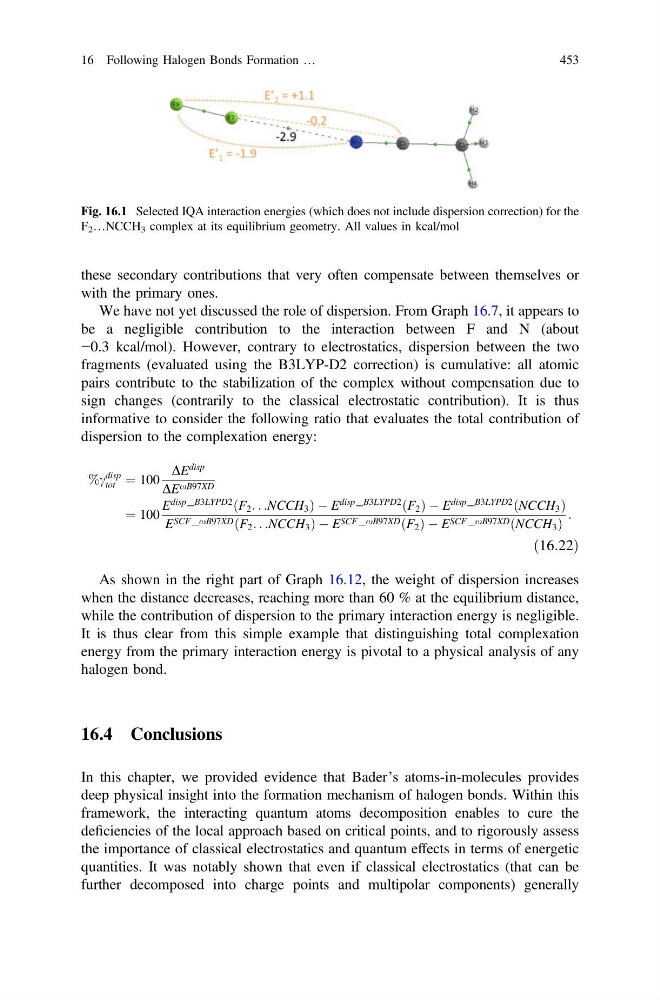
Fig. 16.1 Selected IQA interaction energies (which does not include dispersion correction) for the
F 2 …NCCH 3 complex at its equilibrium geometry. All values in kcal/mol
16 Following Halogen Bonds Formation …
453
with the primary ones.
We have not yet discussed the role of dispersion. From Graph 16.7, it appears to
be a negligible contribution to the interaction between F and N (about
−0.3 kcal/mol). However, contrary to electrostatics, dispersion between the two
fragments (evaluated using the B3LYP-D2 correction) is cumulative: all atomic
pairs contribute to the stabilization of the complex without compensation due to
sign changes (contrarily to the classical electrostatic contribution). It is thus
informative to consider the following ratio that evaluates the total contribution of
dispersion to the complexation energy:
%c
disp
tot ¼ 100
DE
disp
DE xB97XD
¼ 100
E
disp B3LYPD2
ðF 2 . . .NCCH 3 Þ À E
disp B3LYPD2
ðF 2 Þ À E
disp B3LYPD2
ðNCCH 3 Þ
E SCF xB97XD ðF 2 . . .NCCH 3 Þ À E SCF xB97XD ðF 2 Þ À E SCF xB97XD ðNCCH 3 Þ
:
ð16:22Þ
As shown in the right part of Graph 16.12, the weight of dispersion increases
when the distance decreases, reaching more than 60 % at the equilibrium distance,
while the contribution of dispersion to the primary interaction energy is negligible.
It is thus clear from this simple example that distinguishing total complexation
energy from the primary interaction energy is pivotal to a physical analysis of any
halogen bond.
16.4 Conclusions
In this chapter, we provided evidence that Bader’s atoms-in-molecules provides
deep physical insight into the formation mechanism of halogen bonds. Within this
framework, the interacting quantum atoms decomposition enables to cure the
deficiencies of the local approach based on critical points, and to rigorously assess
the importance of classical electrostatics and quantum effects in terms of energetic
quantities. It was notably shown that even if classical electrostatics (that can be
further decomposed into charge points and multipolar components) generally
Fig. 16.1 Selected IQA interaction energies (which does not include dispersion correction) for the
F 2 …NCCH 3 complex at its equilibrium geometry. All values in kcal/mol
16 Following Halogen Bonds Formation …
453