

reaction center [85]; usually the metallic center is considered both experimentally
[86] and theoretically [87].
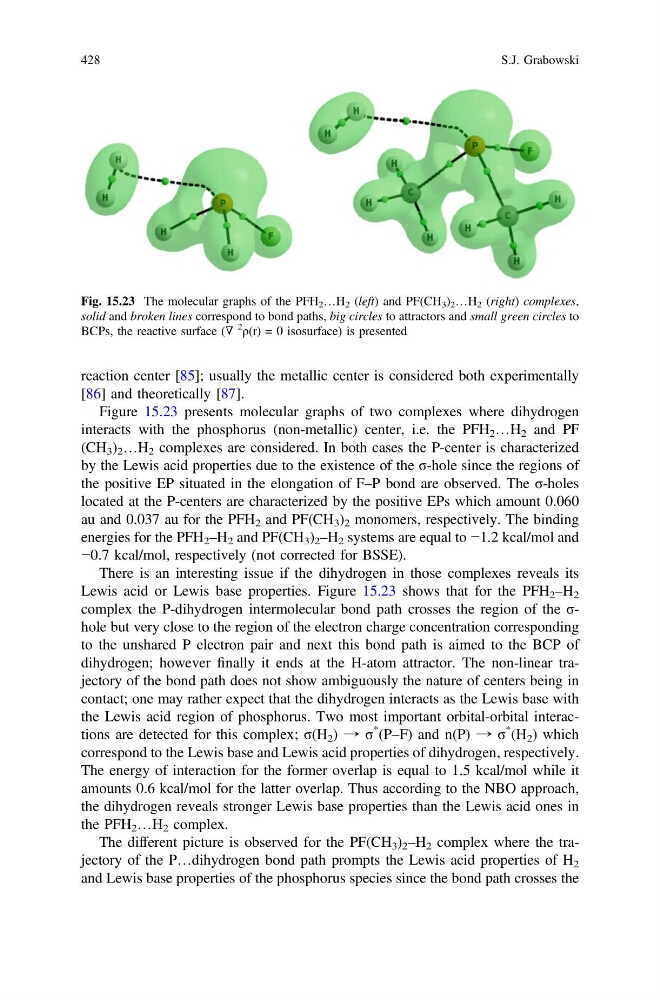
Figure 15.23 presents molecular graphs of two complexes where dihydrogen
interacts with the phosphorus (non-metallic) center, i.e. the PFH 2 …H 2 and PF
(CH 3 ) 2 …H 2 complexes are considered. In both cases the P-center is characterized
by the Lewis acid properties due to the existence of the σ-hole since the regions of
the positive EP situated in the elongation of F–P bond are observed. The σ-holes
located at the P-centers are characterized by the positive EPs which amount 0.060
au and 0.037 au for the PFH 2 and PF(CH 3 ) 2 monomers, respectively. The binding
energies for the PFH 2 –H 2 and PF(CH 3 ) 2 –H 2 systems are equal to −1.2 kcal/mol and
−0.7 kcal/mol, respectively (not corrected for BSSE).
There is an interesting issue if the dihydrogen in those complexes reveals its
Lewis acid or Lewis base properties. Figure 15.23 shows that for the PFH 2 –H 2
complex the P-dihydrogen intermolecular bond path crosses the region of the σhole but very close to the region of the electron charge concentration corresponding
to the unshared P electron pair and next this bond path is aimed to the BCP of
dihydrogen; however finally it ends at the H-atom attractor. The non-linear trajectory of the bond path does not show ambiguously the nature of centers being in
contact; one may rather expect that the dihydrogen interacts as the Lewis base with
the Lewis acid region of phosphorus. Two most important orbital-orbital interactions are detected for this complex; σ(H 2 ) → σ
* (P–F) and n(P) → σ
* (H 2 ) which
correspond to the Lewis base and Lewis acid properties of dihydrogen, respectively.
The energy of interaction for the former overlap is equal to 1.5 kcal/mol while it
amounts 0.6 kcal/mol for the latter overlap. Thus according to the NBO approach,
the dihydrogen reveals stronger Lewis base properties than the Lewis acid ones in
the PFH 2 …H 2 complex.
The different picture is observed for the PF(CH 3 ) 2 –H 2 complex where the trajectory of the P…dihydrogen bond path prompts the Lewis acid properties of H 2
and Lewis base properties of the phosphorus species since the bond path crosses the
Fig. 15.23 The molecular graphs of the PFH 2 …H 2 (left) and PF(CH 3 ) 2 …H 2 (right) complexes,
solid and broken lines correspond to bond paths, big circles to attractors and small green circles to
BCPs, the reactive surface (∇
2
ρ(r) = 0 isosurface) is presented
428
S.J. Grabowski
[86] and theoretically [87].
Figure 15.23 presents molecular graphs of two complexes where dihydrogen
interacts with the phosphorus (non-metallic) center, i.e. the PFH 2 …H 2 and PF
(CH 3 ) 2 …H 2 complexes are considered. In both cases the P-center is characterized
by the Lewis acid properties due to the existence of the σ-hole since the regions of
the positive EP situated in the elongation of F–P bond are observed. The σ-holes
located at the P-centers are characterized by the positive EPs which amount 0.060
au and 0.037 au for the PFH 2 and PF(CH 3 ) 2 monomers, respectively. The binding
energies for the PFH 2 –H 2 and PF(CH 3 ) 2 –H 2 systems are equal to −1.2 kcal/mol and
−0.7 kcal/mol, respectively (not corrected for BSSE).
There is an interesting issue if the dihydrogen in those complexes reveals its
Lewis acid or Lewis base properties. Figure 15.23 shows that for the PFH 2 –H 2
complex the P-dihydrogen intermolecular bond path crosses the region of the σhole but very close to the region of the electron charge concentration corresponding
to the unshared P electron pair and next this bond path is aimed to the BCP of
dihydrogen; however finally it ends at the H-atom attractor. The non-linear trajectory of the bond path does not show ambiguously the nature of centers being in
contact; one may rather expect that the dihydrogen interacts as the Lewis base with
the Lewis acid region of phosphorus. Two most important orbital-orbital interactions are detected for this complex; σ(H 2 ) → σ
* (P–F) and n(P) → σ
* (H 2 ) which
correspond to the Lewis base and Lewis acid properties of dihydrogen, respectively.
The energy of interaction for the former overlap is equal to 1.5 kcal/mol while it
amounts 0.6 kcal/mol for the latter overlap. Thus according to the NBO approach,
the dihydrogen reveals stronger Lewis base properties than the Lewis acid ones in
the PFH 2 …H 2 complex.
The different picture is observed for the PF(CH 3 ) 2 –H 2 complex where the trajectory of the P…dihydrogen bond path prompts the Lewis acid properties of H 2
and Lewis base properties of the phosphorus species since the bond path crosses the
Fig. 15.23 The molecular graphs of the PFH 2 …H 2 (left) and PF(CH 3 ) 2 …H 2 (right) complexes,
solid and broken lines correspond to bond paths, big circles to attractors and small green circles to
BCPs, the reactive surface (∇
2
ρ(r) = 0 isosurface) is presented
428
S.J. Grabowski