

measurements were carried out for the H 2 –HCO
+ complex linked through C–H…σ
interaction, where the σ-electrons of the molecular hydrogen act as the Lewis base
[77]. The authors did not consider the C–H…σ interaction as the hydrogen bond;
however the results of experiment clearly show that this arrangement possesses
characteristics typical for the latter kind of interaction.
Finally it is worth mentioning that the clusters of ammonia cation, NH 4
+
, with
H 2 molecules—(NH 4
+
)–(H 2 ) n (n up to 8) were calculated [69, 78]. It was also found
that the whole molecular surface of ammonia cation (0.001 au electron density
surface was considered) is characterized by the positive EP; however the EP
maxima are attributed to H-atoms [50]. Hence the increase of the number of
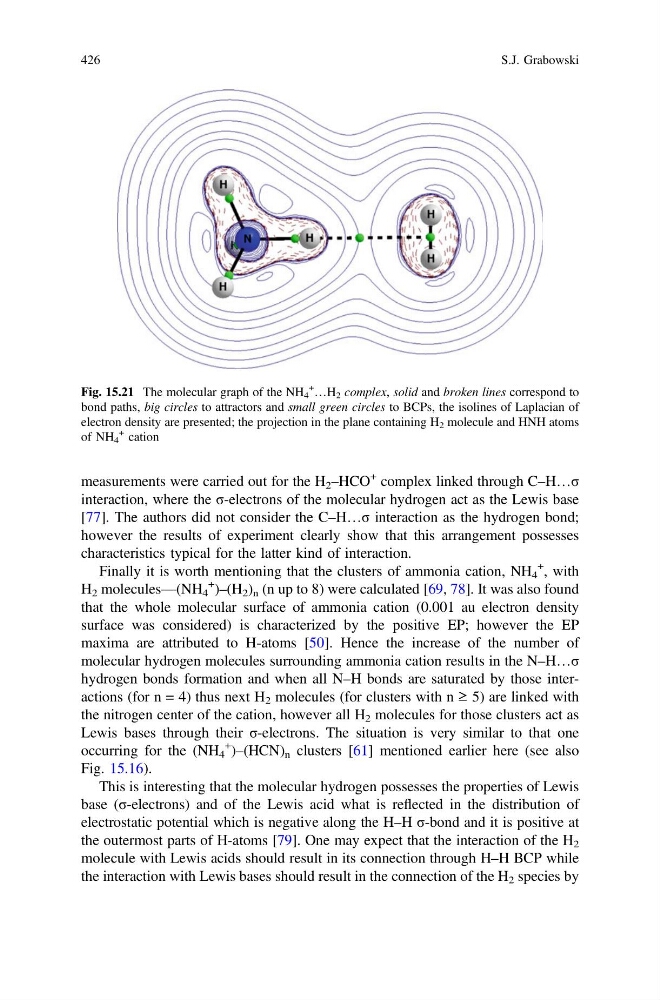
molecular hydrogen molecules surrounding ammonia cation results in the N–H…σ
hydrogen bonds formation and when all N–H bonds are saturated by those interactions (for n = 4) thus next H 2 molecules (for clusters with n ≥ 5) are linked with
the nitrogen center of the cation, however all H 2 molecules for those clusters act as
Lewis bases through their σ-electrons. The situation is very similar to that one
occurring for the (NH 4
+
)–(HCN) n clusters [61] mentioned earlier here (see also
Fig. 15.16).
This is interesting that the molecular hydrogen possesses the properties of Lewis
base (σ-electrons) and of the Lewis acid what is reflected in the distribution of
electrostatic potential which is negative along the H–H σ-bond and it is positive at
the outermost parts of H-atoms [79]. One may expect that the interaction of the H 2
molecule with Lewis acids should result in its connection through H–H BCP while
the interaction with Lewis bases should result in the connection of the H 2 species by
Fig. 15.21 The molecular graph of the NH 4
+ …H 2 complex, solid and broken lines correspond to
bond paths, big circles to attractors and small green circles to BCPs, the isolines of Laplacian of
electron density are presented; the projection in the plane containing H 2 molecule and HNH atoms
of NH 4
+ cation
426
S.J. Grabowski
+ complex linked through C–H…σ
interaction, where the σ-electrons of the molecular hydrogen act as the Lewis base
[77]. The authors did not consider the C–H…σ interaction as the hydrogen bond;
however the results of experiment clearly show that this arrangement possesses
characteristics typical for the latter kind of interaction.
Finally it is worth mentioning that the clusters of ammonia cation, NH 4
+
, with
H 2 molecules—(NH 4
+
)–(H 2 ) n (n up to 8) were calculated [69, 78]. It was also found
that the whole molecular surface of ammonia cation (0.001 au electron density
surface was considered) is characterized by the positive EP; however the EP
maxima are attributed to H-atoms [50]. Hence the increase of the number of
molecular hydrogen molecules surrounding ammonia cation results in the N–H…σ
hydrogen bonds formation and when all N–H bonds are saturated by those interactions (for n = 4) thus next H 2 molecules (for clusters with n ≥ 5) are linked with
the nitrogen center of the cation, however all H 2 molecules for those clusters act as
Lewis bases through their σ-electrons. The situation is very similar to that one
occurring for the (NH 4
+
)–(HCN) n clusters [61] mentioned earlier here (see also
Fig. 15.16).
This is interesting that the molecular hydrogen possesses the properties of Lewis
base (σ-electrons) and of the Lewis acid what is reflected in the distribution of
electrostatic potential which is negative along the H–H σ-bond and it is positive at
the outermost parts of H-atoms [79]. One may expect that the interaction of the H 2
molecule with Lewis acids should result in its connection through H–H BCP while
the interaction with Lewis bases should result in the connection of the H 2 species by
Fig. 15.21 The molecular graph of the NH 4
+ …H 2 complex, solid and broken lines correspond to
bond paths, big circles to attractors and small green circles to BCPs, the isolines of Laplacian of
electron density are presented; the projection in the plane containing H 2 molecule and HNH atoms
of NH 4
+ cation
426
S.J. Grabowski