

respectively; the remaining characteristics differ only slightly). The characteristics
of BCP situated between carbon atoms for the aug-cc-pVQZ basis set are as follows; ρ BCP = 0.416 au and ∇
2
ρ BCP = −1.274 au while for the aug-cc-pVTZ basis set
there are two BCPs between carbon attractors for which ρ BCP = 0.411 au and
∇
2
ρ BCP = −1.278 au, there is also NNA situated between latter BCPs where
ρ BCP = 0.411 au and ∇
2
ρ BCP = −1.370 au.
The situation is more complicated if the multicenter (more than 2 centers) πelectron system plays the role of proton acceptor in hydrogen bond interaction. It is
often stated in the literature that aromatic systems or other closed-ring π-electron
systems may play the role of proton acceptors in hydrogen bonds [67]; such species
as benzene, antracene, cyclopentadienyl anion and their derivatives as well as other
moieties are often considered. This means that π-electrons as a whole are treated as
the Lewis base center. The hydrogen bonds with the multicenter π-electron systems
were analyzed recently (the calculations were performed at the MP2/6-311 ++G(d,
p) level) and it was found that at least few sub-classes of the A–H…π hydrogen
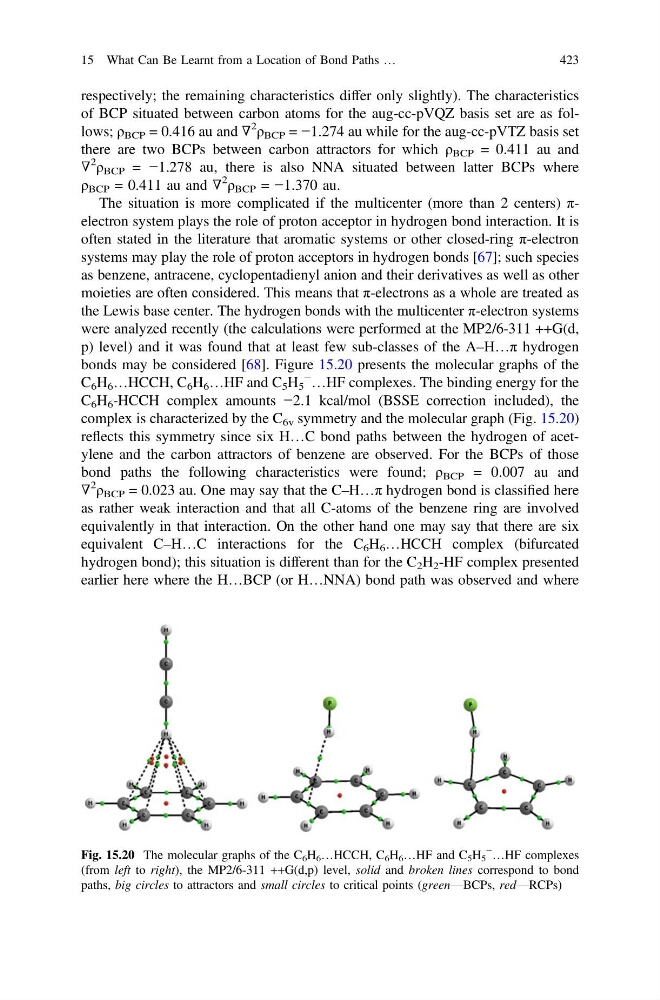
bonds may be considered [68]. Figure 15.20 presents the molecular graphs of the
C 6 H 6 …HCCH, C 6 H 6 …HF and C 5 H 5
−
…HF complexes. The binding energy for the
C 6 H 6 -HCCH complex amounts −2.1 kcal/mol (BSSE correction included), the
complex is characterized by the C 6v symmetry and the molecular graph (Fig. 15.20)
reflects this symmetry since six H…C bond paths between the hydrogen of acetylene and the carbon attractors of benzene are observed. For the BCPs of those
bond paths the following characteristics were found; ρ BCP = 0.007 au and
∇
2
ρ BCP = 0.023 au. One may say that the C–H…π hydrogen bond is classified here
as rather weak interaction and that all C-atoms of the benzene ring are involved
equivalently in that interaction. On the other hand one may say that there are six
equivalent C–H…C interactions for the C 6 H 6 …HCCH complex (bifurcated
hydrogen bond); this situation is different than for the C 2 H 2 -HF complex presented
earlier here where the H…BCP (or H…NNA) bond path was observed and where
Fig. 15.20 The molecular graphs of the C 6 H 6 …HCCH, C 6 H 6 …HF and C 5 H 5
−
…HF complexes
(from left to right), the MP2/6-311 ++G(d,p) level, solid and broken lines correspond to bond
paths, big circles to attractors and small circles to critical points (green—BCPs, red—RCPs)
15 What Can Be Learnt from a Location of Bond Paths …
423
of BCP situated between carbon atoms for the aug-cc-pVQZ basis set are as follows; ρ BCP = 0.416 au and ∇
2
ρ BCP = −1.274 au while for the aug-cc-pVTZ basis set
there are two BCPs between carbon attractors for which ρ BCP = 0.411 au and
∇
2
ρ BCP = −1.278 au, there is also NNA situated between latter BCPs where
ρ BCP = 0.411 au and ∇
2
ρ BCP = −1.370 au.
The situation is more complicated if the multicenter (more than 2 centers) πelectron system plays the role of proton acceptor in hydrogen bond interaction. It is
often stated in the literature that aromatic systems or other closed-ring π-electron
systems may play the role of proton acceptors in hydrogen bonds [67]; such species
as benzene, antracene, cyclopentadienyl anion and their derivatives as well as other
moieties are often considered. This means that π-electrons as a whole are treated as
the Lewis base center. The hydrogen bonds with the multicenter π-electron systems
were analyzed recently (the calculations were performed at the MP2/6-311 ++G(d,
p) level) and it was found that at least few sub-classes of the A–H…π hydrogen
bonds may be considered [68]. Figure 15.20 presents the molecular graphs of the
C 6 H 6 …HCCH, C 6 H 6 …HF and C 5 H 5
−
…HF complexes. The binding energy for the
C 6 H 6 -HCCH complex amounts −2.1 kcal/mol (BSSE correction included), the
complex is characterized by the C 6v symmetry and the molecular graph (Fig. 15.20)
reflects this symmetry since six H…C bond paths between the hydrogen of acetylene and the carbon attractors of benzene are observed. For the BCPs of those
bond paths the following characteristics were found; ρ BCP = 0.007 au and
∇
2
ρ BCP = 0.023 au. One may say that the C–H…π hydrogen bond is classified here
as rather weak interaction and that all C-atoms of the benzene ring are involved
equivalently in that interaction. On the other hand one may say that there are six
equivalent C–H…C interactions for the C 6 H 6 …HCCH complex (bifurcated
hydrogen bond); this situation is different than for the C 2 H 2 -HF complex presented
earlier here where the H…BCP (or H…NNA) bond path was observed and where
Fig. 15.20 The molecular graphs of the C 6 H 6 …HCCH, C 6 H 6 …HF and C 5 H 5
−
…HF complexes
(from left to right), the MP2/6-311 ++G(d,p) level, solid and broken lines correspond to bond
paths, big circles to attractors and small circles to critical points (green—BCPs, red—RCPs)
15 What Can Be Learnt from a Location of Bond Paths …
423