

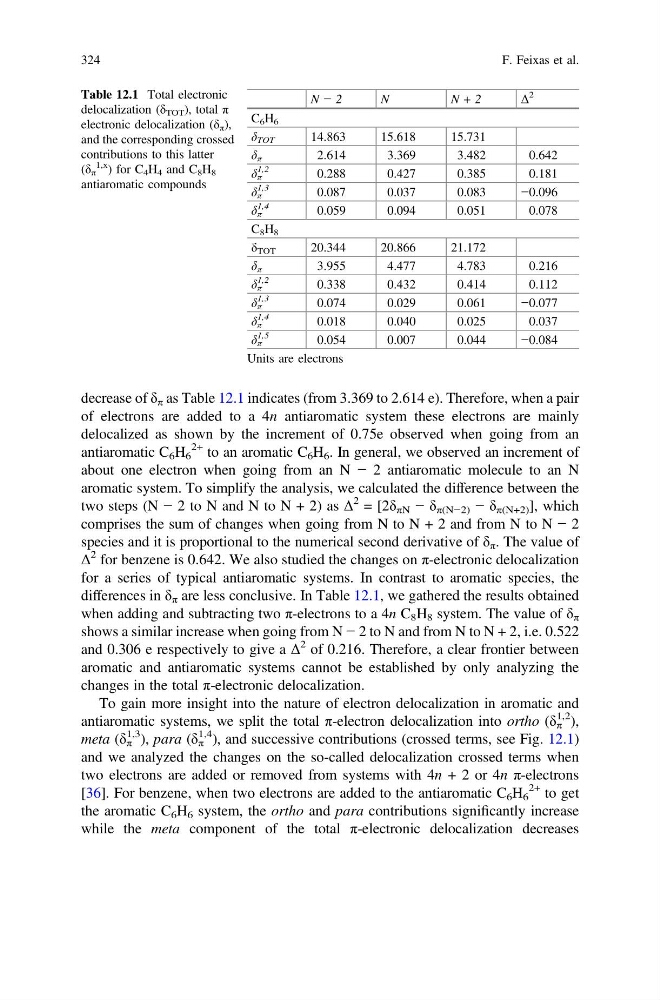
decrease of δ π as Table 12.1 indicates (from 3.369 to 2.614 e). Therefore, when a pair
of electrons are added to a 4n antiaromatic system these electrons are mainly
delocalized as shown by the increment of 0.75e observed when going from an
antiaromatic C 6 H 6
2+ to an aromatic C 6 H 6 . In general, we observed an increment of
about one electron when going from an N − 2 antiaromatic molecule to an N
aromatic system. To simplify the analysis, we calculated the difference between the
two steps (N − 2 to N and N to N + 2) as Δ
2 = [2δ πN − δ π(N−2) − δ π(N+2) ], which
comprises the sum of changes when going from N to N + 2 and from N to N − 2
species and it is proportional to the numerical second derivative of δ π . The value of
Δ
2 for benzene is 0.642. We also studied the changes on π-electronic delocalization
for a series of typical antiaromatic systems. In contrast to aromatic species, the
differences in δ π are less conclusive. In Table 12.1, we gathered the results obtained
when adding and subtracting two π-electrons to a 4n C 8 H 8 system. The value of δ π
shows a similar increase when going from N − 2 to N and from N to N + 2, i.e. 0.522
and 0.306 e respectively to give a Δ
2 of 0.216. Therefore, a clear frontier between
aromatic and antiaromatic systems cannot be established by only analyzing the
changes in the total π-electronic delocalization.
To gain more insight into the nature of electron delocalization in aromatic and
antiaromatic systems, we split the total π-electron delocalization into ortho (δ π
1,2 ),
meta (δ π
1,3 ), para (δ π
1,4 ), and successive contributions (crossed terms, see Fig. 12.1)
and we analyzed the changes on the so-called delocalization crossed terms when
two electrons are added or removed from systems with 4n + 2 or 4n π-electrons
[36]. For benzene, when two electrons are added to the antiaromatic C 6 H 6
2+ to get
the aromatic C 6 H 6 system, the ortho and para contributions significantly increase
while the meta component of the total π-electronic delocalization decreases
Table 12.1 Total electronic
delocalization (δ TOT ), total π
electronic delocalization (δ π ),
and the corresponding crossed
contributions to this latter
(δ π
1,x
) for C 4 H 4 and C 8 H 8
antiaromatic compounds
N − 2
N
N+ 2
Δ
2
C 6 H 6
δ TOT
14.863
15.618
15.731
δ π
2.614
3.369
3.482
0.642
δ π
1,2
0.288
0.427
0.385
0.181
δ π
1,3
0.087
0.037
0.083
−0.096
δ π
1,4
0.059
0.094
0.051
0.078
C 8 H 8
δ TOT
20.344
20.866
21.172
δ π
3.955
4.477
4.783
0.216
δ π
1,2
0.338
0.432
0.414
0.112
δ π
1,3
0.074
0.029
0.061
−0.077
δ π
1,4
0.018
0.040
0.025
0.037
δ π
1,5
0.054
0.007
0.044
−0.084
Units are electrons
324
F. Feixas et al.
of electrons are added to a 4n antiaromatic system these electrons are mainly
delocalized as shown by the increment of 0.75e observed when going from an
antiaromatic C 6 H 6
2+ to an aromatic C 6 H 6 . In general, we observed an increment of
about one electron when going from an N − 2 antiaromatic molecule to an N
aromatic system. To simplify the analysis, we calculated the difference between the
two steps (N − 2 to N and N to N + 2) as Δ
2 = [2δ πN − δ π(N−2) − δ π(N+2) ], which
comprises the sum of changes when going from N to N + 2 and from N to N − 2
species and it is proportional to the numerical second derivative of δ π . The value of
Δ
2 for benzene is 0.642. We also studied the changes on π-electronic delocalization
for a series of typical antiaromatic systems. In contrast to aromatic species, the
differences in δ π are less conclusive. In Table 12.1, we gathered the results obtained
when adding and subtracting two π-electrons to a 4n C 8 H 8 system. The value of δ π
shows a similar increase when going from N − 2 to N and from N to N + 2, i.e. 0.522
and 0.306 e respectively to give a Δ
2 of 0.216. Therefore, a clear frontier between
aromatic and antiaromatic systems cannot be established by only analyzing the
changes in the total π-electronic delocalization.
To gain more insight into the nature of electron delocalization in aromatic and
antiaromatic systems, we split the total π-electron delocalization into ortho (δ π
1,2 ),
meta (δ π
1,3 ), para (δ π
1,4 ), and successive contributions (crossed terms, see Fig. 12.1)
and we analyzed the changes on the so-called delocalization crossed terms when
two electrons are added or removed from systems with 4n + 2 or 4n π-electrons
[36]. For benzene, when two electrons are added to the antiaromatic C 6 H 6
2+ to get
the aromatic C 6 H 6 system, the ortho and para contributions significantly increase
while the meta component of the total π-electronic delocalization decreases
Table 12.1 Total electronic
delocalization (δ TOT ), total π
electronic delocalization (δ π ),
and the corresponding crossed
contributions to this latter
(δ π
1,x
) for C 4 H 4 and C 8 H 8
antiaromatic compounds
N − 2
N
N+ 2
Δ
2
C 6 H 6
δ TOT
14.863
15.618
15.731
δ π
2.614
3.369
3.482
0.642
δ π
1,2
0.288
0.427
0.385
0.181
δ π
1,3
0.087
0.037
0.083
−0.096
δ π
1,4
0.059
0.094
0.051
0.078
C 8 H 8
δ TOT
20.344
20.866
21.172
δ π
3.955
4.477
4.783
0.216
δ π
1,2
0.338
0.432
0.414
0.112
δ π
1,3
0.074
0.029
0.061
−0.077
δ π
1,4
0.018
0.040
0.025
0.037
δ π
1,5
0.054
0.007
0.044
−0.084
Units are electrons
324
F. Feixas et al.