

11.3.2 The Perylene Anomaly
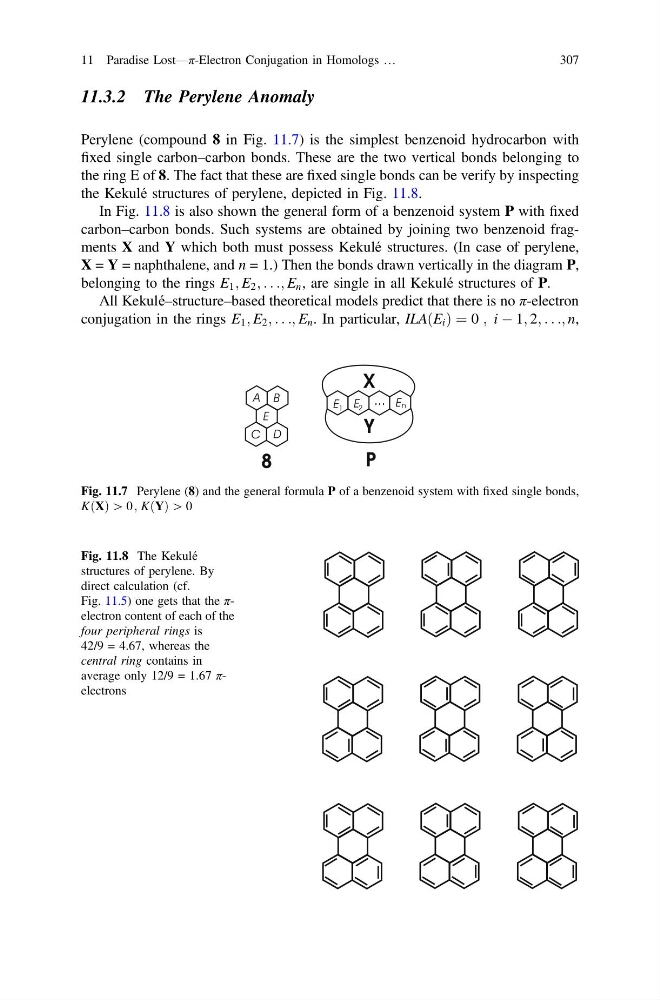
Perylene (compound 8 in Fig. 11.7) is the simplest benzenoid hydrocarbon with
fixed single carbon–carbon bonds. These are the two vertical bonds belonging to
the ring E of 8. The fact that these are fixed single bonds can be verify by inspecting
the Kekulé structures of perylene, depicted in Fig. 11.8.
In Fig. 11.8 is also shown the general form of a benzenoid system P with fixed
carbon–carbon bonds. Such systems are obtained by joining two benzenoid fragments X and Y which both must possess Kekulé structures. (In case of perylene,
X = Y = naphthalene, and n = 1.) Then the bonds drawn vertically in the diagram P,
belonging to the rings E 1 ; E 2 ; . . .; E n , are single in all Kekulé structures of P.
All Kekulé–structure–based theoretical models predict that there is no π-electron
conjugation in the rings E 1 ; E 2 ; . . .; E n . In particular, ILAðE i Þ ¼ 0 ; i À 1; 2; . . .; n,
Fig. 11.7 Perylene (8) and the general formula P of a benzenoid system with fixed single bonds,
KðXÞ [ 0; KðYÞ [ 0
Fig. 11.8 The Kekulé
structures of perylene. By
direct calculation (cf.
Fig. 11.5) one gets that the πelectron content of each of the
four peripheral rings is
42/9 = 4.67, whereas the
central ring contains in
average only 12/9 = 1.67 πelectrons
11 Paradise Lost—π-Electron Conjugation in Homologs …
307
Perylene (compound 8 in Fig. 11.7) is the simplest benzenoid hydrocarbon with
fixed single carbon–carbon bonds. These are the two vertical bonds belonging to
the ring E of 8. The fact that these are fixed single bonds can be verify by inspecting
the Kekulé structures of perylene, depicted in Fig. 11.8.
In Fig. 11.8 is also shown the general form of a benzenoid system P with fixed
carbon–carbon bonds. Such systems are obtained by joining two benzenoid fragments X and Y which both must possess Kekulé structures. (In case of perylene,
X = Y = naphthalene, and n = 1.) Then the bonds drawn vertically in the diagram P,
belonging to the rings E 1 ; E 2 ; . . .; E n , are single in all Kekulé structures of P.
All Kekulé–structure–based theoretical models predict that there is no π-electron
conjugation in the rings E 1 ; E 2 ; . . .; E n . In particular, ILAðE i Þ ¼ 0 ; i À 1; 2; . . .; n,
Fig. 11.7 Perylene (8) and the general formula P of a benzenoid system with fixed single bonds,
KðXÞ [ 0; KðYÞ [ 0
Fig. 11.8 The Kekulé
structures of perylene. By
direct calculation (cf.
Fig. 11.5) one gets that the πelectron content of each of the
four peripheral rings is
42/9 = 4.67, whereas the
central ring contains in
average only 12/9 = 1.67 πelectrons
11 Paradise Lost—π-Electron Conjugation in Homologs …
307