

11.3 Kekulé–Structure–Based Approaches: Failures
11.3.1 Minor Violations
In the 1970s, George Hall noticed that the HMO total π-electron energy of isomeric
benzenoid hydrocarbons is remarkably well linearly correlated with their K-values
[44, 111]. This, so-called “Hall rule” is just what chemists would expect from the
dependence of thermodynamic stability of benzenoids on the number of Kekulé
structures. Eventually, it was shown that this dependence is not linear [49, 112,
113], and that it is violated in numerous cases [114]. Along the same lines,
Cioslowski and Dobrowolski established that there is a complete lack of correlation
between the ab initio π-electron energy and Kekulé structure count of benzenoid
isomers [115].
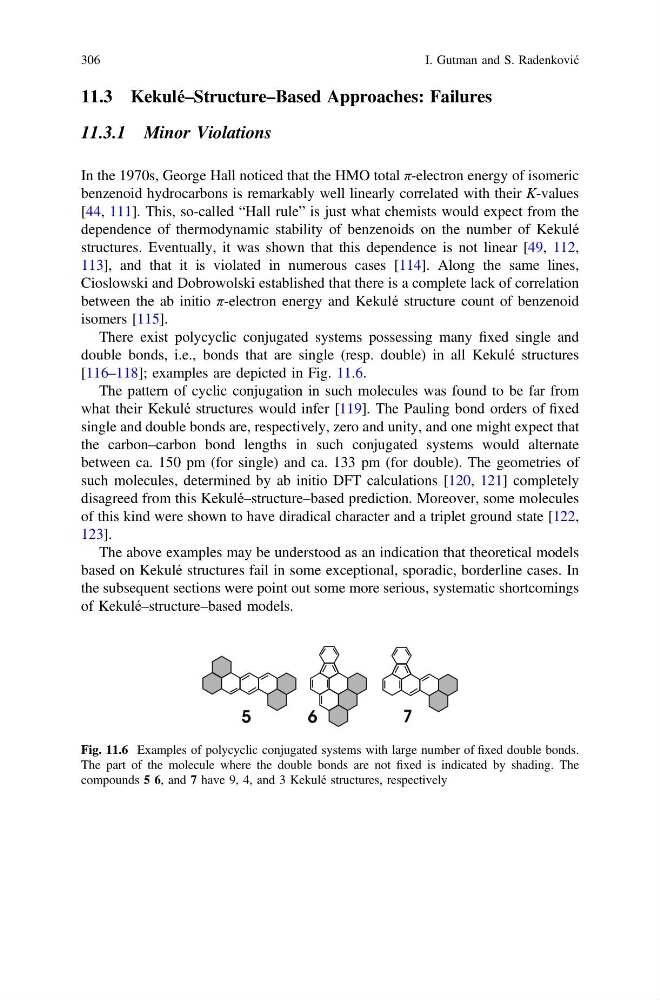
There exist polycyclic conjugated systems possessing many fixed single and
double bonds, i.e., bonds that are single (resp. double) in all Kekulé structures
[116–118]; examples are depicted in Fig. 11.6.
The pattern of cyclic conjugation in such molecules was found to be far from
what their Kekulé structures would infer [119]. The Pauling bond orders of fixed
single and double bonds are, respectively, zero and unity, and one might expect that
the carbon–carbon bond lengths in such conjugated systems would alternate
between ca. 150 pm (for single) and ca. 133 pm (for double). The geometries of
such molecules, determined by ab initio DFT calculations [120, 121] completely
disagreed from this Kekulé–structure–based prediction. Moreover, some molecules
of this kind were shown to have diradical character and a triplet ground state [122,
123].
The above examples may be understood as an indication that theoretical models
based on Kekulé structures fail in some exceptional, sporadic, borderline cases. In
the subsequent sections were point out some more serious, systematic shortcomings
of Kekulé–structure–based models.
Fig. 11.6 Examples of polycyclic conjugated systems with large number of fixed double bonds.
The part of the molecule where the double bonds are not fixed is indicated by shading. The
compounds 5 6, and 7 have 9, 4, and 3 Kekulé structures, respectively
306
I. Gutman and S. Radenković
11.3.1 Minor Violations
In the 1970s, George Hall noticed that the HMO total π-electron energy of isomeric
benzenoid hydrocarbons is remarkably well linearly correlated with their K-values
[44, 111]. This, so-called “Hall rule” is just what chemists would expect from the
dependence of thermodynamic stability of benzenoids on the number of Kekulé
structures. Eventually, it was shown that this dependence is not linear [49, 112,
113], and that it is violated in numerous cases [114]. Along the same lines,
Cioslowski and Dobrowolski established that there is a complete lack of correlation
between the ab initio π-electron energy and Kekulé structure count of benzenoid
isomers [115].
There exist polycyclic conjugated systems possessing many fixed single and
double bonds, i.e., bonds that are single (resp. double) in all Kekulé structures
[116–118]; examples are depicted in Fig. 11.6.
The pattern of cyclic conjugation in such molecules was found to be far from
what their Kekulé structures would infer [119]. The Pauling bond orders of fixed
single and double bonds are, respectively, zero and unity, and one might expect that
the carbon–carbon bond lengths in such conjugated systems would alternate
between ca. 150 pm (for single) and ca. 133 pm (for double). The geometries of
such molecules, determined by ab initio DFT calculations [120, 121] completely
disagreed from this Kekulé–structure–based prediction. Moreover, some molecules
of this kind were shown to have diradical character and a triplet ground state [122,
123].
The above examples may be understood as an indication that theoretical models
based on Kekulé structures fail in some exceptional, sporadic, borderline cases. In
the subsequent sections were point out some more serious, systematic shortcomings
of Kekulé–structure–based models.
Fig. 11.6 Examples of polycyclic conjugated systems with large number of fixed double bonds.
The part of the molecule where the double bonds are not fixed is indicated by shading. The
compounds 5 6, and 7 have 9, 4, and 3 Kekulé structures, respectively
306
I. Gutman and S. Radenković