

(2) the determinant of the Hamiltonian matrix in Hückel molecular orbital
(HMO) theory (after setting α = 0 and β = 1), is equal to K
2 [15].
Eventually, other Kekulé–structure–based relations between valence bond and
molecular orbital theories were discovered [16–21].
Already in the seminal paper by Dewar and Longuet–Higgins [15], it was
established that the K
2 -regularity does not hold for all polycyclic conjugated πelectron systems, and that corrections for the “parity” of Kekulé structures need to
be taken into account. This became the concept of “algebraic structure count” [22,
23], which was later shown to be not applicable to all non-alternant conjugated
hydrocarbons [24, 25]. The fortunate fact is that all Kekulé structures of benzenoid
hydrocarbons have the same “parity” [20], which has the consequences that all
Kekulé–structure–based models work best for benzenoid systems. Also in this
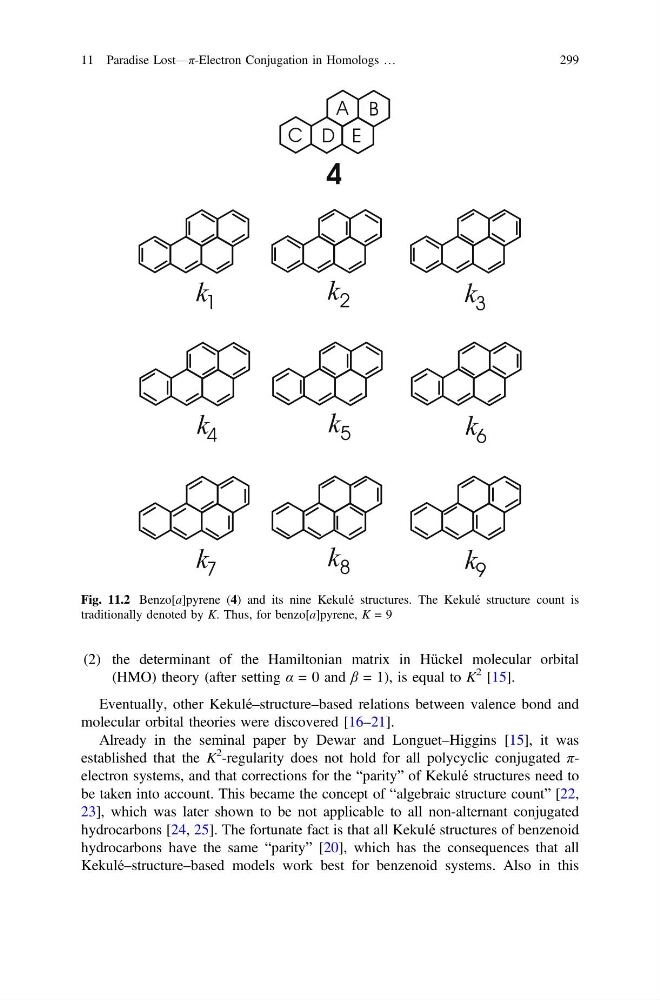
Fig. 11.2 Benzo[a]pyrene (4) and its nine Kekulé structures. The Kekulé structure count is
traditionally denoted by K. Thus, for benzo[a]pyrene, K = 9
11 Paradise Lost—π-Electron Conjugation in Homologs …
299
(HMO) theory (after setting α = 0 and β = 1), is equal to K
2 [15].
Eventually, other Kekulé–structure–based relations between valence bond and
molecular orbital theories were discovered [16–21].
Already in the seminal paper by Dewar and Longuet–Higgins [15], it was
established that the K
2 -regularity does not hold for all polycyclic conjugated πelectron systems, and that corrections for the “parity” of Kekulé structures need to
be taken into account. This became the concept of “algebraic structure count” [22,
23], which was later shown to be not applicable to all non-alternant conjugated
hydrocarbons [24, 25]. The fortunate fact is that all Kekulé structures of benzenoid
hydrocarbons have the same “parity” [20], which has the consequences that all
Kekulé–structure–based models work best for benzenoid systems. Also in this
Fig. 11.2 Benzo[a]pyrene (4) and its nine Kekulé structures. The Kekulé structure count is
traditionally denoted by K. Thus, for benzo[a]pyrene, K = 9
11 Paradise Lost—π-Electron Conjugation in Homologs …
299