

classical structural formula, i.e., that for such compounds several distinct Kekulé
structures can be drawn. A characteristic example is depicted in Fig. 11.2.
The fact that there may exist several equally plausible Kekulé–type structural
formulas for a chemical compound, has long pt there may exist several equally
plausibleuzzled the chemical community. A more–or–less acceptable solution was
found only after quantum–theoretical arguments were used for the description and
explanation of chemical bonding [3–8]. One direction of development of quantum
chemistry (usually referred to as “valence bond theory”) explicitly used mathematical objects resembling Kekulé structural formulas.
Strictly speaking, Kekulé structures provide only a small fraction of the diagrams used in valence bond theory for constructing the wave function. (For
example, of 42 non-ionic Rumer diagrams of naphthalene, only three pertain to
Kekulé structures.) Nevertheless, it was a compelling idea (especially for scholars
with a chemistry background) to try to describe the physical and chemical properties of polycyclic conjugated molecules by employing only their Kekulé structures. This is usually referred to as “resonance theory”, for details see [9–12].
A noteworthy early attempt along these lines was a paper by Pauling and
coworkers [13], who used the quantity
PðijÞ ¼
K ij
K
ð11:1Þ
for rationalizing the variation of the carbon–carbon bond lengths in benzenoid
hydrocarbons; here K is the number of Kekulé structures, whereas K ij is the number
of Kekulé structures in which the bond ij is double. Nowadays, P(ij) is referred to as
the Pauling bond order.
Kekulé structures gained much on their popularity in the 1950s, when it was
discovered that
(1) if K = 0, then the respective conjugated hydrocarbon has non-bonding πelectron molecular orbitals and an open–shell π-electron configuration, and is
thus highly unstable [14], and
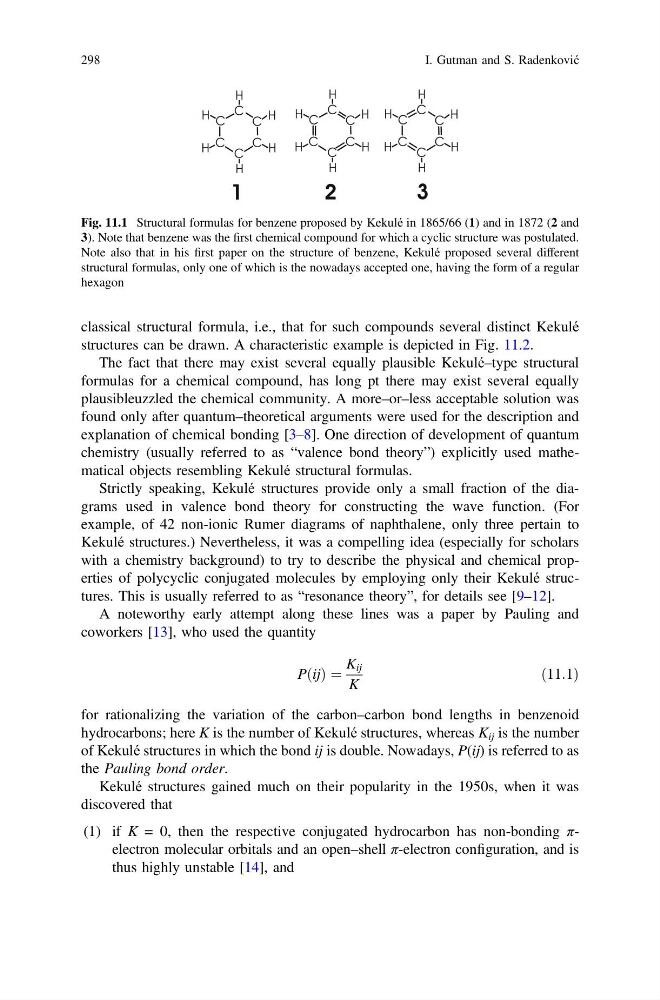
Fig. 11.1 Structural formulas for benzene proposed by Kekulé in 1865/66 (1) and in 1872 (2 and
3). Note that benzene was the first chemical compound for which a cyclic structure was postulated.
Note also that in his first paper on the structure of benzene, Kekulé proposed several different
structural formulas, only one of which is the nowadays accepted one, having the form of a regular
hexagon
298
I. Gutman and S. Radenković
structures can be drawn. A characteristic example is depicted in Fig. 11.2.
The fact that there may exist several equally plausible Kekulé–type structural
formulas for a chemical compound, has long pt there may exist several equally
plausibleuzzled the chemical community. A more–or–less acceptable solution was
found only after quantum–theoretical arguments were used for the description and
explanation of chemical bonding [3–8]. One direction of development of quantum
chemistry (usually referred to as “valence bond theory”) explicitly used mathematical objects resembling Kekulé structural formulas.
Strictly speaking, Kekulé structures provide only a small fraction of the diagrams used in valence bond theory for constructing the wave function. (For
example, of 42 non-ionic Rumer diagrams of naphthalene, only three pertain to
Kekulé structures.) Nevertheless, it was a compelling idea (especially for scholars
with a chemistry background) to try to describe the physical and chemical properties of polycyclic conjugated molecules by employing only their Kekulé structures. This is usually referred to as “resonance theory”, for details see [9–12].
A noteworthy early attempt along these lines was a paper by Pauling and
coworkers [13], who used the quantity
PðijÞ ¼
K ij
K
ð11:1Þ
for rationalizing the variation of the carbon–carbon bond lengths in benzenoid
hydrocarbons; here K is the number of Kekulé structures, whereas K ij is the number
of Kekulé structures in which the bond ij is double. Nowadays, P(ij) is referred to as
the Pauling bond order.
Kekulé structures gained much on their popularity in the 1950s, when it was
discovered that
(1) if K = 0, then the respective conjugated hydrocarbon has non-bonding πelectron molecular orbitals and an open–shell π-electron configuration, and is
thus highly unstable [14], and
Fig. 11.1 Structural formulas for benzene proposed by Kekulé in 1865/66 (1) and in 1872 (2 and
3). Note that benzene was the first chemical compound for which a cyclic structure was postulated.
Note also that in his first paper on the structure of benzene, Kekulé proposed several different
structural formulas, only one of which is the nowadays accepted one, having the form of a regular
hexagon
298
I. Gutman and S. Radenković