

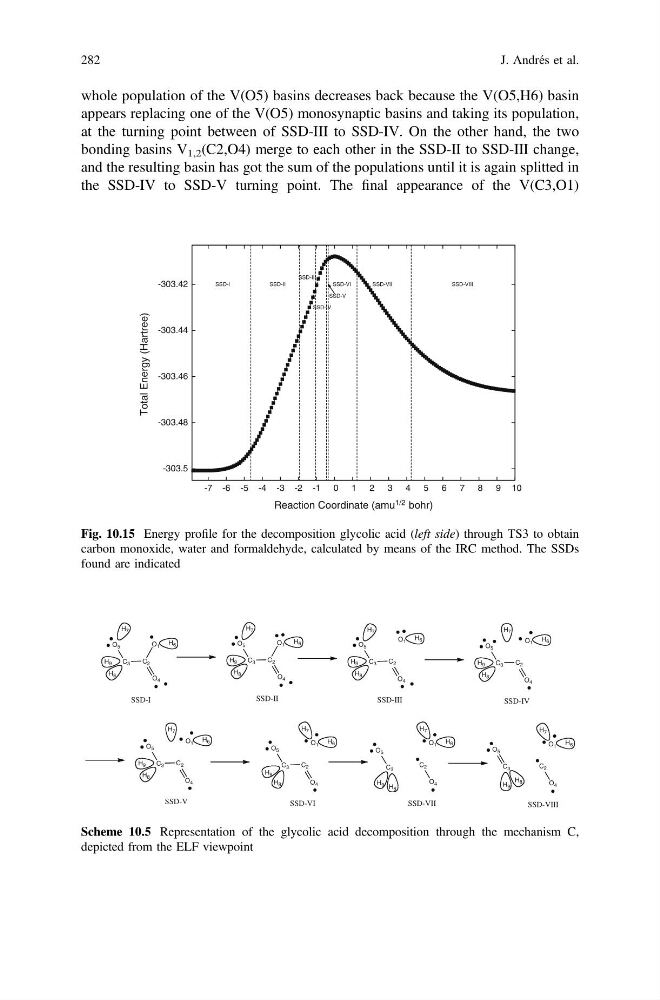
whole population of the V(O5) basins decreases back because the V(O5,H6) basin
appears replacing one of the V(O5) monosynaptic basins and taking its population,
at the turning point between of SSD-III to SSD-IV. On the other hand, the two
bonding basins V 1,2 (C2,O4) merge to each other in the SSD-II to SSD-III change,
and the resulting basin has got the sum of the populations until it is again splitted in
the SSD-IV to SSD-V turning point. The final appearance of the V(C3,O1)
-303.5
-303.48
-303.46
-303.44
-303.42
-7 -6 -5 -4 -3 -2 -1 0 1 2 3 4 5 6 7 8 9 10
Total Energy (Hartree)
Reaction Coordinate (amu 1/2 bohr)
SSD-I
SSD-II
SSD-III
SSD-IV
SSD-V
SSD-VI
SSD-VII
SSD-VIII
Fig. 10.15 Energy profile for the decomposition glycolic acid (left side) through TS3 to obtain
carbon monoxide, water and formaldehyde, calculated by means of the IRC method. The SSDs
found are indicated
O 5
C 3
C 2
O 4
O 1 H 6
H 9
H 8
H 7
SSD-I
O 5
C 3
C 2
O 4
O 1 H 6
H 9
H 8
H 7
SSD-II
O 5
C 3
C 2
O 4
O 1 H 6
H 9
H 8
H 7
SSD-III
O 5
C 3
C 2
O 4
O 1 H 6
H 9
H 8
H 7
SSD-IV
O 5
C 3
C 2
O 4
O 1 H 6
H 9
H 8
H 7
SSD-V
O 5
C 3
C 2
O 4
O 1 H 6
H 9
H 8
H 7
SSD-VI
O 5
C 3
C 2
O 4
O 1 H 6
H 9 H 8
H 7
SSD-VII
O 5
C 3
C 2
O 4
O 1 H 6
H 9
H 8
H 7
SSD-VIII
Scheme 10.5 Representation of the glycolic acid decomposition through the mechanism C,
depicted from the ELF viewpoint
282
J. Andrés et al.
appears replacing one of the V(O5) monosynaptic basins and taking its population,
at the turning point between of SSD-III to SSD-IV. On the other hand, the two
bonding basins V 1,2 (C2,O4) merge to each other in the SSD-II to SSD-III change,
and the resulting basin has got the sum of the populations until it is again splitted in
the SSD-IV to SSD-V turning point. The final appearance of the V(C3,O1)
-303.5
-303.48
-303.46
-303.44
-303.42
-7 -6 -5 -4 -3 -2 -1 0 1 2 3 4 5 6 7 8 9 10
Total Energy (Hartree)
Reaction Coordinate (amu 1/2 bohr)
SSD-I
SSD-II
SSD-III
SSD-IV
SSD-V
SSD-VI
SSD-VII
SSD-VIII
Fig. 10.15 Energy profile for the decomposition glycolic acid (left side) through TS3 to obtain
carbon monoxide, water and formaldehyde, calculated by means of the IRC method. The SSDs
found are indicated
O 5
C 3
C 2
O 4
O 1 H 6
H 9
H 8
H 7
SSD-I
O 5
C 3
C 2
O 4
O 1 H 6
H 9
H 8
H 7
SSD-II
O 5
C 3
C 2
O 4
O 1 H 6
H 9
H 8
H 7
SSD-III
O 5
C 3
C 2
O 4
O 1 H 6
H 9
H 8
H 7
SSD-IV
O 5
C 3
C 2
O 4
O 1 H 6
H 9
H 8
H 7
SSD-V
O 5
C 3
C 2
O 4
O 1 H 6
H 9
H 8
H 7
SSD-VI
O 5
C 3
C 2
O 4
O 1 H 6
H 9 H 8
H 7
SSD-VII
O 5
C 3
C 2
O 4
O 1 H 6
H 9
H 8
H 7
SSD-VIII
Scheme 10.5 Representation of the glycolic acid decomposition through the mechanism C,
depicted from the ELF viewpoint
282
J. Andrés et al.