

whereas in the mechanism B the C3–O5 bond breaks before the H6–O5 bond has
developed. From a topological point of view this is the main difference between the
two mechanisms, and might explain why the mechanism A is favored over the
mechanism B. As can be seen in Fig. 10.6, the turning point between SSD-IV and
SSD-V (namely, the breaking of the C3–O5 bond according to the ELF description)
is ca 8.5 kcal/mol below the TS, so that the water departure is not very much energy
demanding. However, as can be seen in Fig. 10.12, the turning point between
SSD-II and SSD-III (where the C3–O5 breaks in this case) is ca 20.5 kcal/mol
under the TS, and therefore the OH departure with the H6 proton surrounding O1, is
in this case much more energy demanding until the TS is found with the water
molecule formed far from the rest of the system. This would explain why the
mechanism A is favored over the mechanism B.
The latter steps of the mechanism B can be described analogously to the
description of the mechanism A: the double bond is developed, now between C2
and O4, when SSD-V is reached, and the last change corresponds to the ring
closure.
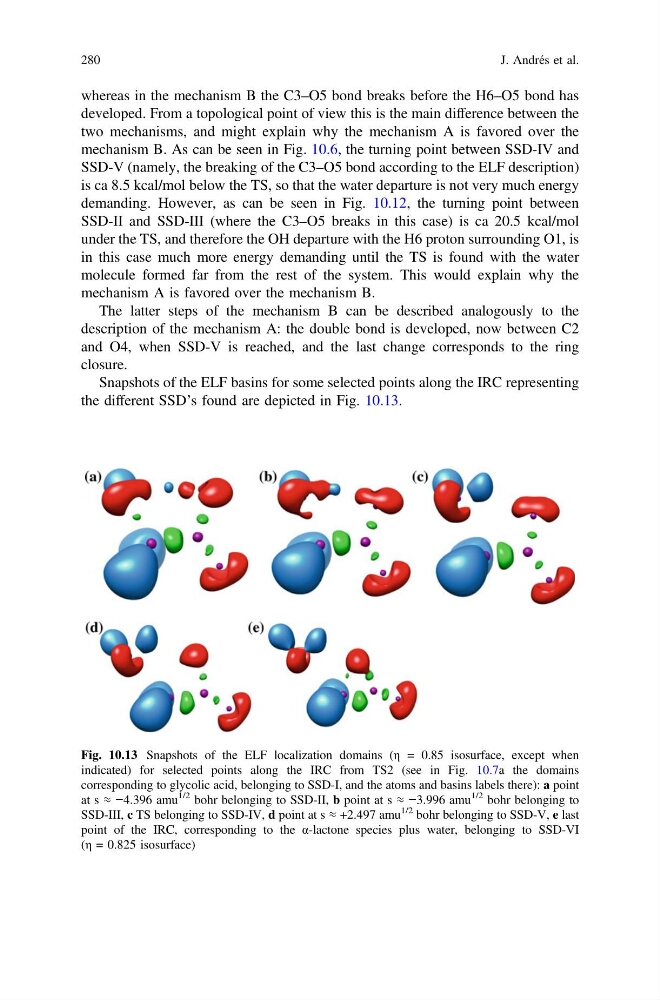
Snapshots of the ELF basins for some selected points along the IRC representing
the different SSD’s found are depicted in Fig. 10.13.
Fig. 10.13 Snapshots of the ELF localization domains (η = 0.85 isosurface, except when
indicated) for selected points along the IRC from TS2 (see in Fig. 10.7a the domains
corresponding to glycolic acid, belonging to SSD-I, and the atoms and basins labels there): a point
at s ≈ −4.396 amu
1/2 bohr belonging to SSD-II, b point at s ≈ −3.996 amu
1/2 bohr belonging to
SSD-III, c TS belonging to SSD-IV, d point at s ≈ +2.497 amu
1/2 bohr belonging to SSD-V, e last
point of the IRC, corresponding to the α-lactone species plus water, belonging to SSD-VI
(η = 0.825 isosurface)
280
J. Andrés et al.
developed. From a topological point of view this is the main difference between the
two mechanisms, and might explain why the mechanism A is favored over the
mechanism B. As can be seen in Fig. 10.6, the turning point between SSD-IV and
SSD-V (namely, the breaking of the C3–O5 bond according to the ELF description)
is ca 8.5 kcal/mol below the TS, so that the water departure is not very much energy
demanding. However, as can be seen in Fig. 10.12, the turning point between
SSD-II and SSD-III (where the C3–O5 breaks in this case) is ca 20.5 kcal/mol
under the TS, and therefore the OH departure with the H6 proton surrounding O1, is
in this case much more energy demanding until the TS is found with the water
molecule formed far from the rest of the system. This would explain why the
mechanism A is favored over the mechanism B.
The latter steps of the mechanism B can be described analogously to the
description of the mechanism A: the double bond is developed, now between C2
and O4, when SSD-V is reached, and the last change corresponds to the ring
closure.
Snapshots of the ELF basins for some selected points along the IRC representing
the different SSD’s found are depicted in Fig. 10.13.
Fig. 10.13 Snapshots of the ELF localization domains (η = 0.85 isosurface, except when
indicated) for selected points along the IRC from TS2 (see in Fig. 10.7a the domains
corresponding to glycolic acid, belonging to SSD-I, and the atoms and basins labels there): a point
at s ≈ −4.396 amu
1/2 bohr belonging to SSD-II, b point at s ≈ −3.996 amu
1/2 bohr belonging to
SSD-III, c TS belonging to SSD-IV, d point at s ≈ +2.497 amu
1/2 bohr belonging to SSD-V, e last
point of the IRC, corresponding to the α-lactone species plus water, belonging to SSD-VI
(η = 0.825 isosurface)
280
J. Andrés et al.