

analysis and a comparison of the geometries for a neutral (N = 0) and charged (N =
4) structures show a pronounced increase in the corresponding Ag–O distances with
the addition of electrons. There are two types of [AgO 6 ], [AgO 6 ] 1 centered by
Ag1/Ag2 and [AgO 6 ] 2 centered by Ag3/Ag4 (see Fig. 10.1a). [AgO 6 ] 1 cluster when
N = 0 pass to [AgO 4 ] for N = 1, while [AgO 6 ] 2 appears as an octahedron more
distorted with three different Ag–O distances. For N = 2, each Ag is surrounded by
four O atoms at the same time that the Ag1–Ag3 and Ag2–Ag4 contact distance is
noticeably shortened. For N = 3 and N = 4 each Ag is surrounded only by two O
atoms. Ag1–Ag3 and Ag2–Ag4 distances are shortened to 2.65 Å. For the [VO 4 ]
clusters we find that the V–O distances remain almost unaltered.
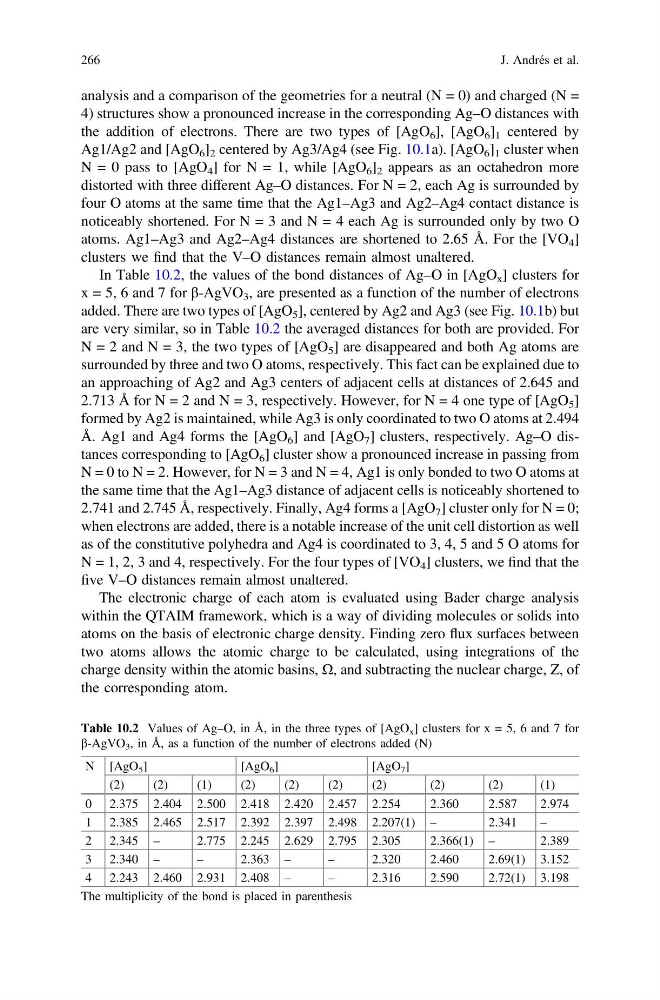
In Table 10.2, the values of the bond distances of Ag–O in [AgO x ] clusters for
x = 5, 6 and 7 for β-AgVO 3 , are presented as a function of the number of electrons
added. There are two types of [AgO 5 ], centered by Ag2 and Ag3 (see Fig. 10.1b) but
are very similar, so in Table 10.2 the averaged distances for both are provided. For
N = 2 and N = 3, the two types of [AgO 5 ] are disappeared and both Ag atoms are
surrounded by three and two O atoms, respectively. This fact can be explained due to
an approaching of Ag2 and Ag3 centers of adjacent cells at distances of 2.645 and
2.713 Å for N = 2 and N = 3, respectively. However, for N = 4 one type of [AgO 5 ]
formed by Ag2 is maintained, while Ag3 is only coordinated to two O atoms at 2.494
Å. Ag1 and Ag4 forms the [AgO 6 ] and [AgO 7 ] clusters, respectively. Ag–O distances corresponding to [AgO 6 ] cluster show a pronounced increase in passing from
N = 0 to N = 2. However, for N = 3 and N = 4, Ag1 is only bonded to two O atoms at
the same time that the Ag1–Ag3 distance of adjacent cells is noticeably shortened to
2.741 and 2.745 Å, respectively. Finally, Ag4 forms a [AgO 7 ] cluster only for N = 0;
when electrons are added, there is a notable increase of the unit cell distortion as well
as of the constitutive polyhedra and Ag4 is coordinated to 3, 4, 5 and 5 O atoms for
N = 1, 2, 3 and 4, respectively. For the four types of [VO 4 ] clusters, we find that the
five V–O distances remain almost unaltered.
The electronic charge of each atom is evaluated using Bader charge analysis
within the QTAIM framework, which is a way of dividing molecules or solids into
atoms on the basis of electronic charge density. Finding zero flux surfaces between
two atoms allows the atomic charge to be calculated, using integrations of the
charge density within the atomic basins, Ω, and subtracting the nuclear charge, Z, of
the corresponding atom.
Table 10.2 Values of Ag–O, in Å, in the three types of [AgO x ] clusters for x = 5, 6 and 7 for
β-AgVO 3 , in Å, as a function of the number of electrons added (N)
N [AgO 5 ]
[AgO 6 ]
[AgO 7 ]
(2)
(2)
(1)
(2)
(2)
(2)
(2)
(2)
(2)
(1)
0 2.375 2.404 2.500 2.418 2.420 2.457 2.254
2.360
2.587
2.974
1 2.385 2.465 2.517 2.392 2.397 2.498 2.207(1) –
2.341
–
2 2.345 –
2.775 2.245 2.629 2.795 2.305
2.366(1) –
2.389
3 2.340 –
–
2.363 –
–
2.320
2.460
2.69(1) 3.152
4 2.243 2.460 2.931 2.408 –
–
2.316
2.590
2.72(1) 3.198
The multiplicity of the bond is placed in parenthesis
266
J. Andrés et al.
4) structures show a pronounced increase in the corresponding Ag–O distances with
the addition of electrons. There are two types of [AgO 6 ], [AgO 6 ] 1 centered by
Ag1/Ag2 and [AgO 6 ] 2 centered by Ag3/Ag4 (see Fig. 10.1a). [AgO 6 ] 1 cluster when
N = 0 pass to [AgO 4 ] for N = 1, while [AgO 6 ] 2 appears as an octahedron more
distorted with three different Ag–O distances. For N = 2, each Ag is surrounded by
four O atoms at the same time that the Ag1–Ag3 and Ag2–Ag4 contact distance is
noticeably shortened. For N = 3 and N = 4 each Ag is surrounded only by two O
atoms. Ag1–Ag3 and Ag2–Ag4 distances are shortened to 2.65 Å. For the [VO 4 ]
clusters we find that the V–O distances remain almost unaltered.
In Table 10.2, the values of the bond distances of Ag–O in [AgO x ] clusters for
x = 5, 6 and 7 for β-AgVO 3 , are presented as a function of the number of electrons
added. There are two types of [AgO 5 ], centered by Ag2 and Ag3 (see Fig. 10.1b) but
are very similar, so in Table 10.2 the averaged distances for both are provided. For
N = 2 and N = 3, the two types of [AgO 5 ] are disappeared and both Ag atoms are
surrounded by three and two O atoms, respectively. This fact can be explained due to
an approaching of Ag2 and Ag3 centers of adjacent cells at distances of 2.645 and
2.713 Å for N = 2 and N = 3, respectively. However, for N = 4 one type of [AgO 5 ]
formed by Ag2 is maintained, while Ag3 is only coordinated to two O atoms at 2.494
Å. Ag1 and Ag4 forms the [AgO 6 ] and [AgO 7 ] clusters, respectively. Ag–O distances corresponding to [AgO 6 ] cluster show a pronounced increase in passing from
N = 0 to N = 2. However, for N = 3 and N = 4, Ag1 is only bonded to two O atoms at
the same time that the Ag1–Ag3 distance of adjacent cells is noticeably shortened to
2.741 and 2.745 Å, respectively. Finally, Ag4 forms a [AgO 7 ] cluster only for N = 0;
when electrons are added, there is a notable increase of the unit cell distortion as well
as of the constitutive polyhedra and Ag4 is coordinated to 3, 4, 5 and 5 O atoms for
N = 1, 2, 3 and 4, respectively. For the four types of [VO 4 ] clusters, we find that the
five V–O distances remain almost unaltered.
The electronic charge of each atom is evaluated using Bader charge analysis
within the QTAIM framework, which is a way of dividing molecules or solids into
atoms on the basis of electronic charge density. Finding zero flux surfaces between
two atoms allows the atomic charge to be calculated, using integrations of the
charge density within the atomic basins, Ω, and subtracting the nuclear charge, Z, of
the corresponding atom.
Table 10.2 Values of Ag–O, in Å, in the three types of [AgO x ] clusters for x = 5, 6 and 7 for
β-AgVO 3 , in Å, as a function of the number of electrons added (N)
N [AgO 5 ]
[AgO 6 ]
[AgO 7 ]
(2)
(2)
(1)
(2)
(2)
(2)
(2)
(2)
(2)
(1)
0 2.375 2.404 2.500 2.418 2.420 2.457 2.254
2.360
2.587
2.974
1 2.385 2.465 2.517 2.392 2.397 2.498 2.207(1) –
2.341
–
2 2.345 –
2.775 2.245 2.629 2.795 2.305
2.366(1) –
2.389
3 2.340 –
–
2.363 –
–
2.320
2.460
2.69(1) 3.152
4 2.243 2.460 2.931 2.408 –
–
2.316
2.590
2.72(1) 3.198
The multiplicity of the bond is placed in parenthesis
266
J. Andrés et al.