

f k ¼
Z
X k
f ðrÞdr
ð8:11Þ
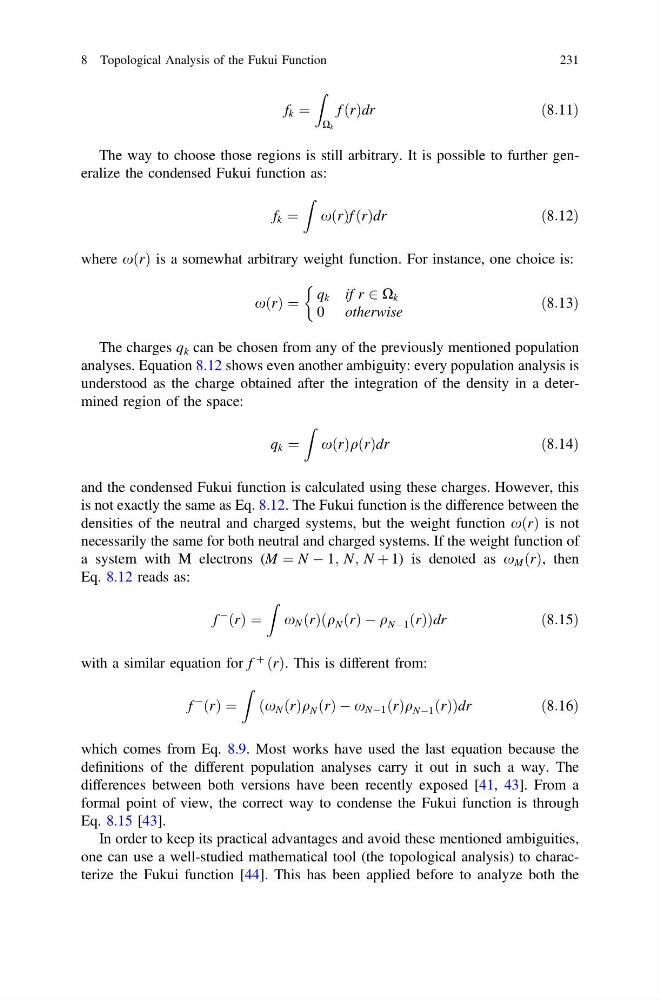
The way to choose those regions is still arbitrary. It is possible to further generalize the condensed Fukui function as:
f k ¼
Z
xðrÞf ðrÞdr
ð8:12Þ
where xðrÞ is a somewhat arbitrary weight function. For instance, one choice is:
xðrÞ ¼
q k if r 2 X k
0 otherwise
ð8:13Þ
The charges q k can be chosen from any of the previously mentioned population
analyses. Equation 8.12 shows even another ambiguity: every population analysis is
understood as the charge obtained after the integration of the density in a determined region of the space:
q k ¼
Z
xðrÞqðrÞdr
ð8:14Þ
and the condensed Fukui function is calculated using these charges. However, this
is not exactly the same as Eq. 8.12. The Fukui function is the difference between the
densities of the neutral and charged systems, but the weight function xðrÞ is not
necessarily the same for both neutral and charged systems. If the weight function of
a system with M electrons (M ¼ N À 1; N; N þ 1) is denoted as x M ðrÞ, then
Eq. 8.12 reads as:
f
À
ðrÞ ¼
Z
x N ðrÞðq N ðrÞ À q NÀ1 ðrÞÞdr
ð8:15Þ
with a similar equation for f
þ
ðrÞ. This is different from:
f
À
ðrÞ ¼
Z
ðx N ðrÞq N ðrÞ À x NÀ1 ðrÞq NÀ1 ðrÞÞdr
ð8:16Þ
which comes from Eq. 8.9. Most works have used the last equation because the
definitions of the different population analyses carry it out in such a way. The
differences between both versions have been recently exposed [41, 43]. From a
formal point of view, the correct way to condense the Fukui function is through
Eq. 8.15 [43].
In order to keep its practical advantages and avoid these mentioned ambiguities,
one can use a well-studied mathematical tool (the topological analysis) to characterize the Fukui function [44]. This has been applied before to analyze both the
8 Topological Analysis of the Fukui Function
231
Z
X k
f ðrÞdr
ð8:11Þ
The way to choose those regions is still arbitrary. It is possible to further generalize the condensed Fukui function as:
f k ¼
Z
xðrÞf ðrÞdr
ð8:12Þ
where xðrÞ is a somewhat arbitrary weight function. For instance, one choice is:
xðrÞ ¼
q k if r 2 X k
0 otherwise
ð8:13Þ
The charges q k can be chosen from any of the previously mentioned population
analyses. Equation 8.12 shows even another ambiguity: every population analysis is
understood as the charge obtained after the integration of the density in a determined region of the space:
q k ¼
Z
xðrÞqðrÞdr
ð8:14Þ
and the condensed Fukui function is calculated using these charges. However, this
is not exactly the same as Eq. 8.12. The Fukui function is the difference between the
densities of the neutral and charged systems, but the weight function xðrÞ is not
necessarily the same for both neutral and charged systems. If the weight function of
a system with M electrons (M ¼ N À 1; N; N þ 1) is denoted as x M ðrÞ, then
Eq. 8.12 reads as:
f
À
ðrÞ ¼
Z
x N ðrÞðq N ðrÞ À q NÀ1 ðrÞÞdr
ð8:15Þ
with a similar equation for f
þ
ðrÞ. This is different from:
f
À
ðrÞ ¼
Z
ðx N ðrÞq N ðrÞ À x NÀ1 ðrÞq NÀ1 ðrÞÞdr
ð8:16Þ
which comes from Eq. 8.9. Most works have used the last equation because the
definitions of the different population analyses carry it out in such a way. The
differences between both versions have been recently exposed [41, 43]. From a
formal point of view, the correct way to condense the Fukui function is through
Eq. 8.15 [43].
In order to keep its practical advantages and avoid these mentioned ambiguities,
one can use a well-studied mathematical tool (the topological analysis) to characterize the Fukui function [44]. This has been applied before to analyze both the
8 Topological Analysis of the Fukui Function
231