

On the other side, there are many numerical evidences that the Fukui function
can have negative values [29–33]. Therefore, it cannot be interpreted as a distribution function.
In chemistry, it is important to know the local preference inside a molecule to
make or break bonds (For instance, in regioselectivity and stereoselectivity). Then,
it is desirable to describe this preference by assigning a number to each atom, which
was carried out in the early days of the Fukui function. Yang and Mortier [34] had
the brilliant idea of “condensing” the Fukui function through a simple protocol, in
order to assign a number to the Fukui function on each atom of the molecule. This
was done in analogy with the Mulliken atomic population analysis. Considering
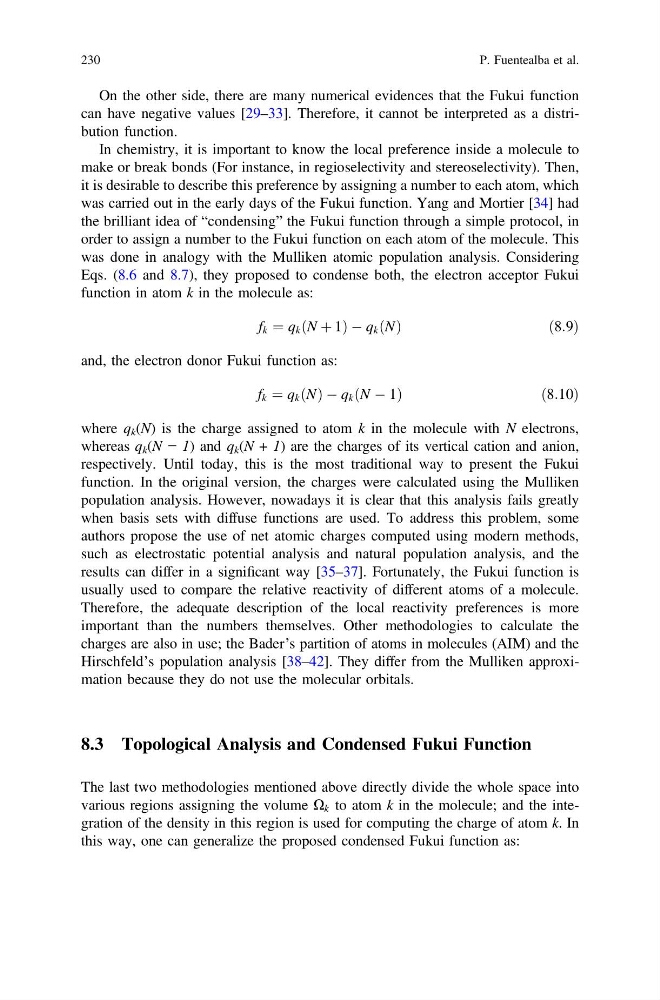
Eqs. (8.6 and 8.7), they proposed to condense both, the electron acceptor Fukui
function in atom k in the molecule as:
f k ¼ q k ðN þ 1Þ À q k ðNÞ
ð 8:9Þ
and, the electron donor Fukui function as:
f k ¼ q k ðNÞ À q k ðN À 1Þ
ð 8:10Þ
where q k (N) is the charge assigned to atom k in the molecule with N electrons,
whereas q k (N − 1) and q k (N + 1) are the charges of its vertical cation and anion,
respectively. Until today, this is the most traditional way to present the Fukui
function. In the original version, the charges were calculated using the Mulliken
population analysis. However, nowadays it is clear that this analysis fails greatly
when basis sets with diffuse functions are used. To address this problem, some
authors propose the use of net atomic charges computed using modern methods,
such as electrostatic potential analysis and natural population analysis, and the
results can differ in a significant way [35–37]. Fortunately, the Fukui function is
usually used to compare the relative reactivity of different atoms of a molecule.
Therefore, the adequate description of the local reactivity preferences is more
important than the numbers themselves. Other methodologies to calculate the
charges are also in use; the Bader’s partition of atoms in molecules (AIM) and the
Hirschfeld’s population analysis [38–42]. They differ from the Mulliken approximation because they do not use the molecular orbitals.
8.3 Topological Analysis and Condensed Fukui Function
The last two methodologies mentioned above directly divide the whole space into
various regions assigning the volume X k to atom k in the molecule; and the integration of the density in this region is used for computing the charge of atom k. In
this way, one can generalize the proposed condensed Fukui function as:
230
P. Fuentealba et al.
can have negative values [29–33]. Therefore, it cannot be interpreted as a distribution function.
In chemistry, it is important to know the local preference inside a molecule to
make or break bonds (For instance, in regioselectivity and stereoselectivity). Then,
it is desirable to describe this preference by assigning a number to each atom, which
was carried out in the early days of the Fukui function. Yang and Mortier [34] had
the brilliant idea of “condensing” the Fukui function through a simple protocol, in
order to assign a number to the Fukui function on each atom of the molecule. This
was done in analogy with the Mulliken atomic population analysis. Considering
Eqs. (8.6 and 8.7), they proposed to condense both, the electron acceptor Fukui
function in atom k in the molecule as:
f k ¼ q k ðN þ 1Þ À q k ðNÞ
ð 8:9Þ
and, the electron donor Fukui function as:
f k ¼ q k ðNÞ À q k ðN À 1Þ
ð 8:10Þ
where q k (N) is the charge assigned to atom k in the molecule with N electrons,
whereas q k (N − 1) and q k (N + 1) are the charges of its vertical cation and anion,
respectively. Until today, this is the most traditional way to present the Fukui
function. In the original version, the charges were calculated using the Mulliken
population analysis. However, nowadays it is clear that this analysis fails greatly
when basis sets with diffuse functions are used. To address this problem, some
authors propose the use of net atomic charges computed using modern methods,
such as electrostatic potential analysis and natural population analysis, and the
results can differ in a significant way [35–37]. Fortunately, the Fukui function is
usually used to compare the relative reactivity of different atoms of a molecule.
Therefore, the adequate description of the local reactivity preferences is more
important than the numbers themselves. Other methodologies to calculate the
charges are also in use; the Bader’s partition of atoms in molecules (AIM) and the
Hirschfeld’s population analysis [38–42]. They differ from the Mulliken approximation because they do not use the molecular orbitals.
8.3 Topological Analysis and Condensed Fukui Function
The last two methodologies mentioned above directly divide the whole space into
various regions assigning the volume X k to atom k in the molecule; and the integration of the density in this region is used for computing the charge of atom k. In
this way, one can generalize the proposed condensed Fukui function as:
230
P. Fuentealba et al.