

[126] illustrate the peculiar delocalization of charge in ionic conjugated systems,
e.g., R-CO
À
2 ; CHðCH 2 Þ
þ
2 . Attempts have been made at rationalizing electron
delocalization in recent papers citing previous relevant literature [27, 127–130].
On the other hand, practical and clearcut definitions, well-suited to reconcile
diverging views [131–133], are not available for the related concept of delocalized
current induced in the electrons of a molecule by an applied magnetic field B. In
general it is merely assumed that delocalized p-electrons are quite free to move.
There is a general accord that they sustain diatropic [104, 134–136] “ring currents’’
in conjugated planar cyclic molecules, e.g., the “aromatic’’ benzene [15, 137, 138],
in the presence of B orthogonal to the molecular plane. On the same ground it is
assumed that the p-electrons of “anti-aromatic’’ systems, e.g., cyclobutadiene and
the flattened cyclo-octatetraene model molecule, support paratropic currents delocalized all over the carbon ring [49, 139]. The SG of the latter presents quite
remarkable features, see Fig. 5 of Ref. [139].
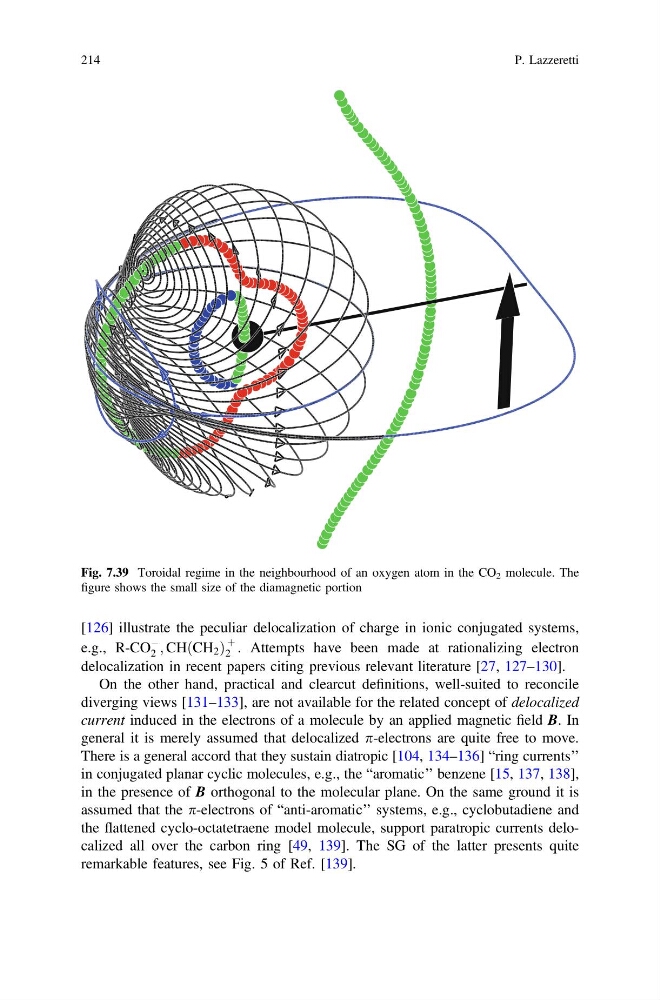
Fig. 7.39 Toroidal regime in the neighbourhood of an oxygen atom in the CO 2 molecule. The
figure shows the small size of the diamagnetic portion
214
P. Lazzeretti
e.g., R-CO
À
2 ; CHðCH 2 Þ
þ
2 . Attempts have been made at rationalizing electron
delocalization in recent papers citing previous relevant literature [27, 127–130].
On the other hand, practical and clearcut definitions, well-suited to reconcile
diverging views [131–133], are not available for the related concept of delocalized
current induced in the electrons of a molecule by an applied magnetic field B. In
general it is merely assumed that delocalized p-electrons are quite free to move.
There is a general accord that they sustain diatropic [104, 134–136] “ring currents’’
in conjugated planar cyclic molecules, e.g., the “aromatic’’ benzene [15, 137, 138],
in the presence of B orthogonal to the molecular plane. On the same ground it is
assumed that the p-electrons of “anti-aromatic’’ systems, e.g., cyclobutadiene and
the flattened cyclo-octatetraene model molecule, support paratropic currents delocalized all over the carbon ring [49, 139]. The SG of the latter presents quite
remarkable features, see Fig. 5 of Ref. [139].
Fig. 7.39 Toroidal regime in the neighbourhood of an oxygen atom in the CO 2 molecule. The
figure shows the small size of the diamagnetic portion
214
P. Lazzeretti