

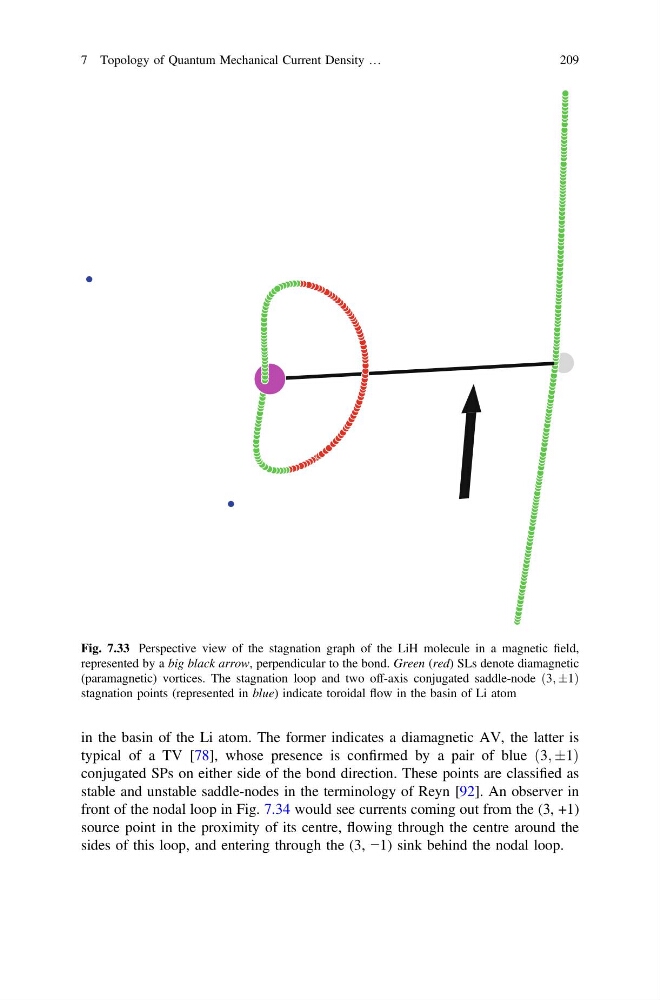
in the basin of the Li atom. The former indicates a diamagnetic AV, the latter is
typical of a TV [78], whose presence is confirmed by a pair of blue ð3; Æ1Þ
conjugated SPs on either side of the bond direction. These points are classified as
stable and unstable saddle-nodes in the terminology of Reyn [92]. An observer in
front of the nodal loop in Fig. 7.34 would see currents coming out from the (3, +1)
source point in the proximity of its centre, flowing through the centre around the
sides of this loop, and entering through the (3, −1) sink behind the nodal loop.
Fig. 7.33 Perspective view of the stagnation graph of the LiH molecule in a magnetic field,
represented by a big black arrow, perpendicular to the bond. Green (red) SLs denote diamagnetic
(paramagnetic) vortices. The stagnation loop and two off-axis conjugated saddle-node ð3; Æ1Þ
stagnation points (represented in blue) indicate toroidal flow in the basin of Li atom
7 Topology of Quantum Mechanical Current Density …
209
typical of a TV [78], whose presence is confirmed by a pair of blue ð3; Æ1Þ
conjugated SPs on either side of the bond direction. These points are classified as
stable and unstable saddle-nodes in the terminology of Reyn [92]. An observer in
front of the nodal loop in Fig. 7.34 would see currents coming out from the (3, +1)
source point in the proximity of its centre, flowing through the centre around the
sides of this loop, and entering through the (3, −1) sink behind the nodal loop.
Fig. 7.33 Perspective view of the stagnation graph of the LiH molecule in a magnetic field,
represented by a big black arrow, perpendicular to the bond. Green (red) SLs denote diamagnetic
(paramagnetic) vortices. The stagnation loop and two off-axis conjugated saddle-node ð3; Æ1Þ
stagnation points (represented in blue) indicate toroidal flow in the basin of Li atom
7 Topology of Quantum Mechanical Current Density …
209