

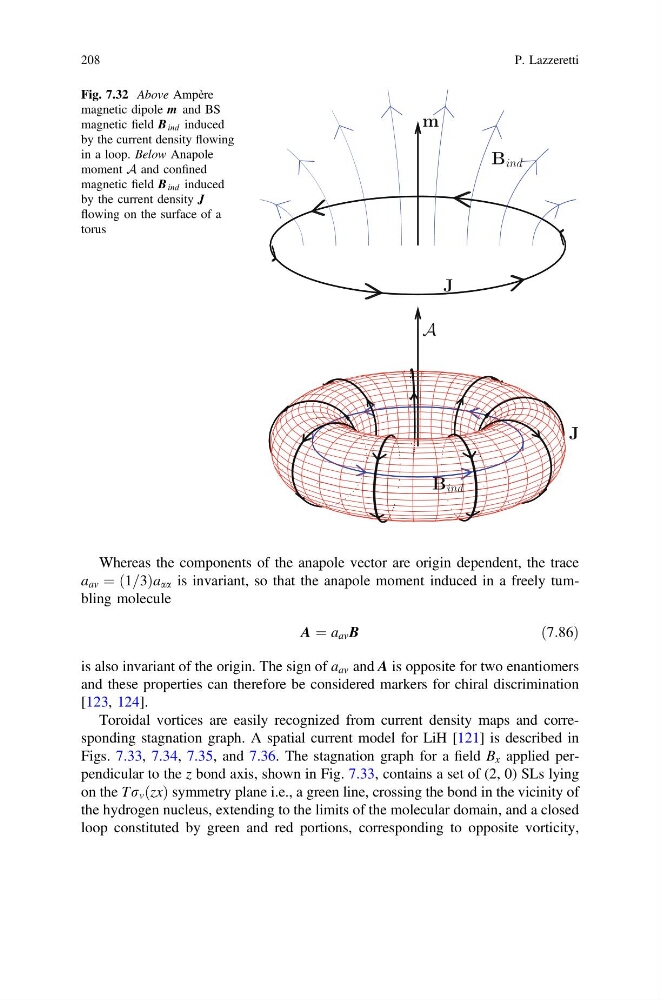
Whereas the components of the anapole vector are origin dependent, the trace
a av ¼ ð1=3Þa aa is invariant, so that the anapole moment induced in a freely tumbling molecule
A ¼ a av B
ð7:86Þ
is also invariant of the origin. The sign of a av and A is opposite for two enantiomers
and these properties can therefore be considered markers for chiral discrimination
[123, 124].
Toroidal vortices are easily recognized from current density maps and corresponding stagnation graph. A spatial current model for LiH [121] is described in
Figs. 7.33, 7.34, 7.35, and 7.36. The stagnation graph for a field B x applied perpendicular to the z bond axis, shown in Fig. 7.33, contains a set of (2, 0) SLs lying
on the Tr v ðzxÞ symmetry plane i.e., a green line, crossing the bond in the vicinity of
the hydrogen nucleus, extending to the limits of the molecular domain, and a closed
loop constituted by green and red portions, corresponding to opposite vorticity,
m
J
B ind
A
B ind
J
Fig. 7.32 Above Ampère
magnetic dipole m and BS
magnetic field B ind induced
by the current density flowing
in a loop. Below Anapole
moment A and confined
magnetic field B ind induced
by the current density J
flowing on the surface of a
torus
208
P. Lazzeretti
a av ¼ ð1=3Þa aa is invariant, so that the anapole moment induced in a freely tumbling molecule
A ¼ a av B
ð7:86Þ
is also invariant of the origin. The sign of a av and A is opposite for two enantiomers
and these properties can therefore be considered markers for chiral discrimination
[123, 124].
Toroidal vortices are easily recognized from current density maps and corresponding stagnation graph. A spatial current model for LiH [121] is described in
Figs. 7.33, 7.34, 7.35, and 7.36. The stagnation graph for a field B x applied perpendicular to the z bond axis, shown in Fig. 7.33, contains a set of (2, 0) SLs lying
on the Tr v ðzxÞ symmetry plane i.e., a green line, crossing the bond in the vicinity of
the hydrogen nucleus, extending to the limits of the molecular domain, and a closed
loop constituted by green and red portions, corresponding to opposite vorticity,
m
J
B ind
A
B ind
J
Fig. 7.32 Above Ampère
magnetic dipole m and BS
magnetic field B ind induced
by the current density flowing
in a loop. Below Anapole
moment A and confined
magnetic field B ind induced
by the current density J
flowing on the surface of a
torus
208
P. Lazzeretti