

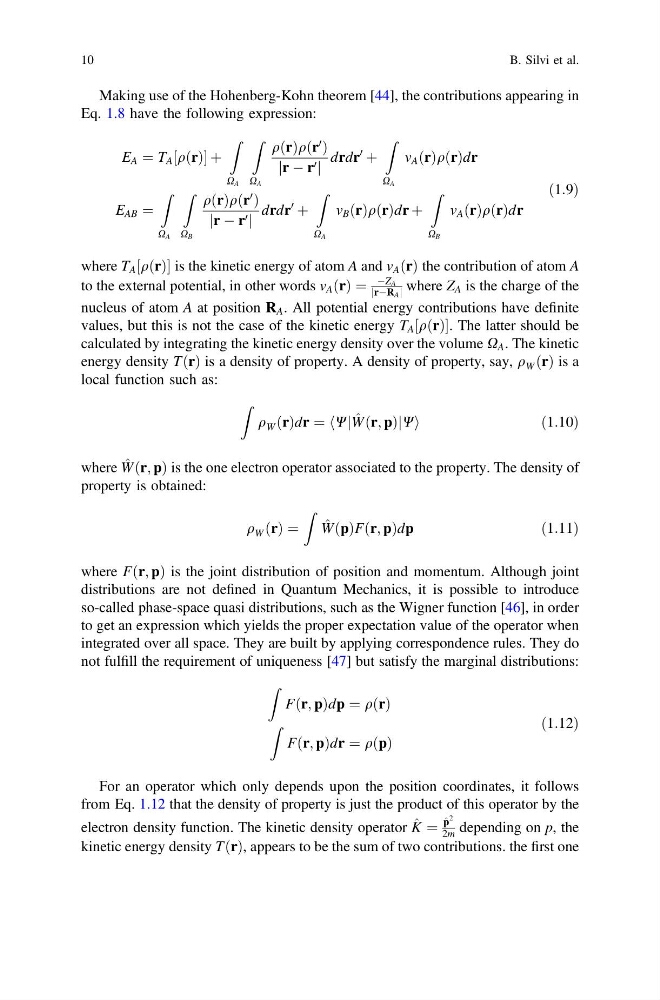
Making use of the Hohenberg-Kohn theorem [44], the contributions appearing in
Eq. 1.8 have the following expression:
E A ¼ T A ½qðrÞ þ
Z
X A
Z
X A
qðrÞqðr
0
Þ
jr À r 0 j
drdr
0
þ
Z
X A
v A ðrÞqðrÞdr
E AB ¼
Z
X A
Z
X B
qðrÞqðr
0
Þ
jr À r 0 j
drdr
0
þ
Z
X A
v B ðrÞqðrÞdr þ
Z
X B
v A ðrÞqðrÞdr
ð1:9Þ
where T A ½qðrÞ is the kinetic energy of atom A and v A ðrÞ the contribution of atom A
to the external potential, in other words v A ðrÞ ¼
ÀZ A
jrÀR A j where Z A is the charge of the
nucleus of atom A at position R A . All potential energy contributions have definite
values, but this is not the case of the kinetic energy T A ½qðrÞ. The latter should be
calculated by integrating the kinetic energy density over the volume X A . The kinetic
energy density TðrÞ is a density of property. A density of property, say, q W ðrÞ is a
local function such as:
Z
q W ðrÞdr ¼ hWj ^
Wðr; pÞjWi
ð 1:10Þ
where ^
Wðr; pÞ is the one electron operator associated to the property. The density of
property is obtained:
q W ðrÞ ¼
Z
^
WðpÞFðr; pÞdp
ð1:11Þ
where Fðr; pÞ is the joint distribution of position and momentum. Although joint
distributions are not defined in Quantum Mechanics, it is possible to introduce
so-called phase-space quasi distributions, such as the Wigner function [46], in order
to get an expression which yields the proper expectation value of the operator when
integrated over all space. They are built by applying correspondence rules. They do
not fulfill the requirement of uniqueness [47] but satisfy the marginal distributions:
Z
Fðr; pÞdp ¼ qðrÞ
Z
Fðr; pÞdr ¼ qðpÞ
ð1:12Þ
For an operator which only depends upon the position coordinates, it follows
from Eq. 1.12 that the density of property is just the product of this operator by the
electron density function. The kinetic density operator ^
K ¼
^
p
2
2m depending on p, the
kinetic energy density TðrÞ, appears to be the sum of two contributions. the first one
10
B. Silvi et al.
Eq. 1.8 have the following expression:
E A ¼ T A ½qðrÞ þ
Z
X A
Z
X A
qðrÞqðr
0
Þ
jr À r 0 j
drdr
0
þ
Z
X A
v A ðrÞqðrÞdr
E AB ¼
Z
X A
Z
X B
qðrÞqðr
0
Þ
jr À r 0 j
drdr
0
þ
Z
X A
v B ðrÞqðrÞdr þ
Z
X B
v A ðrÞqðrÞdr
ð1:9Þ
where T A ½qðrÞ is the kinetic energy of atom A and v A ðrÞ the contribution of atom A
to the external potential, in other words v A ðrÞ ¼
ÀZ A
jrÀR A j where Z A is the charge of the
nucleus of atom A at position R A . All potential energy contributions have definite
values, but this is not the case of the kinetic energy T A ½qðrÞ. The latter should be
calculated by integrating the kinetic energy density over the volume X A . The kinetic
energy density TðrÞ is a density of property. A density of property, say, q W ðrÞ is a
local function such as:
Z
q W ðrÞdr ¼ hWj ^
Wðr; pÞjWi
ð 1:10Þ
where ^
Wðr; pÞ is the one electron operator associated to the property. The density of
property is obtained:
q W ðrÞ ¼
Z
^
WðpÞFðr; pÞdp
ð1:11Þ
where Fðr; pÞ is the joint distribution of position and momentum. Although joint
distributions are not defined in Quantum Mechanics, it is possible to introduce
so-called phase-space quasi distributions, such as the Wigner function [46], in order
to get an expression which yields the proper expectation value of the operator when
integrated over all space. They are built by applying correspondence rules. They do
not fulfill the requirement of uniqueness [47] but satisfy the marginal distributions:
Z
Fðr; pÞdp ¼ qðrÞ
Z
Fðr; pÞdr ¼ qðpÞ
ð1:12Þ
For an operator which only depends upon the position coordinates, it follows
from Eq. 1.12 that the density of property is just the product of this operator by the
electron density function. The kinetic density operator ^
K ¼
^
p
2
2m depending on p, the
kinetic energy density TðrÞ, appears to be the sum of two contributions. the first one
10
B. Silvi et al.