

electron density of probability functions and more generally density of property
functions enables a step-by-step recognition of the chemical objects showing that
“Chemistry emerges from Quantum Mechanics” [39].
The one-electron density, qðrÞ, expresses the probability of finding one electron
in a volume element centered at r, the remaining electrons being anywhere. It is a
fundamental physical property measured in coherent X-ray scattering experiments
or calculated with quantum chemical methods. It is involved in very important
theorems such as the electrostatic expression of the Hellmann-Feynman theorem
[40–43] which enables the calculation of the forces on nuclei and the
Hohenberg-Kohn theorem [44] which is at the root of the Density Functional
Theory (DFT). The one electron density can be be written as the sum of the spin
contributions:
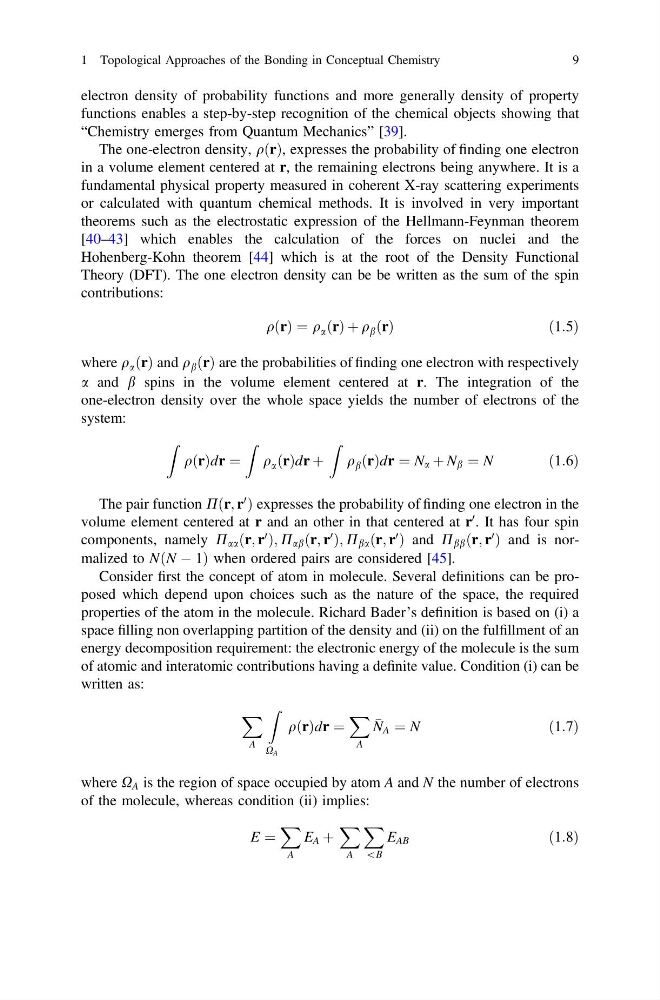
qðrÞ ¼ q a ðrÞ þ q b ðrÞ
ð 1:5Þ
where q a ðrÞ and q b ðrÞ are the probabilities of finding one electron with respectively
a and b spins in the volume element centered at r. The integration of the
one-electron density over the whole space yields the number of electrons of the
system:
Z
qðrÞdr ¼
Z
q a ðrÞdr þ
Z
q b ðrÞdr ¼ N a þ N b ¼ N
ð1:6Þ
The pair function Pðr; r
0
Þ expresses the probability of finding one electron in the
volume element centered at r and an other in that centered at r
0 . It has four spin
components, namely P aa ðr; r
0
Þ; P ab ðr; r
0
Þ; P ba ðr; r
0
Þ and P bb ðr; r
0
Þ and is normalized to NðN À 1Þ when ordered pairs are considered [45].
Consider first the concept of atom in molecule. Several definitions can be proposed which depend upon choices such as the nature of the space, the required
properties of the atom in the molecule. Richard Bader’s definition is based on (i) a
space filling non overlapping partition of the density and (ii) on the fulfillment of an
energy decomposition requirement: the electronic energy of the molecule is the sum
of atomic and interatomic contributions having a definite value. Condition (i) can be
written as:
X
A
Z
X A
qðrÞdr ¼
X
A
N A ¼ N
ð1:7Þ
where X A is the region of space occupied by atom A and N the number of electrons
of the molecule, whereas condition (ii) implies:
E ¼
X
A
E A þ
X
A
X
\B
E AB
ð1:8Þ
1 Topological Approaches of the Bonding in Conceptual Chemistry
9
functions enables a step-by-step recognition of the chemical objects showing that
“Chemistry emerges from Quantum Mechanics” [39].
The one-electron density, qðrÞ, expresses the probability of finding one electron
in a volume element centered at r, the remaining electrons being anywhere. It is a
fundamental physical property measured in coherent X-ray scattering experiments
or calculated with quantum chemical methods. It is involved in very important
theorems such as the electrostatic expression of the Hellmann-Feynman theorem
[40–43] which enables the calculation of the forces on nuclei and the
Hohenberg-Kohn theorem [44] which is at the root of the Density Functional
Theory (DFT). The one electron density can be be written as the sum of the spin
contributions:
qðrÞ ¼ q a ðrÞ þ q b ðrÞ
ð 1:5Þ
where q a ðrÞ and q b ðrÞ are the probabilities of finding one electron with respectively
a and b spins in the volume element centered at r. The integration of the
one-electron density over the whole space yields the number of electrons of the
system:
Z
qðrÞdr ¼
Z
q a ðrÞdr þ
Z
q b ðrÞdr ¼ N a þ N b ¼ N
ð1:6Þ
The pair function Pðr; r
0
Þ expresses the probability of finding one electron in the
volume element centered at r and an other in that centered at r
0 . It has four spin
components, namely P aa ðr; r
0
Þ; P ab ðr; r
0
Þ; P ba ðr; r
0
Þ and P bb ðr; r
0
Þ and is normalized to NðN À 1Þ when ordered pairs are considered [45].
Consider first the concept of atom in molecule. Several definitions can be proposed which depend upon choices such as the nature of the space, the required
properties of the atom in the molecule. Richard Bader’s definition is based on (i) a
space filling non overlapping partition of the density and (ii) on the fulfillment of an
energy decomposition requirement: the electronic energy of the molecule is the sum
of atomic and interatomic contributions having a definite value. Condition (i) can be
written as:
X
A
Z
X A
qðrÞdr ¼
X
A
N A ¼ N
ð1:7Þ
where X A is the region of space occupied by atom A and N the number of electrons
of the molecule, whereas condition (ii) implies:
E ¼
X
A
E A þ
X
A
X
\B
E AB
ð1:8Þ
1 Topological Approaches of the Bonding in Conceptual Chemistry
9