

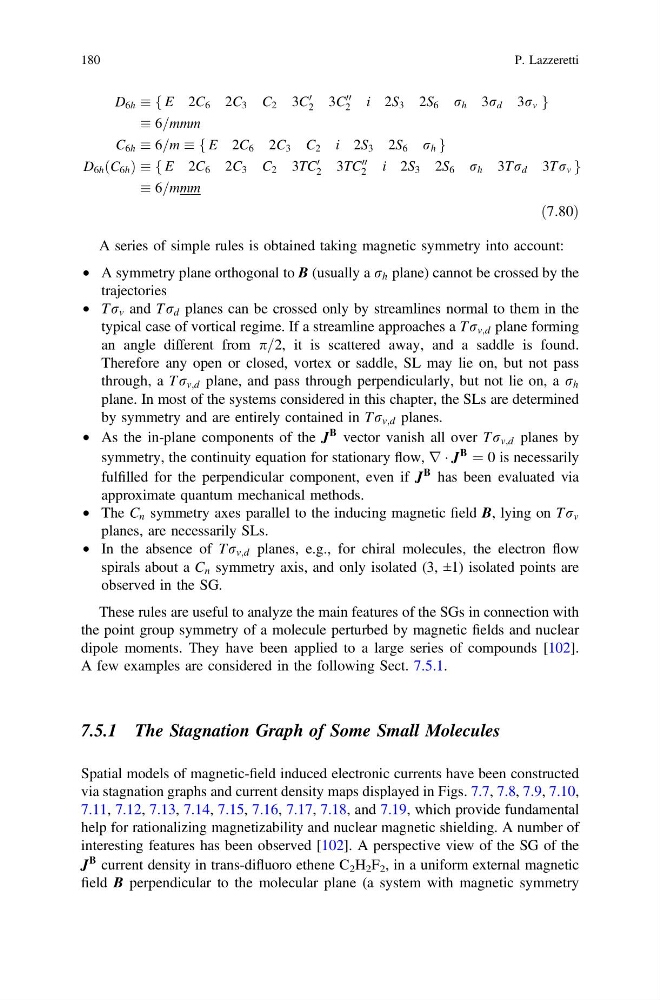
D 6h f E 2C 6 2C 3 C 2 3C
0
2 3C
00
2
i 2S 3 2S 6 r h 3r d 3r v g
6=mmm
C 6h 6=m f E 2C 6 2C 3 C 2 i 2S 3 2S 6 r h g
D 6h ðC 6h Þ f E 2C 6 2C 3 C 2 3TC
0
2 3TC
00
2
i 2S 3 2S 6 r h 3Tr d 3Tr v g
6=mmm
ð7:80Þ
A series of simple rules is obtained taking magnetic symmetry into account:
• A symmetry plane orthogonal to B (usually a r h plane) cannot be crossed by the
trajectories
• Tr v and Tr d planes can be crossed only by streamlines normal to them in the
typical case of vortical regime. If a streamline approaches a Tr v;d plane forming
an angle different from p=2, it is scattered away, and a saddle is found.
Therefore any open or closed, vortex or saddle, SL may lie on, but not pass
through, a Tr v;d plane, and pass through perpendicularly, but not lie on, a r h
plane. In most of the systems considered in this chapter, the SLs are determined
by symmetry and are entirely contained in Tr v;d planes.
• As the in-plane components of the J
B vector vanish all over Tr v;d planes by
symmetry, the continuity equation for stationary flow, r Á J
B
¼ 0 is necessarily
fulfilled for the perpendicular component, even if J
B has been evaluated via
approximate quantum mechanical methods.
• The C n symmetry axes parallel to the inducing magnetic field B, lying on Tr v
planes, are necessarily SLs.
• In the absence of Tr v;d planes, e.g., for chiral molecules, the electron flow
spirals about a C n symmetry axis, and only isolated (3, ±1) isolated points are
observed in the SG.
These rules are useful to analyze the main features of the SGs in connection with
the point group symmetry of a molecule perturbed by magnetic fields and nuclear
dipole moments. They have been applied to a large series of compounds [102].
A few examples are considered in the following Sect. 7.5.1.
7.5.1 The Stagnation Graph of Some Small Molecules
Spatial models of magnetic-field induced electronic currents have been constructed
via stagnation graphs and current density maps displayed in Figs. 7.7, 7.8, 7.9, 7.10,
7.11, 7.12, 7.13, 7.14, 7.15, 7.16, 7.17, 7.18, and 7.19, which provide fundamental
help for rationalizing magnetizability and nuclear magnetic shielding. A number of
interesting features has been observed [102]. A perspective view of the SG of the
J
B current density in trans-difluoro ethene C 2 H 2 F 2 , in a uniform external magnetic
field B perpendicular to the molecular plane (a system with magnetic symmetry
180
P. Lazzeretti
0
2 3C
00
2
i 2S 3 2S 6 r h 3r d 3r v g
6=mmm
C 6h 6=m f E 2C 6 2C 3 C 2 i 2S 3 2S 6 r h g
D 6h ðC 6h Þ f E 2C 6 2C 3 C 2 3TC
0
2 3TC
00
2
i 2S 3 2S 6 r h 3Tr d 3Tr v g
6=mmm
ð7:80Þ
A series of simple rules is obtained taking magnetic symmetry into account:
• A symmetry plane orthogonal to B (usually a r h plane) cannot be crossed by the
trajectories
• Tr v and Tr d planes can be crossed only by streamlines normal to them in the
typical case of vortical regime. If a streamline approaches a Tr v;d plane forming
an angle different from p=2, it is scattered away, and a saddle is found.
Therefore any open or closed, vortex or saddle, SL may lie on, but not pass
through, a Tr v;d plane, and pass through perpendicularly, but not lie on, a r h
plane. In most of the systems considered in this chapter, the SLs are determined
by symmetry and are entirely contained in Tr v;d planes.
• As the in-plane components of the J
B vector vanish all over Tr v;d planes by
symmetry, the continuity equation for stationary flow, r Á J
B
¼ 0 is necessarily
fulfilled for the perpendicular component, even if J
B has been evaluated via
approximate quantum mechanical methods.
• The C n symmetry axes parallel to the inducing magnetic field B, lying on Tr v
planes, are necessarily SLs.
• In the absence of Tr v;d planes, e.g., for chiral molecules, the electron flow
spirals about a C n symmetry axis, and only isolated (3, ±1) isolated points are
observed in the SG.
These rules are useful to analyze the main features of the SGs in connection with
the point group symmetry of a molecule perturbed by magnetic fields and nuclear
dipole moments. They have been applied to a large series of compounds [102].
A few examples are considered in the following Sect. 7.5.1.
7.5.1 The Stagnation Graph of Some Small Molecules
Spatial models of magnetic-field induced electronic currents have been constructed
via stagnation graphs and current density maps displayed in Figs. 7.7, 7.8, 7.9, 7.10,
7.11, 7.12, 7.13, 7.14, 7.15, 7.16, 7.17, 7.18, and 7.19, which provide fundamental
help for rationalizing magnetizability and nuclear magnetic shielding. A number of
interesting features has been observed [102]. A perspective view of the SG of the
J
B current density in trans-difluoro ethene C 2 H 2 F 2 , in a uniform external magnetic
field B perpendicular to the molecular plane (a system with magnetic symmetry
180
P. Lazzeretti