

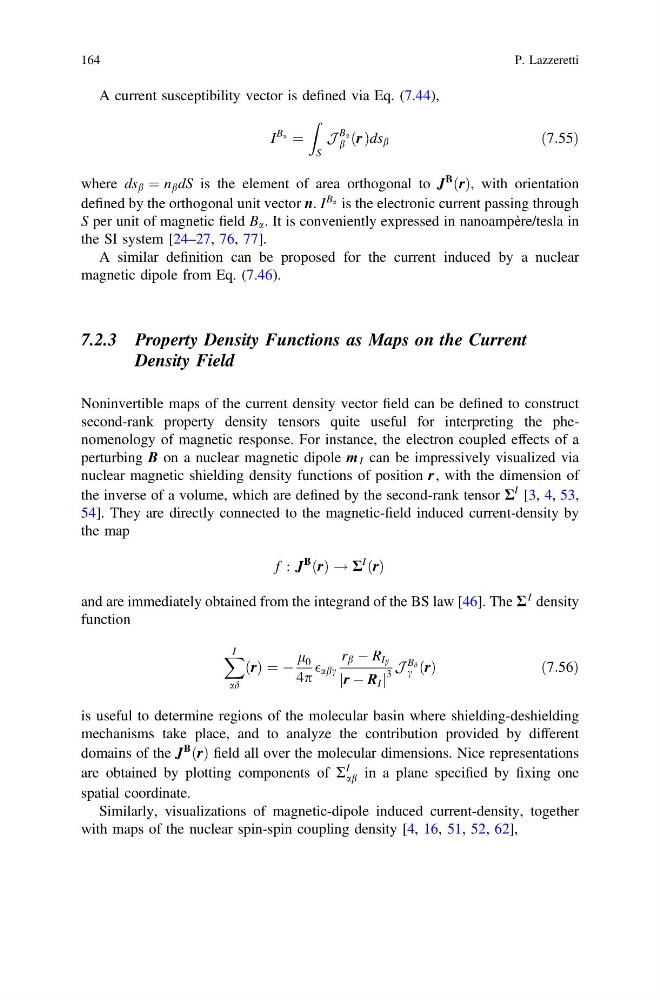
A current susceptibility vector is defined via Eq. (7.44),
I
B a ¼
Z
S
J
B a
b ðr Þds b
ð7:55Þ
where ds b ¼ n b dS is the element of area orthogonal to J
B
ðrÞ, with orientation
defined by the orthogonal unit vector n. I
B a is the electronic current passing through
S per unit of magnetic field B a . It is conveniently expressed in nanoampère/tesla in
the SI system [24–27, 76, 77].
A similar definition can be proposed for the current induced by a nuclear
magnetic dipole from Eq. (7.46).
7.2.3 Property Density Functions as Maps on the Current
Density Field
Noninvertible maps of the current density vector field can be defined to construct
second-rank property density tensors quite useful for interpreting the phenomenology of magnetic response. For instance, the electron coupled effects of a
perturbing B on a nuclear magnetic dipole m I can be impressively visualized via
nuclear magnetic shielding density functions of position r, with the dimension of
the inverse of a volume, which are defined by the second-rank tensor R
I [3, 4, 53,
54]. They are directly connected to the magnetic-field induced current-density by
the map
f : J
B
ðrÞ ! R
I
ðrÞ
and are immediately obtained from the integrand of the BS law [46]. The R
I density
function
X I
ad
ðrÞ ¼ À
l 0
4p
abc
r b À R I b
jr À R I j
3
J
B d
c ðrÞ
ð 7:56Þ
is useful to determine regions of the molecular basin where shielding-deshielding
mechanisms take place, and to analyze the contribution provided by different
domains of the J
B
ðrÞ field all over the molecular dimensions. Nice representations
are obtained by plotting components of R
I
ab in a plane specified by fixing one
spatial coordinate.
Similarly, visualizations of magnetic-dipole induced current-density, together
with maps of the nuclear spin-spin coupling density [4, 16, 51, 52, 62],
164
P. Lazzeretti
I
B a ¼
Z
S
J
B a
b ðr Þds b
ð7:55Þ
where ds b ¼ n b dS is the element of area orthogonal to J
B
ðrÞ, with orientation
defined by the orthogonal unit vector n. I
B a is the electronic current passing through
S per unit of magnetic field B a . It is conveniently expressed in nanoampère/tesla in
the SI system [24–27, 76, 77].
A similar definition can be proposed for the current induced by a nuclear
magnetic dipole from Eq. (7.46).
7.2.3 Property Density Functions as Maps on the Current
Density Field
Noninvertible maps of the current density vector field can be defined to construct
second-rank property density tensors quite useful for interpreting the phenomenology of magnetic response. For instance, the electron coupled effects of a
perturbing B on a nuclear magnetic dipole m I can be impressively visualized via
nuclear magnetic shielding density functions of position r, with the dimension of
the inverse of a volume, which are defined by the second-rank tensor R
I [3, 4, 53,
54]. They are directly connected to the magnetic-field induced current-density by
the map
f : J
B
ðrÞ ! R
I
ðrÞ
and are immediately obtained from the integrand of the BS law [46]. The R
I density
function
X I
ad
ðrÞ ¼ À
l 0
4p
abc
r b À R I b
jr À R I j
3
J
B d
c ðrÞ
ð 7:56Þ
is useful to determine regions of the molecular basin where shielding-deshielding
mechanisms take place, and to analyze the contribution provided by different
domains of the J
B
ðrÞ field all over the molecular dimensions. Nice representations
are obtained by plotting components of R
I
ab in a plane specified by fixing one
spatial coordinate.
Similarly, visualizations of magnetic-dipole induced current-density, together
with maps of the nuclear spin-spin coupling density [4, 16, 51, 52, 62],
164
P. Lazzeretti