

J
m I b
da ðrÞ ¼ À
l 0
4p
e
2
m e
abc
r c À R I c
j r À R I j
3
c
ð0Þ
ðrÞ;
ð7:49Þ
J
m I b
pa ðrÞ ¼ À
ne
m e
Z
dx 2 . . .dx n
 W
m I b Ã
a
ðr; x 2 ; . . .x n Þ^ p a W
ð0Þ
a ðr; x 2 ; . . .x n Þ
h
þ W
ð0ÞÃ
a ðr; x 2 . . .x n Þ^ p a W
m I b
a ðr; x 2 ; . . .x n Þ
i
:
ð7:50Þ
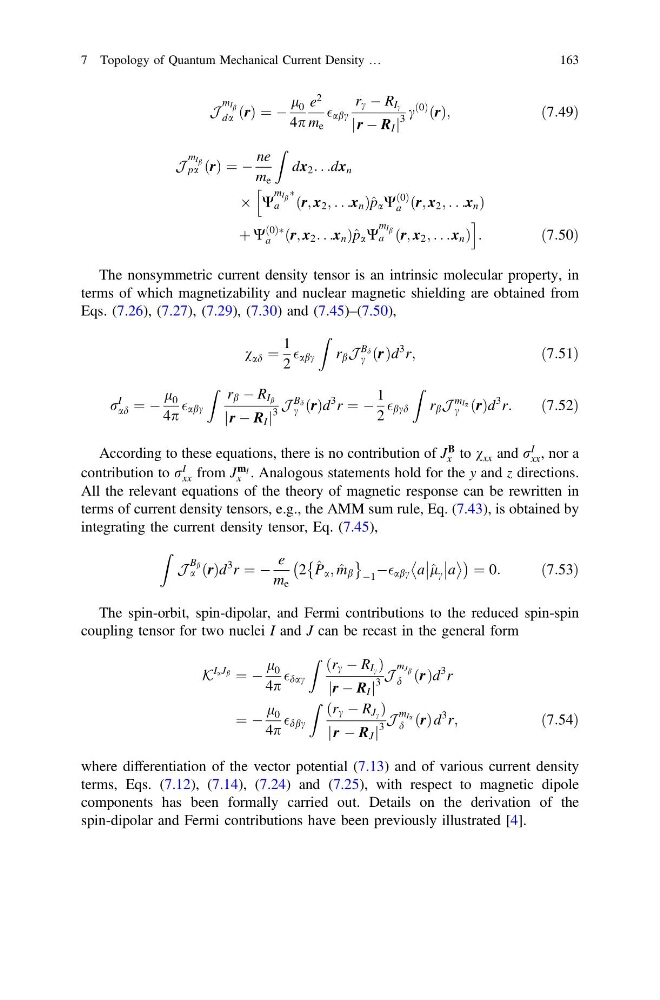
The nonsymmetric current density tensor is an intrinsic molecular property, in
terms of which magnetizability and nuclear magnetic shielding are obtained from
Eqs. (7.26), (7.27), (7.29), (7.30) and (7.45)–(7.50),
v ad ¼
1
2
abc
Z
r b J
B d
c ðrÞd
3 r;
ð7:51Þ
r
I
ad ¼ À
l 0
4p
abc
Z r b À R I b
jr À R I j
3
J
B d
c ðrÞd
3 r ¼ À
1
2
bcd
Z
r b J
m Ia
c ðrÞd
3 r:
ð7:52Þ
According to these equations, there is no contribution of J
B
x to v xx and r
I
xx , nor a
contribution to r
I
xx from J
m I
x . Analogous statements hold for the y and z directions.
All the relevant equations of the theory of magnetic response can be rewritten in
terms of current density tensors, e.g., the AMM sum rule, Eq. (7.43), is obtained by
integrating the current density tensor, Eq. (7.45),
Z
J
B b
a ðrÞd
3 r ¼ À
e
m e
2 ^
P a ; ^
m b
È
É
À1
À abc a ^
l c
a
À
Á ¼ 0:
ð7:53Þ
The spin-orbit, spin-dipolar, and Fermi contributions to the reduced spin-spin
coupling tensor for two nuclei I and J can be recast in the general form
K
I a J b ¼ À
l 0
4p
dac
Z ðr c À R I c Þ
jr À R I j
3
J
m J b
d ðr Þd
3 r
¼ À
l 0
4p
dbc
Z ðr c À R J c Þ
jr À R J j
3
J
m Ia
d ðrÞ d
3 r;
ð7:54Þ
where differentiation of the vector potential (7.13) and of various current density
terms, Eqs. (7.12), (7.14), (7.24) and (7.25), with respect to magnetic dipole
components has been formally carried out. Details on the derivation of the
spin-dipolar and Fermi contributions have been previously illustrated [4].
7 Topology of Quantum Mechanical Current Density …
163
m I b
da ðrÞ ¼ À
l 0
4p
e
2
m e
abc
r c À R I c
j r À R I j
3
c
ð0Þ
ðrÞ;
ð7:49Þ
J
m I b
pa ðrÞ ¼ À
ne
m e
Z
dx 2 . . .dx n
 W
m I b Ã
a
ðr; x 2 ; . . .x n Þ^ p a W
ð0Þ
a ðr; x 2 ; . . .x n Þ
h
þ W
ð0ÞÃ
a ðr; x 2 . . .x n Þ^ p a W
m I b
a ðr; x 2 ; . . .x n Þ
i
:
ð7:50Þ
The nonsymmetric current density tensor is an intrinsic molecular property, in
terms of which magnetizability and nuclear magnetic shielding are obtained from
Eqs. (7.26), (7.27), (7.29), (7.30) and (7.45)–(7.50),
v ad ¼
1
2
abc
Z
r b J
B d
c ðrÞd
3 r;
ð7:51Þ
r
I
ad ¼ À
l 0
4p
abc
Z r b À R I b
jr À R I j
3
J
B d
c ðrÞd
3 r ¼ À
1
2
bcd
Z
r b J
m Ia
c ðrÞd
3 r:
ð7:52Þ
According to these equations, there is no contribution of J
B
x to v xx and r
I
xx , nor a
contribution to r
I
xx from J
m I
x . Analogous statements hold for the y and z directions.
All the relevant equations of the theory of magnetic response can be rewritten in
terms of current density tensors, e.g., the AMM sum rule, Eq. (7.43), is obtained by
integrating the current density tensor, Eq. (7.45),
Z
J
B b
a ðrÞd
3 r ¼ À
e
m e
2 ^
P a ; ^
m b
È
É
À1
À abc a ^
l c
a
À
Á ¼ 0:
ð7:53Þ
The spin-orbit, spin-dipolar, and Fermi contributions to the reduced spin-spin
coupling tensor for two nuclei I and J can be recast in the general form
K
I a J b ¼ À
l 0
4p
dac
Z ðr c À R I c Þ
jr À R I j
3
J
m J b
d ðr Þd
3 r
¼ À
l 0
4p
dbc
Z ðr c À R J c Þ
jr À R J j
3
J
m Ia
d ðrÞ d
3 r;
ð7:54Þ
where differentiation of the vector potential (7.13) and of various current density
terms, Eqs. (7.12), (7.14), (7.24) and (7.25), with respect to magnetic dipole
components has been formally carried out. Details on the derivation of the
spin-dipolar and Fermi contributions have been previously illustrated [4].
7 Topology of Quantum Mechanical Current Density …
163