

Z
X A
E
add
ðrÞdr ¼ E
add
ðX A Þ ¼
Z
X A
GðrÞ À
X
B
Z
B
Z
X A
qðrÞ
jr À R B j
dr
þ
1
2
Z
R
3
dr 2
Z
X A
q 2 ðr 1 ; r 2 Þ
r 12
dr 1 þ
1
2
X
B6 ¼A
Z
A Z
B
R AB
;
ð6:21Þ
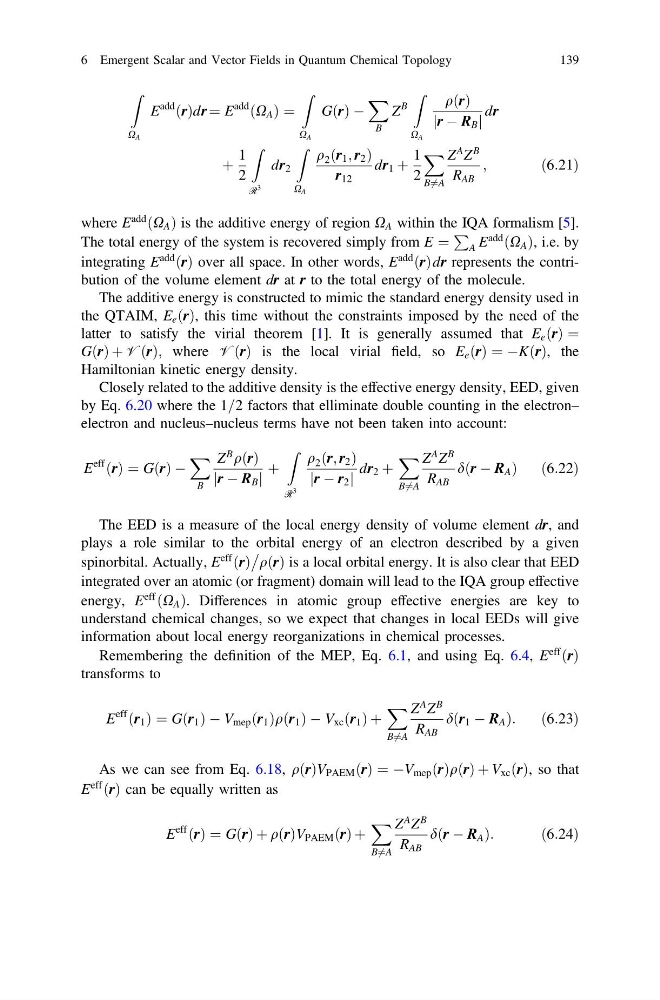
where E
add
X A
ð Þ is the additive energy of region X A within the IQA formalism [5].
The total energy of the system is recovered simply from E ¼
P
A E
add
X A
ð Þ, i.e. by
integrating E
add r
ð Þ over all space. In other words, E
add r
ð Þdr represents the contribution of the volume element dr at r to the total energy of the molecule.
The additive energy is constructed to mimic the standard energy density used in
the QTAIM, E e r
ð Þ, this time without the constraints imposed by the need of the
latter to satisfy the virial theorem [1]. It is generally assumed that E e ðrÞ ¼
GðrÞ þ VðrÞ; where VðrÞ is the local virial field, so E e r
ð Þ ¼ ÀK r
ð Þ, the
Hamiltonian kinetic energy density.
Closely related to the additive density is the effective energy density, EED, given
by Eq. 6.20 where the 1=2 factors that elliminate double counting in the electron–
electron and nucleus–nucleus terms have not been taken into account:
E
eff
ðrÞ ¼ GðrÞ À
X
B
Z
B
qðrÞ
jr À R B j
þ
Z
R
3
q 2 ðr; r 2 Þ
jr À r 2 j
dr 2 þ
X
B6 ¼A
Z
A Z
B
R AB
dðr À R A Þ
ð6:22Þ
The EED is a measure of the local energy density of volume element dr, and
plays a role similar to the orbital energy of an electron described by a given
spinorbital. Actually, E
eff r
ð Þ
q r
ð Þ is a local orbital energy. It is also clear that EED
integrated over an atomic (or fragment) domain will lead to the IQA group effective
energy, E
eff
X A
ð Þ. Differences in atomic group effective energies are key to
understand chemical changes, so we expect that changes in local EEDs will give
information about local energy reorganizations in chemical processes.
Remembering the definition of the MEP, Eq. 6.1, and using Eq. 6.4, E
eff r
ð Þ
transforms to
E
eff r 1
ð Þ ¼ G r 1
ð Þ À V mep r 1
ð Þq r 1
ð Þ À V xc r 1
ð Þþ
X
B6 ¼A
Z
A Z
B
R AB
d r 1 À R A
ð
Þ :
ð6:23Þ
As we can see from Eq. 6.18, q r
ð ÞV PAEM r
ð Þ ¼ ÀV mep r
ð Þq r
ð Þ þ V xc r
ð Þ, so that
E
eff r
ð Þ can be equally written as
E
eff r
ð Þ ¼ G r
ð Þ þ q r
ð ÞV PAEM r
ð Þ þ
X
B6 ¼A
Z
A Z
B
R AB
d r À R A
ð
Þ:
ð6:24Þ
6 Emergent Scalar and Vector Fields in Quantum Chemical Topology
139
X A
E
add
ðrÞdr ¼ E
add
ðX A Þ ¼
Z
X A
GðrÞ À
X
B
Z
B
Z
X A
qðrÞ
jr À R B j
dr
þ
1
2
Z
R
3
dr 2
Z
X A
q 2 ðr 1 ; r 2 Þ
r 12
dr 1 þ
1
2
X
B6 ¼A
Z
A Z
B
R AB
;
ð6:21Þ
where E
add
X A
ð Þ is the additive energy of region X A within the IQA formalism [5].
The total energy of the system is recovered simply from E ¼
P
A E
add
X A
ð Þ, i.e. by
integrating E
add r
ð Þ over all space. In other words, E
add r
ð Þdr represents the contribution of the volume element dr at r to the total energy of the molecule.
The additive energy is constructed to mimic the standard energy density used in
the QTAIM, E e r
ð Þ, this time without the constraints imposed by the need of the
latter to satisfy the virial theorem [1]. It is generally assumed that E e ðrÞ ¼
GðrÞ þ VðrÞ; where VðrÞ is the local virial field, so E e r
ð Þ ¼ ÀK r
ð Þ, the
Hamiltonian kinetic energy density.
Closely related to the additive density is the effective energy density, EED, given
by Eq. 6.20 where the 1=2 factors that elliminate double counting in the electron–
electron and nucleus–nucleus terms have not been taken into account:
E
eff
ðrÞ ¼ GðrÞ À
X
B
Z
B
qðrÞ
jr À R B j
þ
Z
R
3
q 2 ðr; r 2 Þ
jr À r 2 j
dr 2 þ
X
B6 ¼A
Z
A Z
B
R AB
dðr À R A Þ
ð6:22Þ
The EED is a measure of the local energy density of volume element dr, and
plays a role similar to the orbital energy of an electron described by a given
spinorbital. Actually, E
eff r
ð Þ
q r
ð Þ is a local orbital energy. It is also clear that EED
integrated over an atomic (or fragment) domain will lead to the IQA group effective
energy, E
eff
X A
ð Þ. Differences in atomic group effective energies are key to
understand chemical changes, so we expect that changes in local EEDs will give
information about local energy reorganizations in chemical processes.
Remembering the definition of the MEP, Eq. 6.1, and using Eq. 6.4, E
eff r
ð Þ
transforms to
E
eff r 1
ð Þ ¼ G r 1
ð Þ À V mep r 1
ð Þq r 1
ð Þ À V xc r 1
ð Þþ
X
B6 ¼A
Z
A Z
B
R AB
d r 1 À R A
ð
Þ :
ð6:23Þ
As we can see from Eq. 6.18, q r
ð ÞV PAEM r
ð Þ ¼ ÀV mep r
ð Þq r
ð Þ þ V xc r
ð Þ, so that
E
eff r
ð Þ can be equally written as
E
eff r
ð Þ ¼ G r
ð Þ þ q r
ð ÞV PAEM r
ð Þ þ
X
B6 ¼A
Z
A Z
B
R AB
d r À R A
ð
Þ:
ð6:24Þ
6 Emergent Scalar and Vector Fields in Quantum Chemical Topology
139