

energy of an external unit charge with the whole molecule. Second, V PAEM r
ð Þ
contains the xc interaction energy of the target electron with all the other electrons,
a quantum effect, while there is no such xc effect in ÀV mep r
ð Þ. Third and finally, the
second term in Eq. 6.18 also includes the self-interaction of the considered electron
with itself that is canceled by that which is contained in the electronic part of
V mep r
ð Þ.
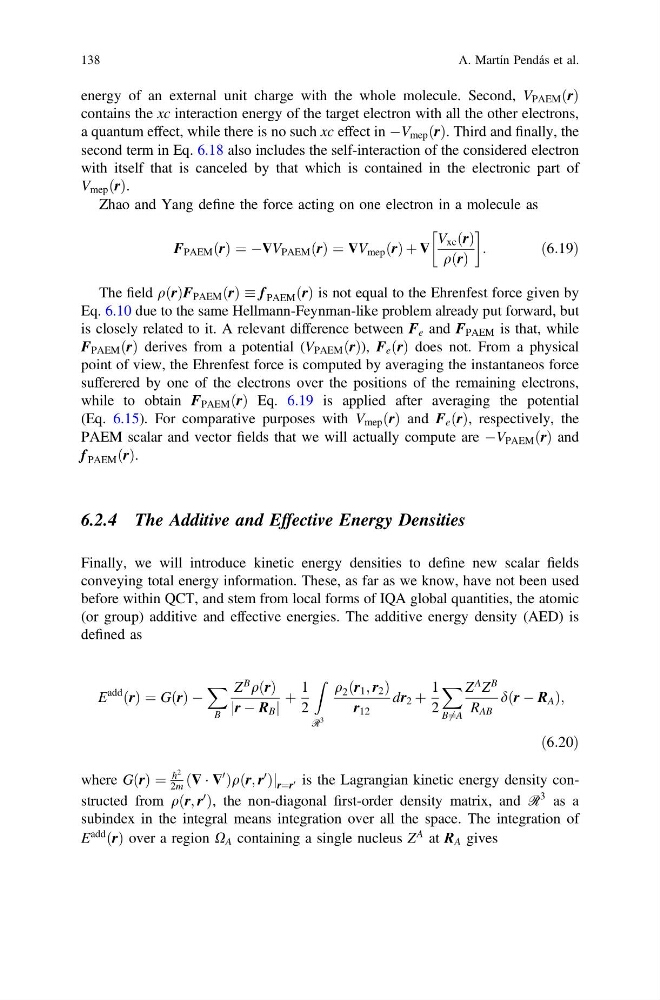
Zhao and Yang define the force acting on one electron in a molecule as
F PAEM r
ð Þ ¼ À$V PAEM r
ð Þ ¼ $V mep r
ð Þ þ $
V xc r
ð Þ
q r
ð Þ
!
:
ð6:19Þ
The field q r
ð ÞF PAEM r
ð Þ f PAEM r
ð Þ is not equal to the Ehrenfest force given by
Eq. 6.10 due to the same Hellmann-Feynman-like problem already put forward, but
is closely related to it. A relevant difference between F e and F PAEM is that, while
F PAEM r
ð Þ derives from a potential (V PAEM r
ð Þ), F e r
ð Þ does not. From a physical
point of view, the Ehrenfest force is computed by averaging the instantaneos force
sufferered by one of the electrons over the positions of the remaining electrons,
while to obtain F PAEM r
ð Þ Eq. 6.19 is applied after averaging the potential
(Eq. 6.15). For comparative purposes with V mep r
ð Þ and F e ðrÞ, respectively, the
PAEM scalar and vector fields that we will actually compute are ÀV PAEM r
ð Þ and
f PAEM r
ð Þ.
6.2.4 The Additive and Effective Energy Densities
Finally, we will introduce kinetic energy densities to define new scalar fields
conveying total energy information. These, as far as we know, have not been used
before within QCT, and stem from local forms of IQA global quantities, the atomic
(or group) additive and effective energies. The additive energy density (AED) is
defined as
E
add
ðrÞ ¼ GðrÞ À
X
B
Z
B
qðrÞ
jr À R B j
þ
1
2
Z
R
3
q 2 ðr 1 ; r 2 Þ
r 12
dr 2 þ
1
2
X
B6 ¼A
Z
A Z
B
R AB
dðr À R A Þ;
ð6:20Þ
where G r
ð Þ ¼
h
2
2m $ Á $
0
ð
Þq r; r
0
ð Þj r¼r 0 is the Lagrangian kinetic energy density constructed from q r; r
0
ð Þ, the non-diagonal first-order density matrix, and R
3 as a
subindex in the integral means integration over all the space. The integration of
E
add r
ð Þ over a region X A containing a single nucleus Z
A at R A gives
138
A. Martín Pendás et al.
ð Þ
contains the xc interaction energy of the target electron with all the other electrons,
a quantum effect, while there is no such xc effect in ÀV mep r
ð Þ. Third and finally, the
second term in Eq. 6.18 also includes the self-interaction of the considered electron
with itself that is canceled by that which is contained in the electronic part of
V mep r
ð Þ.
Zhao and Yang define the force acting on one electron in a molecule as
F PAEM r
ð Þ ¼ À$V PAEM r
ð Þ ¼ $V mep r
ð Þ þ $
V xc r
ð Þ
q r
ð Þ
!
:
ð6:19Þ
The field q r
ð ÞF PAEM r
ð Þ f PAEM r
ð Þ is not equal to the Ehrenfest force given by
Eq. 6.10 due to the same Hellmann-Feynman-like problem already put forward, but
is closely related to it. A relevant difference between F e and F PAEM is that, while
F PAEM r
ð Þ derives from a potential (V PAEM r
ð Þ), F e r
ð Þ does not. From a physical
point of view, the Ehrenfest force is computed by averaging the instantaneos force
sufferered by one of the electrons over the positions of the remaining electrons,
while to obtain F PAEM r
ð Þ Eq. 6.19 is applied after averaging the potential
(Eq. 6.15). For comparative purposes with V mep r
ð Þ and F e ðrÞ, respectively, the
PAEM scalar and vector fields that we will actually compute are ÀV PAEM r
ð Þ and
f PAEM r
ð Þ.
6.2.4 The Additive and Effective Energy Densities
Finally, we will introduce kinetic energy densities to define new scalar fields
conveying total energy information. These, as far as we know, have not been used
before within QCT, and stem from local forms of IQA global quantities, the atomic
(or group) additive and effective energies. The additive energy density (AED) is
defined as
E
add
ðrÞ ¼ GðrÞ À
X
B
Z
B
qðrÞ
jr À R B j
þ
1
2
Z
R
3
q 2 ðr 1 ; r 2 Þ
r 12
dr 2 þ
1
2
X
B6 ¼A
Z
A Z
B
R AB
dðr À R A Þ;
ð6:20Þ
where G r
ð Þ ¼
h
2
2m $ Á $
0
ð
Þq r; r
0
ð Þj r¼r 0 is the Lagrangian kinetic energy density constructed from q r; r
0
ð Þ, the non-diagonal first-order density matrix, and R
3 as a
subindex in the integral means integration over all the space. The integration of
E
add r
ð Þ over a region X A containing a single nucleus Z
A at R A gives
138
A. Martín Pendás et al.