

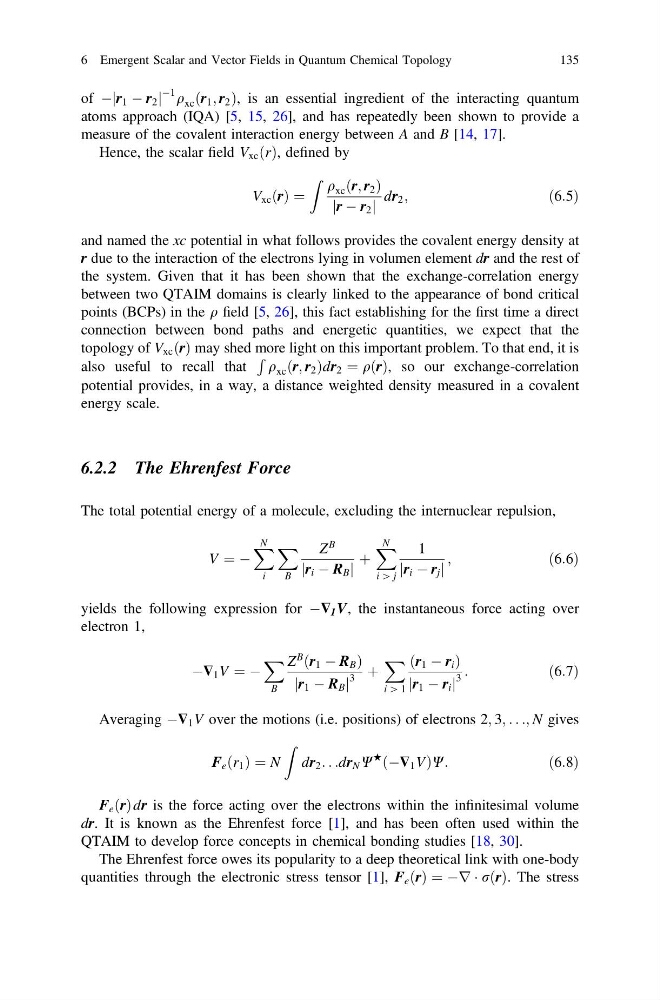
of Àjr 1 À r 2 j
À1 q xc r 1 ; r 2
ð
Þ, is an essential ingredient of the interacting quantum
atoms approach (IQA) [5, 15, 26], and has repeatedly been shown to provide a
measure of the covalent interaction energy between A and B [14, 17].
Hence, the scalar field V xc r
ð Þ, defined by
V xc ðrÞ ¼
Z q xc r; r 2
ð
Þ
jr À r 2 j
dr 2 ;
ð6:5Þ
and named the xc potential in what follows provides the covalent energy density at
r due to the interaction of the electrons lying in volumen element dr and the rest of
the system. Given that it has been shown that the exchange-correlation energy
between two QTAIM domains is clearly linked to the appearance of bond critical
points (BCPs) in the q field [5, 26], this fact establishing for the first time a direct
connection between bond paths and energetic quantities, we expect that the
topology of V xc r
ð Þ may shed more light on this important problem. To that end, it is
also useful to recall that
R q xc r; r 2
ð
Þdr 2 ¼ q r
ð Þ, so our exchange-correlation
potential provides, in a way, a distance weighted density measured in a covalent
energy scale.
6.2.2 The Ehrenfest Force
The total potential energy of a molecule, excluding the internuclear repulsion,
V ¼ À
X N
i
X
B
Z
B
jr i À R B j
þ
X N
i [ j
1
jr i À r j j
;
ð6:6Þ
yields the following expression for À$ 1 V, the instantaneous force acting over
electron 1,
À$ 1 V ¼ À
X
B
Z
B r 1 À R B
ð
Þ
jr 1 À R B j
3
þ
X
i [ 1
r 1 À r i
ð
Þ
jr 1 À r i j
3
:
ð6:7Þ
Averaging À$ 1 V over the motions (i.e. positions) of electrons 2; 3; . . .; N gives
F e r 1
ð Þ ¼ N
Z
dr 2 . . .dr N W
H
À$ 1 V
ð
ÞW:
ð6:8Þ
F e r
ð Þdr is the force acting over the electrons within the infinitesimal volume
dr. It is known as the Ehrenfest force [1], and has been often used within the
QTAIM to develop force concepts in chemical bonding studies [18, 30].
The Ehrenfest force owes its popularity to a deep theoretical link with one-body
quantities through the electronic stress tensor [1], F e r
ð Þ ¼ Àr Á r r
ð Þ. The stress
6 Emergent Scalar and Vector Fields in Quantum Chemical Topology
135
À1 q xc r 1 ; r 2
ð
Þ, is an essential ingredient of the interacting quantum
atoms approach (IQA) [5, 15, 26], and has repeatedly been shown to provide a
measure of the covalent interaction energy between A and B [14, 17].
Hence, the scalar field V xc r
ð Þ, defined by
V xc ðrÞ ¼
Z q xc r; r 2
ð
Þ
jr À r 2 j
dr 2 ;
ð6:5Þ
and named the xc potential in what follows provides the covalent energy density at
r due to the interaction of the electrons lying in volumen element dr and the rest of
the system. Given that it has been shown that the exchange-correlation energy
between two QTAIM domains is clearly linked to the appearance of bond critical
points (BCPs) in the q field [5, 26], this fact establishing for the first time a direct
connection between bond paths and energetic quantities, we expect that the
topology of V xc r
ð Þ may shed more light on this important problem. To that end, it is
also useful to recall that
R q xc r; r 2
ð
Þdr 2 ¼ q r
ð Þ, so our exchange-correlation
potential provides, in a way, a distance weighted density measured in a covalent
energy scale.
6.2.2 The Ehrenfest Force
The total potential energy of a molecule, excluding the internuclear repulsion,
V ¼ À
X N
i
X
B
Z
B
jr i À R B j
þ
X N
i [ j
1
jr i À r j j
;
ð6:6Þ
yields the following expression for À$ 1 V, the instantaneous force acting over
electron 1,
À$ 1 V ¼ À
X
B
Z
B r 1 À R B
ð
Þ
jr 1 À R B j
3
þ
X
i [ 1
r 1 À r i
ð
Þ
jr 1 À r i j
3
:
ð6:7Þ
Averaging À$ 1 V over the motions (i.e. positions) of electrons 2; 3; . . .; N gives
F e r 1
ð Þ ¼ N
Z
dr 2 . . .dr N W
H
À$ 1 V
ð
ÞW:
ð6:8Þ
F e r
ð Þdr is the force acting over the electrons within the infinitesimal volume
dr. It is known as the Ehrenfest force [1], and has been often used within the
QTAIM to develop force concepts in chemical bonding studies [18, 30].
The Ehrenfest force owes its popularity to a deep theoretical link with one-body
quantities through the electronic stress tensor [1], F e r
ð Þ ¼ Àr Á r r
ð Þ. The stress
6 Emergent Scalar and Vector Fields in Quantum Chemical Topology
135