

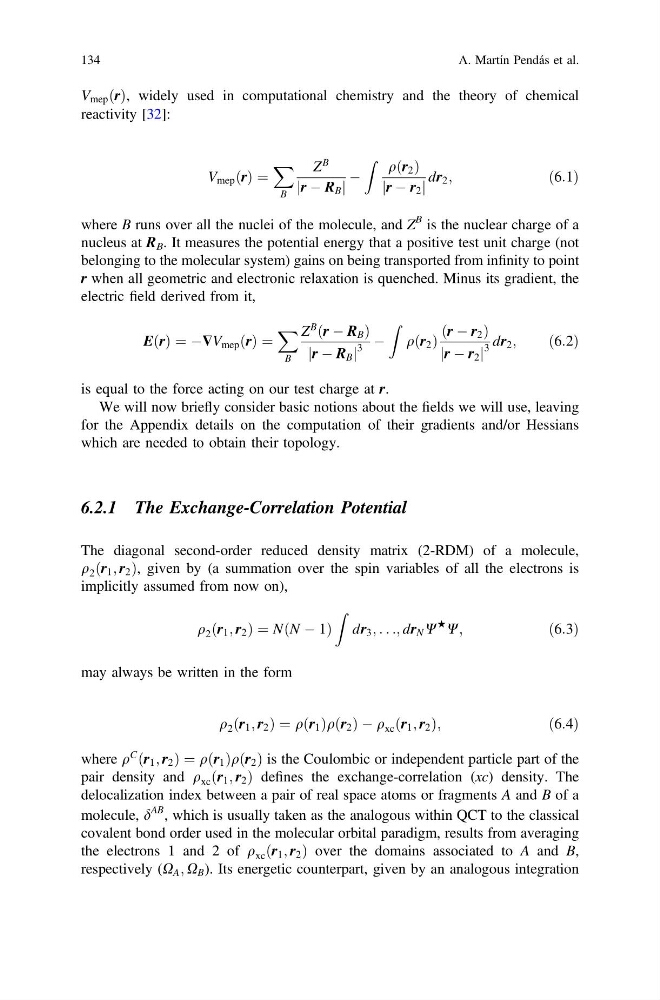
V mep r
ð Þ, widely used in computational chemistry and the theory of chemical
reactivity [32]:
V mep r
ð Þ ¼
X
B
Z
B
jr À R B j
À
Z q r 2
ð Þ
jr À r 2 j
dr 2 ;
ð6:1Þ
where B runs over all the nuclei of the molecule, and Z
B is the nuclear charge of a
nucleus at R B . It measures the potential energy that a positive test unit charge (not
belonging to the molecular system) gains on being transported from infinity to point
r when all geometric and electronic relaxation is quenched. Minus its gradient, the
electric field derived from it,
EðrÞ ¼ À$V mep r
ð Þ ¼
X
B
Z
B r À R B
ð
Þ
jr À R B j
3
À
Z
q r 2
ð Þ
r À r 2
ð
Þ
jr À r 2 j
3
dr 2 ;
ð6:2Þ
is equal to the force acting on our test charge at r.
We will now briefly consider basic notions about the fields we will use, leaving
for the Appendix details on the computation of their gradients and/or Hessians
which are needed to obtain their topology.
6.2.1 The Exchange-Correlation Potential
The diagonal second-order reduced density matrix (2-RDM) of a molecule,
q 2 r 1 ; r 2
ð
Þ, given by (a summation over the spin variables of all the electrons is
implicitly assumed from now on),
q 2 r 1 ; r 2
ð
Þ¼N N À 1
ð
Þ
Z
dr 3 ; . . .; dr N W
H
W;
ð6:3Þ
may always be written in the form
q 2 r 1 ; r 2
ð
Þ¼q r 1
ð Þq r 2
ð Þ À q xc r 1 ; r 2
ð
Þ;
ð6:4Þ
where q
C r 1 ; r 2
ð
Þ¼q r 1
ð Þq r 2
ð Þ is the Coulombic or independent particle part of the
pair density and q xc r 1 ; r 2
ð
Þ defines the exchange-correlation (xc) density. The
delocalization index between a pair of real space atoms or fragments A and B of a
molecule, d
AB , which is usually taken as the analogous within QCT to the classical
covalent bond order used in the molecular orbital paradigm, results from averaging
the electrons 1 and 2 of q xc r 1 ; r 2
ð
Þ over the domains associated to A and B,
respectively (X A ; X B ). Its energetic counterpart, given by an analogous integration
134
A. Martín Pendás et al.
ð Þ, widely used in computational chemistry and the theory of chemical
reactivity [32]:
V mep r
ð Þ ¼
X
B
Z
B
jr À R B j
À
Z q r 2
ð Þ
jr À r 2 j
dr 2 ;
ð6:1Þ
where B runs over all the nuclei of the molecule, and Z
B is the nuclear charge of a
nucleus at R B . It measures the potential energy that a positive test unit charge (not
belonging to the molecular system) gains on being transported from infinity to point
r when all geometric and electronic relaxation is quenched. Minus its gradient, the
electric field derived from it,
EðrÞ ¼ À$V mep r
ð Þ ¼
X
B
Z
B r À R B
ð
Þ
jr À R B j
3
À
Z
q r 2
ð Þ
r À r 2
ð
Þ
jr À r 2 j
3
dr 2 ;
ð6:2Þ
is equal to the force acting on our test charge at r.
We will now briefly consider basic notions about the fields we will use, leaving
for the Appendix details on the computation of their gradients and/or Hessians
which are needed to obtain their topology.
6.2.1 The Exchange-Correlation Potential
The diagonal second-order reduced density matrix (2-RDM) of a molecule,
q 2 r 1 ; r 2
ð
Þ, given by (a summation over the spin variables of all the electrons is
implicitly assumed from now on),
q 2 r 1 ; r 2
ð
Þ¼N N À 1
ð
Þ
Z
dr 3 ; . . .; dr N W
H
W;
ð6:3Þ
may always be written in the form
q 2 r 1 ; r 2
ð
Þ¼q r 1
ð Þq r 2
ð Þ À q xc r 1 ; r 2
ð
Þ;
ð6:4Þ
where q
C r 1 ; r 2
ð
Þ¼q r 1
ð Þq r 2
ð Þ is the Coulombic or independent particle part of the
pair density and q xc r 1 ; r 2
ð
Þ defines the exchange-correlation (xc) density. The
delocalization index between a pair of real space atoms or fragments A and B of a
molecule, d
AB , which is usually taken as the analogous within QCT to the classical
covalent bond order used in the molecular orbital paradigm, results from averaging
the electrons 1 and 2 of q xc r 1 ; r 2
ð
Þ over the domains associated to A and B,
respectively (X A ; X B ). Its energetic counterpart, given by an analogous integration
134
A. Martín Pendás et al.