

much larger in magnitude than the s value at rp, but not as large as the individual
atomic contributions because of the opposing contributions from their covalently
bonded atoms. At last, while the SF contributions from the H atoms of the terminal
CH 2
• group to the C11–H13 bcp density markedly differ between each other, and
with that from H13 being almost 14 times as large as the one from H12, this is not
at all the same for the corresponding SF S contributions. The latter are more comparable in magnitude, as that from H13 is only three times as large as that from H12
atom, which is not directly related to the bcp taken as rp. It is clear, from such data,
that the spin density at C–H bcp originates from much less local sources than it is
for its corresponding electron density.
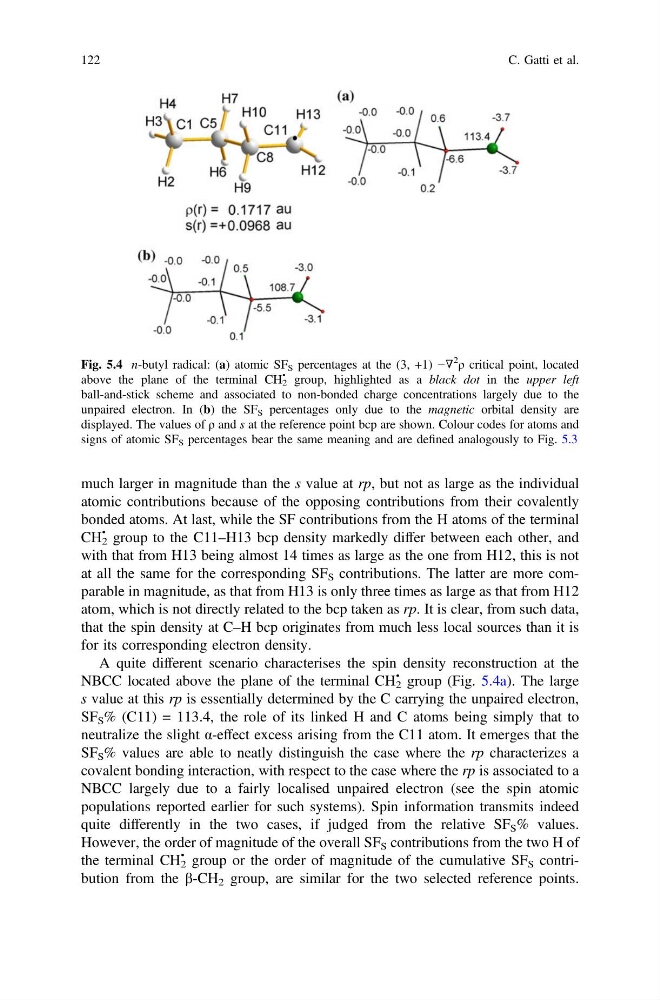
A quite different scenario characterises the spin density reconstruction at the
NBCC located above the plane of the terminal CH 2
• group (Fig. 5.4a). The large
s value at this rp is essentially determined by the C carrying the unpaired electron,
SF S % (C11) = 113.4, the role of its linked H and C atoms being simply that to
neutralize the slight α-effect excess arising from the C11 atom. It emerges that the
SF S % values are able to neatly distinguish the case where the rp characterizes a
covalent bonding interaction, with respect to the case where the rp is associated to a
NBCC largely due to a fairly localised unpaired electron (see the spin atomic
populations reported earlier for such systems). Spin information transmits indeed
quite differently in the two cases, if judged from the relative SF S % values.
However, the order of magnitude of the overall SF S contributions from the two H of
the terminal CH 2
• group or the order of magnitude of the cumulative SF S contribution from the β-CH 2 group, are similar for the two selected reference points.
Fig. 5.4 n-butyl radical: (a) atomic SF S percentages at the (3, +1) −∇
2
ρ critical point, located
above the plane of the terminal CH 2
• group, highlighted as a black dot in the upper left
ball-and-stick scheme and associated to non-bonded charge concentrations largely due to the
unpaired electron. In (b) the SF S percentages only due to the magnetic orbital density are
displayed. The values of ρ and s at the reference point bcp are shown. Colour codes for atoms and
signs of atomic SF S percentages bear the same meaning and are defined analogously to Fig. 5.3
122
C. Gatti et al.
atomic contributions because of the opposing contributions from their covalently
bonded atoms. At last, while the SF contributions from the H atoms of the terminal
CH 2
• group to the C11–H13 bcp density markedly differ between each other, and
with that from H13 being almost 14 times as large as the one from H12, this is not
at all the same for the corresponding SF S contributions. The latter are more comparable in magnitude, as that from H13 is only three times as large as that from H12
atom, which is not directly related to the bcp taken as rp. It is clear, from such data,
that the spin density at C–H bcp originates from much less local sources than it is
for its corresponding electron density.
A quite different scenario characterises the spin density reconstruction at the
NBCC located above the plane of the terminal CH 2
• group (Fig. 5.4a). The large
s value at this rp is essentially determined by the C carrying the unpaired electron,
SF S % (C11) = 113.4, the role of its linked H and C atoms being simply that to
neutralize the slight α-effect excess arising from the C11 atom. It emerges that the
SF S % values are able to neatly distinguish the case where the rp characterizes a
covalent bonding interaction, with respect to the case where the rp is associated to a
NBCC largely due to a fairly localised unpaired electron (see the spin atomic
populations reported earlier for such systems). Spin information transmits indeed
quite differently in the two cases, if judged from the relative SF S % values.
However, the order of magnitude of the overall SF S contributions from the two H of
the terminal CH 2
• group or the order of magnitude of the cumulative SF S contribution from the β-CH 2 group, are similar for the two selected reference points.
Fig. 5.4 n-butyl radical: (a) atomic SF S percentages at the (3, +1) −∇
2
ρ critical point, located
above the plane of the terminal CH 2
• group, highlighted as a black dot in the upper left
ball-and-stick scheme and associated to non-bonded charge concentrations largely due to the
unpaired electron. In (b) the SF S percentages only due to the magnetic orbital density are
displayed. The values of ρ and s at the reference point bcp are shown. Colour codes for atoms and
signs of atomic SF S percentages bear the same meaning and are defined analogously to Fig. 5.3
122
C. Gatti et al.