

(NBCCs). They are largely due to the unpaired electron, although they do not
correspond to electron spin density maxima.
At variance with the case of the terminal C–H bcp, the s value is large and
positive, s = 0.0968 au, at this NBCC. It is larger than half the density value,
ρ = 0.1717 au, and fully dominated by the overall α effect contribution, s = 0.1026,
from the terminal CH 2
• group. The role of the remaining part of the molecule is just
that of slightly counteracting such contribution through a comparatively modest
overall β effect (s = −0.0058) at the NBCC. In summary, though transferability
holds true for both the electron and the electron spin density in n-alkyl radicals, it
realizes in quite different ways and largely dependent on the selected rp.
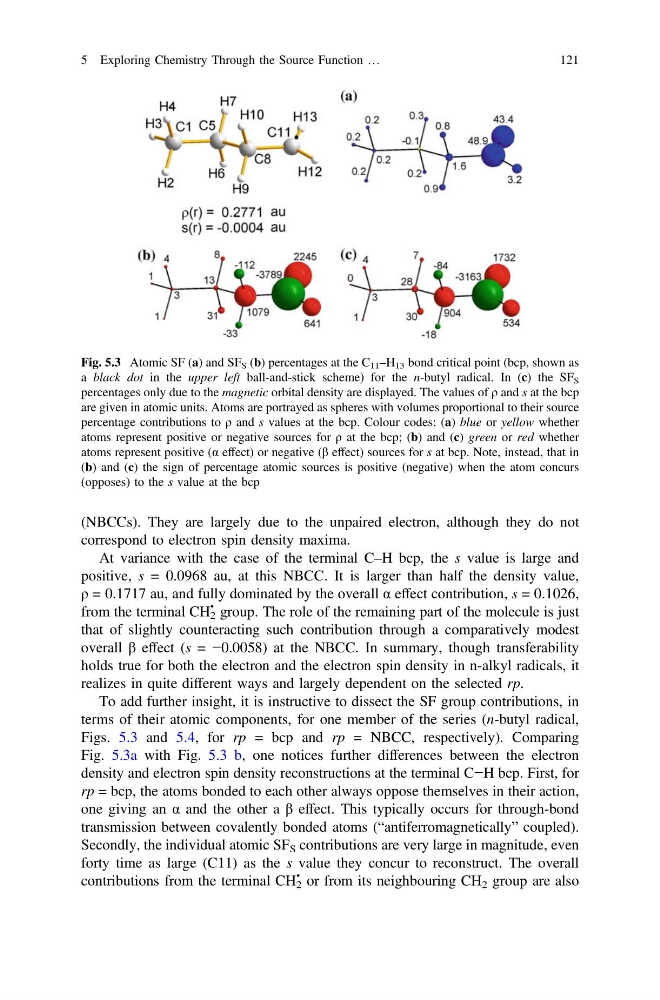
To add further insight, it is instructive to dissect the SF group contributions, in
terms of their atomic components, for one member of the series (n-butyl radical,
Figs. 5.3 and 5.4, for rp = bcp and rp = NBCC, respectively). Comparing
Fig. 5.3a with Fig. 5.3 b, one notices further differences between the electron
density and electron spin density reconstructions at the terminal C−H bcp. First, for
rp = bcp, the atoms bonded to each other always oppose themselves in their action,
one giving an α and the other a β effect. This typically occurs for through-bond
transmission between covalently bonded atoms (“antiferromagnetically” coupled).
Secondly, the individual atomic SF S contributions are very large in magnitude, even
forty time as large (C11) as the s value they concur to reconstruct. The overall
contributions from the terminal CH 2
• or from its neighbouring CH 2 group are also
Fig. 5.3 Atomic SF (a) and SF S (b) percentages at the C 11 –H 13 bond critical point (bcp, shown as
a black dot in the upper left ball-and-stick scheme) for the n-butyl radical. In (c) the SF S
percentages only due to the magnetic orbital density are displayed. The values of ρ and s at the bcp
are given in atomic units. Atoms are portrayed as spheres with volumes proportional to their source
percentage contributions to ρ and s values at the bcp. Colour codes: (a) blue or yellow whether
atoms represent positive or negative sources for ρ at the bcp; (b) and (c) green or red whether
atoms represent positive (α effect) or negative (β effect) sources for s at bcp. Note, instead, that in
(b) and (c) the sign of percentage atomic sources is positive (negative) when the atom concurs
(opposes) to the s value at the bcp
5 Exploring Chemistry Through the Source Function …
121
correspond to electron spin density maxima.
At variance with the case of the terminal C–H bcp, the s value is large and
positive, s = 0.0968 au, at this NBCC. It is larger than half the density value,
ρ = 0.1717 au, and fully dominated by the overall α effect contribution, s = 0.1026,
from the terminal CH 2
• group. The role of the remaining part of the molecule is just
that of slightly counteracting such contribution through a comparatively modest
overall β effect (s = −0.0058) at the NBCC. In summary, though transferability
holds true for both the electron and the electron spin density in n-alkyl radicals, it
realizes in quite different ways and largely dependent on the selected rp.
To add further insight, it is instructive to dissect the SF group contributions, in
terms of their atomic components, for one member of the series (n-butyl radical,
Figs. 5.3 and 5.4, for rp = bcp and rp = NBCC, respectively). Comparing
Fig. 5.3a with Fig. 5.3 b, one notices further differences between the electron
density and electron spin density reconstructions at the terminal C−H bcp. First, for
rp = bcp, the atoms bonded to each other always oppose themselves in their action,
one giving an α and the other a β effect. This typically occurs for through-bond
transmission between covalently bonded atoms (“antiferromagnetically” coupled).
Secondly, the individual atomic SF S contributions are very large in magnitude, even
forty time as large (C11) as the s value they concur to reconstruct. The overall
contributions from the terminal CH 2
• or from its neighbouring CH 2 group are also
Fig. 5.3 Atomic SF (a) and SF S (b) percentages at the C 11 –H 13 bond critical point (bcp, shown as
a black dot in the upper left ball-and-stick scheme) for the n-butyl radical. In (c) the SF S
percentages only due to the magnetic orbital density are displayed. The values of ρ and s at the bcp
are given in atomic units. Atoms are portrayed as spheres with volumes proportional to their source
percentage contributions to ρ and s values at the bcp. Colour codes: (a) blue or yellow whether
atoms represent positive or negative sources for ρ at the bcp; (b) and (c) green or red whether
atoms represent positive (α effect) or negative (β effect) sources for s at bcp. Note, instead, that in
(b) and (c) the sign of percentage atomic sources is positive (negative) when the atom concurs
(opposes) to the s value at the bcp
5 Exploring Chemistry Through the Source Function …
121