

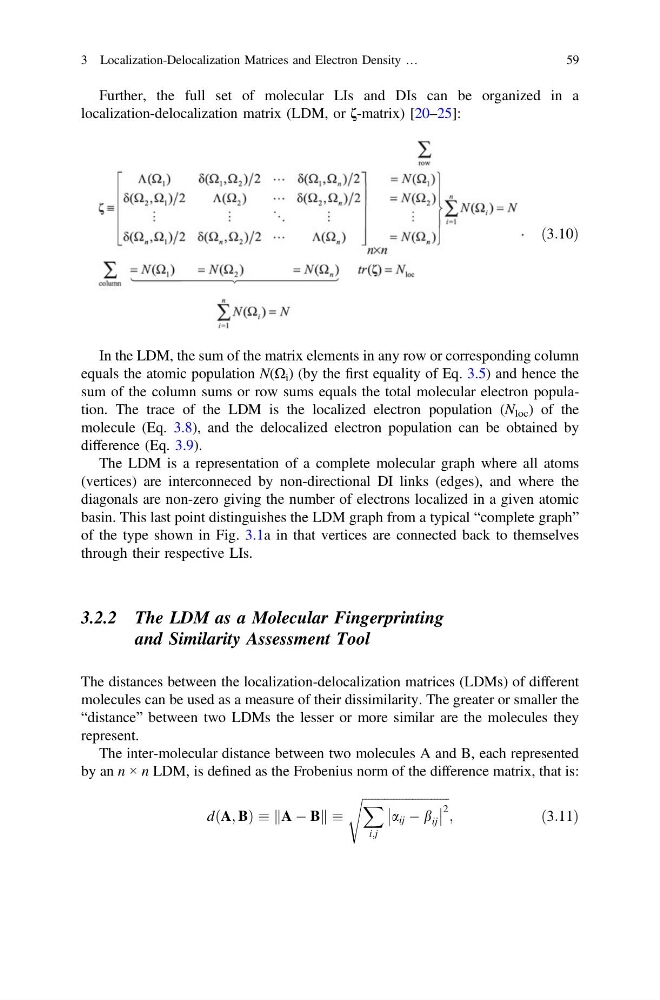
Further, the full set of molecular LIs and DIs can be organized in a
localization-delocalization matrix (LDM, or ζ-matrix) [20–25]:
ð3:10Þ
In the LDM, the sum of the matrix elements in any row or corresponding column
equals the atomic population N(Ω i ) (by the first equality of Eq. 3.5) and hence the
sum of the column sums or row sums equals the total molecular electron population. The trace of the LDM is the localized electron population (N loc ) of the
molecule (Eq. 3.8), and the delocalized electron population can be obtained by
difference (Eq. 3.9).
The LDM is a representation of a complete molecular graph where all atoms
(vertices) are interconneced by non-directional DI links (edges), and where the
diagonals are non-zero giving the number of electrons localized in a given atomic
basin. This last point distinguishes the LDM graph from a typical “complete graph”
of the type shown in Fig. 3.1a in that vertices are connected back to themselves
through their respective LIs.
3.2.2 The LDM as a Molecular Fingerprinting
and Similarity Assessment Tool
The distances between the localization-delocalization matrices (LDMs) of different
molecules can be used as a measure of their dissimilarity. The greater or smaller the
“distance” between two LDMs the lesser or more similar are the molecules they
represent.
The inter-molecular distance between two molecules A and B, each represented
by an n × n LDM, is defined as the Frobenius norm of the difference matrix, that is:
dðA; BÞ A À B
k
k
ffiffiffiffiffiffiffiffiffiffiffiffiffiffiffiffiffiffiffiffiffiffiffiffiffiffiffiffi X
i;j
a ij À b ij
2
s
;
ð3:11Þ
3 Localization-Delocalization Matrices and Electron Density …
59
localization-delocalization matrix (LDM, or ζ-matrix) [20–25]:
ð3:10Þ
In the LDM, the sum of the matrix elements in any row or corresponding column
equals the atomic population N(Ω i ) (by the first equality of Eq. 3.5) and hence the
sum of the column sums or row sums equals the total molecular electron population. The trace of the LDM is the localized electron population (N loc ) of the
molecule (Eq. 3.8), and the delocalized electron population can be obtained by
difference (Eq. 3.9).
The LDM is a representation of a complete molecular graph where all atoms
(vertices) are interconneced by non-directional DI links (edges), and where the
diagonals are non-zero giving the number of electrons localized in a given atomic
basin. This last point distinguishes the LDM graph from a typical “complete graph”
of the type shown in Fig. 3.1a in that vertices are connected back to themselves
through their respective LIs.
3.2.2 The LDM as a Molecular Fingerprinting
and Similarity Assessment Tool
The distances between the localization-delocalization matrices (LDMs) of different
molecules can be used as a measure of their dissimilarity. The greater or smaller the
“distance” between two LDMs the lesser or more similar are the molecules they
represent.
The inter-molecular distance between two molecules A and B, each represented
by an n × n LDM, is defined as the Frobenius norm of the difference matrix, that is:
dðA; BÞ A À B
k
k
ffiffiffiffiffiffiffiffiffiffiffiffiffiffiffiffiffiffiffiffiffiffiffiffiffiffiffiffi X
i;j
a ij À b ij
2
s
;
ð3:11Þ
3 Localization-Delocalization Matrices and Electron Density …
59