

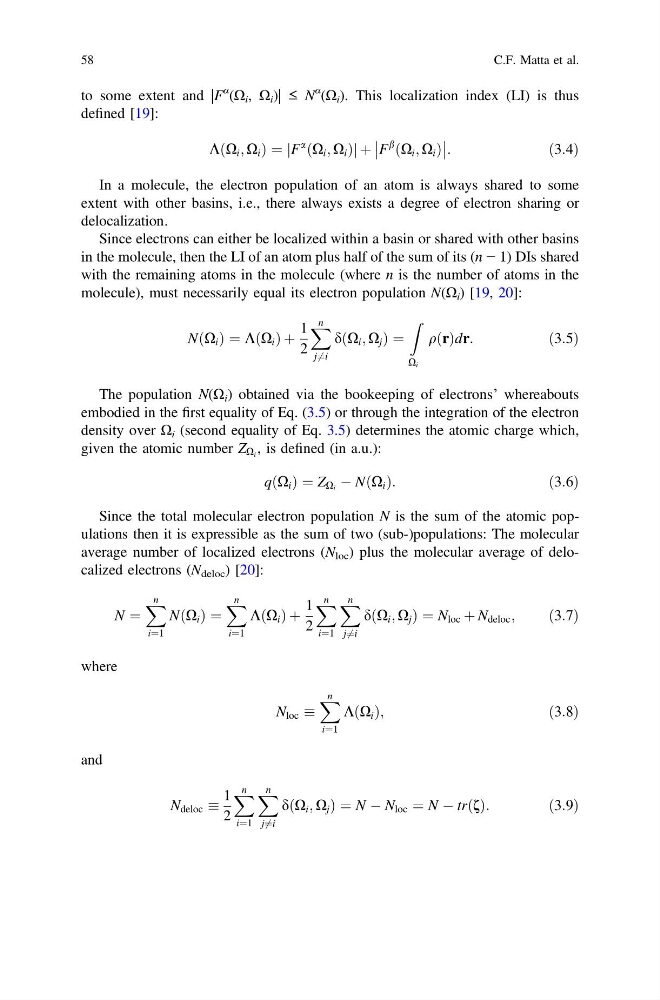
to some extent and |F
α (Ω i , Ω i )| ≤ N
α
(Ω i ). This localization index (LI) is thus
defined [19]:
KðX i ; X i Þ ¼ F
a
ðX i ; X i Þ
j
jþ F
b
ðX i ; X i Þ
:
ð3:4Þ
In a molecule, the electron population of an atom is always shared to some
extent with other basins, i.e., there always exists a degree of electron sharing or
delocalization.
Since electrons can either be localized within a basin or shared with other basins
in the molecule, then the LI of an atom plus half of the sum of its (n − 1) DIs shared
with the remaining atoms in the molecule (where n is the number of atoms in the
molecule), must necessarily equal its electron population N(Ω i ) [19, 20]:
NðX i Þ ¼ KðX i Þ þ
1
2
X n
j6 ¼i
dðX i ; X j Þ ¼
Z
X i
qðrÞdr:
ð3:5Þ
The population N(Ω i ) obtained via the bookeeping of electrons’ whereabouts
embodied in the first equality of Eq. (3.5) or through the integration of the electron
density over Ω i (second equality of Eq. 3.5) determines the atomic charge which,
given the atomic number Z X i , is defined (in a.u.):
qðX i Þ ¼ Z X i À NðX i Þ:
ð3:6Þ
Since the total molecular electron population N is the sum of the atomic populations then it is expressible as the sum of two (sub-)populations: The molecular
average number of localized electrons (N loc ) plus the molecular average of delocalized electrons (N deloc ) [20]:
N ¼
X n
i¼1
NðX i Þ ¼
X n
i¼1
KðX i Þ þ
1
2
X n
i¼1
X n
j6 ¼i
dðX i ; X j Þ ¼ N loc þ N deloc ;
ð3:7Þ
where
N loc
X n
i¼1
KðX i Þ;
ð3:8Þ
and
N deloc
1
2
X n
i¼1
X n
j6 ¼i
dðX i ; X j Þ ¼ N À N loc ¼ N À trðfÞ:
ð3:9Þ
58
C.F. Matta et al.
α (Ω i , Ω i )| ≤ N
α
(Ω i ). This localization index (LI) is thus
defined [19]:
KðX i ; X i Þ ¼ F
a
ðX i ; X i Þ
j
jþ F
b
ðX i ; X i Þ
:
ð3:4Þ
In a molecule, the electron population of an atom is always shared to some
extent with other basins, i.e., there always exists a degree of electron sharing or
delocalization.
Since electrons can either be localized within a basin or shared with other basins
in the molecule, then the LI of an atom plus half of the sum of its (n − 1) DIs shared
with the remaining atoms in the molecule (where n is the number of atoms in the
molecule), must necessarily equal its electron population N(Ω i ) [19, 20]:
NðX i Þ ¼ KðX i Þ þ
1
2
X n
j6 ¼i
dðX i ; X j Þ ¼
Z
X i
qðrÞdr:
ð3:5Þ
The population N(Ω i ) obtained via the bookeeping of electrons’ whereabouts
embodied in the first equality of Eq. (3.5) or through the integration of the electron
density over Ω i (second equality of Eq. 3.5) determines the atomic charge which,
given the atomic number Z X i , is defined (in a.u.):
qðX i Þ ¼ Z X i À NðX i Þ:
ð3:6Þ
Since the total molecular electron population N is the sum of the atomic populations then it is expressible as the sum of two (sub-)populations: The molecular
average number of localized electrons (N loc ) plus the molecular average of delocalized electrons (N deloc ) [20]:
N ¼
X n
i¼1
NðX i Þ ¼
X n
i¼1
KðX i Þ þ
1
2
X n
i¼1
X n
j6 ¼i
dðX i ; X j Þ ¼ N loc þ N deloc ;
ð3:7Þ
where
N loc
X n
i¼1
KðX i Þ;
ð3:8Þ
and
N deloc
1
2
X n
i¼1
X n
j6 ¼i
dðX i ; X j Þ ¼ N À N loc ¼ N À trðfÞ:
ð3:9Þ
58
C.F. Matta et al.