

Weinhold, who pioneered the natural bond orbital (NBO) method, writes in a paper
[75] dating from 1997: “A persistent theme of this work is that steric exchange
repulsion is not simply a sum of pairwise interactions between two electron pairs,
but rather a complex function of the entire N-electron distribution. The pattern of
orbital energy changes due to exchange repulsion is more complex than a simple
‘‘atom–atom repulsion’’ picture would suggest.” The contribution E intra has indeed
an imprint of the whole molecule, although it has a practical cut-off, which we call
the atomic horizon (see next paragraph and energetic transferability between triand penta-peptides).
Setting A = B in Eqs. 2.15 and 2.17 allows one to write the intra-atomic energy
of topological atom A as
E
A
intra ¼ T
A
þ V
AA
ee þ V
AA
en
ð2:19Þ
where T
A is its kinetic energy. The intra-atomic energy E
A
intra is the energy that a
single atom possesses inside a system, regardless of whether this system is a single
molecule or a cluster of molecules (including even ions). Work from our lab (to be
published in Molecular Physics 2016) shows that an oxygen, nitrogen or carbon has
the same energy, within maximum 2.3 kJmol
−1 , when appearing in a tri-peptide
(three amino acids) compared to appearing in a penta-peptide, with these peptides’
common nuclear skeleton in the same configuration. This energetic transferability
was observed in seven test cases, i.e. the homo-oligopeptides of Ala, Ser, Thr, Gly,
Val, Leu and Ile. This high degree of energetic transferability is an asset to QCT.
Transferability has also been detected [76] in terms of atomic charges by those who
develop alternative partitioning schemes (such as the Hirshfeld partitioning [77]
scheme and all its variants).
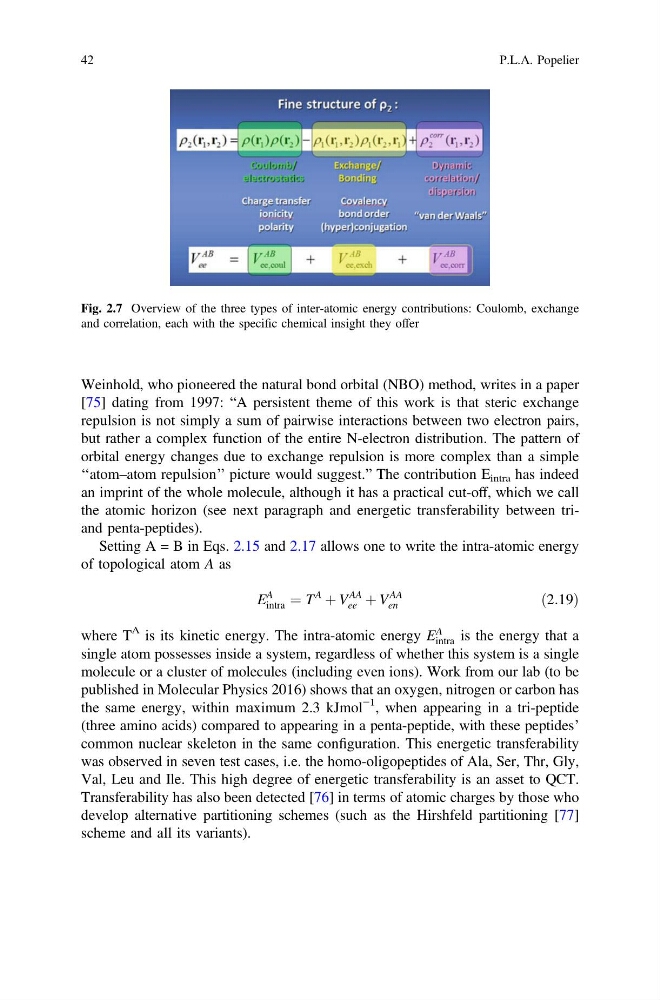
Fig. 2.7 Overview of the three types of inter-atomic energy contributions: Coulomb, exchange
and correlation, each with the specific chemical insight they offer
42
P.L.A. Popelier
[75] dating from 1997: “A persistent theme of this work is that steric exchange
repulsion is not simply a sum of pairwise interactions between two electron pairs,
but rather a complex function of the entire N-electron distribution. The pattern of
orbital energy changes due to exchange repulsion is more complex than a simple
‘‘atom–atom repulsion’’ picture would suggest.” The contribution E intra has indeed
an imprint of the whole molecule, although it has a practical cut-off, which we call
the atomic horizon (see next paragraph and energetic transferability between triand penta-peptides).
Setting A = B in Eqs. 2.15 and 2.17 allows one to write the intra-atomic energy
of topological atom A as
E
A
intra ¼ T
A
þ V
AA
ee þ V
AA
en
ð2:19Þ
where T
A is its kinetic energy. The intra-atomic energy E
A
intra is the energy that a
single atom possesses inside a system, regardless of whether this system is a single
molecule or a cluster of molecules (including even ions). Work from our lab (to be
published in Molecular Physics 2016) shows that an oxygen, nitrogen or carbon has
the same energy, within maximum 2.3 kJmol
−1 , when appearing in a tri-peptide
(three amino acids) compared to appearing in a penta-peptide, with these peptides’
common nuclear skeleton in the same configuration. This energetic transferability
was observed in seven test cases, i.e. the homo-oligopeptides of Ala, Ser, Thr, Gly,
Val, Leu and Ile. This high degree of energetic transferability is an asset to QCT.
Transferability has also been detected [76] in terms of atomic charges by those who
develop alternative partitioning schemes (such as the Hirshfeld partitioning [77]
scheme and all its variants).
Fig. 2.7 Overview of the three types of inter-atomic energy contributions: Coulomb, exchange
and correlation, each with the specific chemical insight they offer
42
P.L.A. Popelier