

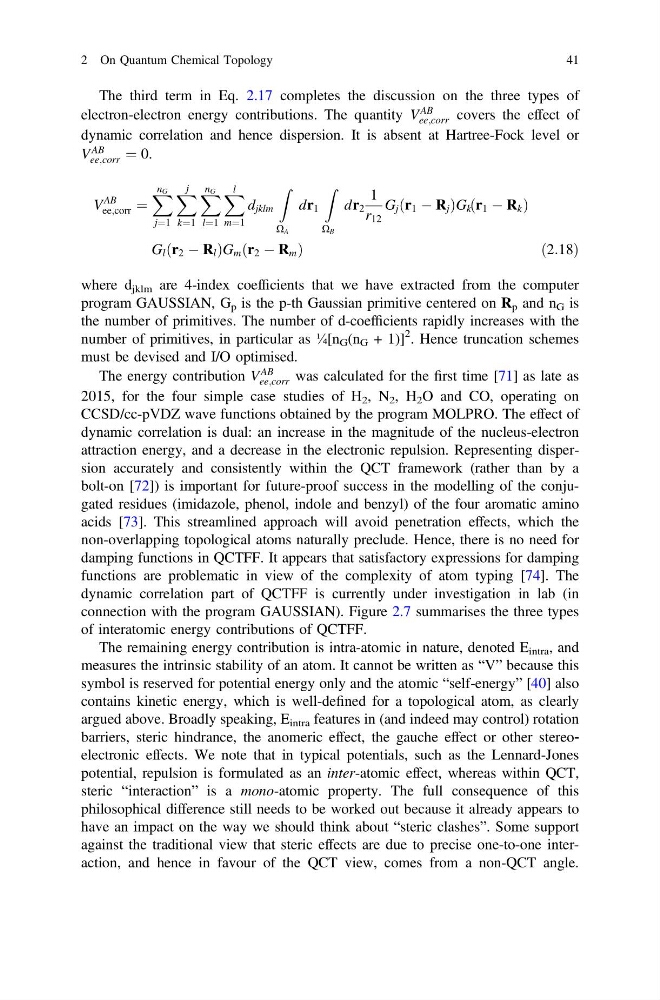
The third term in Eq. 2.17 completes the discussion on the three types of
electron-electron energy contributions. The quantity V
AB
ee;corr covers the effect of
dynamic correlation and hence dispersion. It is absent at Hartree-Fock level or
V
AB
ee;corr ¼ 0.
V
AB
ee;corr ¼
X n G
j¼1
X j
k¼1
X n G
l¼1
X l
m¼1
d jklm
Z
X A
dr 1
Z
X B
dr 2
1
r 12
G j ðr 1 À R j ÞG k ðr 1 À R k Þ
G l ðr 2 À R l ÞG m ðr 2 À R m Þ
ð 2:18Þ
where d jklm are 4-index coefficients that we have extracted from the computer
program GAUSSIAN, G p is the p-th Gaussian primitive centered on R p and n G is
the number of primitives. The number of d-coefficients rapidly increases with the
number of primitives, in particular as ¼[n G (n G + 1)]
2 . Hence truncation schemes
must be devised and I/O optimised.
The energy contribution V
AB
ee;corr was calculated for the first time [71] as late as
2015, for the four simple case studies of H 2 , N 2 , H 2 O and CO, operating on
CCSD/cc-pVDZ wave functions obtained by the program MOLPRO. The effect of
dynamic correlation is dual: an increase in the magnitude of the nucleus-electron
attraction energy, and a decrease in the electronic repulsion. Representing dispersion accurately and consistently within the QCT framework (rather than by a
bolt-on [72]) is important for future-proof success in the modelling of the conjugated residues (imidazole, phenol, indole and benzyl) of the four aromatic amino
acids [73]. This streamlined approach will avoid penetration effects, which the
non-overlapping topological atoms naturally preclude. Hence, there is no need for
damping functions in QCTFF. It appears that satisfactory expressions for damping
functions are problematic in view of the complexity of atom typing [74]. The
dynamic correlation part of QCTFF is currently under investigation in lab (in
connection with the program GAUSSIAN). Figure 2.7 summarises the three types
of interatomic energy contributions of QCTFF.
The remaining energy contribution is intra-atomic in nature, denoted E intra , and
measures the intrinsic stability of an atom. It cannot be written as “V” because this
symbol is reserved for potential energy only and the atomic “self-energy” [40] also
contains kinetic energy, which is well-defined for a topological atom, as clearly
argued above. Broadly speaking, E intra features in (and indeed may control) rotation
barriers, steric hindrance, the anomeric effect, the gauche effect or other stereo‐
electronic effects. We note that in typical potentials, such as the Lennard-Jones
potential, repulsion is formulated as an inter-atomic effect, whereas within QCT,
steric “interaction” is a mono-atomic property. The full consequence of this
philosophical difference still needs to be worked out because it already appears to
have an impact on the way we should think about “steric clashes”. Some support
against the traditional view that steric effects are due to precise one-to-one interaction, and hence in favour of the QCT view, comes from a non-QCT angle.
2 On Quantum Chemical Topology
41
electron-electron energy contributions. The quantity V
AB
ee;corr covers the effect of
dynamic correlation and hence dispersion. It is absent at Hartree-Fock level or
V
AB
ee;corr ¼ 0.
V
AB
ee;corr ¼
X n G
j¼1
X j
k¼1
X n G
l¼1
X l
m¼1
d jklm
Z
X A
dr 1
Z
X B
dr 2
1
r 12
G j ðr 1 À R j ÞG k ðr 1 À R k Þ
G l ðr 2 À R l ÞG m ðr 2 À R m Þ
ð 2:18Þ
where d jklm are 4-index coefficients that we have extracted from the computer
program GAUSSIAN, G p is the p-th Gaussian primitive centered on R p and n G is
the number of primitives. The number of d-coefficients rapidly increases with the
number of primitives, in particular as ¼[n G (n G + 1)]
2 . Hence truncation schemes
must be devised and I/O optimised.
The energy contribution V
AB
ee;corr was calculated for the first time [71] as late as
2015, for the four simple case studies of H 2 , N 2 , H 2 O and CO, operating on
CCSD/cc-pVDZ wave functions obtained by the program MOLPRO. The effect of
dynamic correlation is dual: an increase in the magnitude of the nucleus-electron
attraction energy, and a decrease in the electronic repulsion. Representing dispersion accurately and consistently within the QCT framework (rather than by a
bolt-on [72]) is important for future-proof success in the modelling of the conjugated residues (imidazole, phenol, indole and benzyl) of the four aromatic amino
acids [73]. This streamlined approach will avoid penetration effects, which the
non-overlapping topological atoms naturally preclude. Hence, there is no need for
damping functions in QCTFF. It appears that satisfactory expressions for damping
functions are problematic in view of the complexity of atom typing [74]. The
dynamic correlation part of QCTFF is currently under investigation in lab (in
connection with the program GAUSSIAN). Figure 2.7 summarises the three types
of interatomic energy contributions of QCTFF.
The remaining energy contribution is intra-atomic in nature, denoted E intra , and
measures the intrinsic stability of an atom. It cannot be written as “V” because this
symbol is reserved for potential energy only and the atomic “self-energy” [40] also
contains kinetic energy, which is well-defined for a topological atom, as clearly
argued above. Broadly speaking, E intra features in (and indeed may control) rotation
barriers, steric hindrance, the anomeric effect, the gauche effect or other stereo‐
electronic effects. We note that in typical potentials, such as the Lennard-Jones
potential, repulsion is formulated as an inter-atomic effect, whereas within QCT,
steric “interaction” is a mono-atomic property. The full consequence of this
philosophical difference still needs to be worked out because it already appears to
have an impact on the way we should think about “steric clashes”. Some support
against the traditional view that steric effects are due to precise one-to-one interaction, and hence in favour of the QCT view, comes from a non-QCT angle.
2 On Quantum Chemical Topology
41