

(Sect. 5.3.2) and naphthalene [15]. The latter compound was considered for the sake
of comparison with the annulenic 10MR of (IIa). The level of theory and adopted
computer codes are the same as described in Sect. 5.3.2. Computations on IIa have
been performed within the C 2v symmetry constraint.
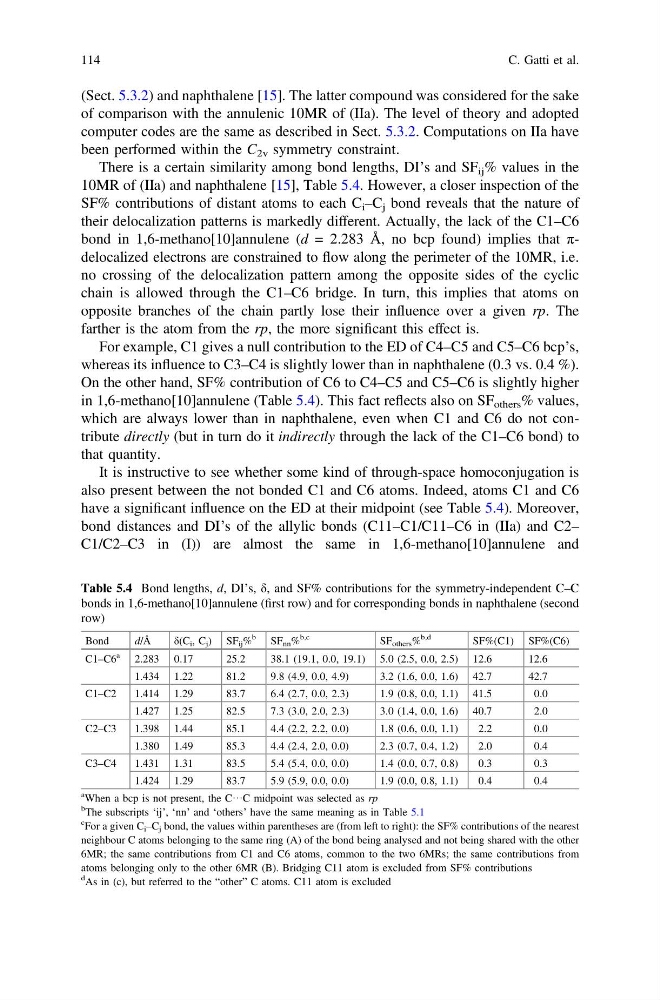
There is a certain similarity among bond lengths, DI’s and SF ij % values in the
10MR of (IIa) and naphthalene [15], Table 5.4. However, a closer inspection of the
SF% contributions of distant atoms to each C i –C j bond reveals that the nature of
their delocalization patterns is markedly different. Actually, the lack of the C1–C6
bond in 1,6-methano[10]annulene (d = 2.283 Å, no bcp found) implies that πdelocalized electrons are constrained to flow along the perimeter of the 10MR, i.e.
no crossing of the delocalization pattern among the opposite sides of the cyclic
chain is allowed through the C1–C6 bridge. In turn, this implies that atoms on
opposite branches of the chain partly lose their influence over a given rp. The
farther is the atom from the rp, the more significant this effect is.
For example, C1 gives a null contribution to the ED of C4–C5 and C5–C6 bcp’s,
whereas its influence to C3–C4 is slightly lower than in naphthalene (0.3 vs. 0.4 %).
On the other hand, SF% contribution of C6 to C4–C5 and C5–C6 is slightly higher
in 1,6-methano[10]annulene (Table 5.4). This fact reflects also on SF others % values,
which are always lower than in naphthalene, even when C1 and C6 do not contribute directly (but in turn do it indirectly through the lack of the C1–C6 bond) to
that quantity.
It is instructive to see whether some kind of through-space homoconjugation is
also present between the not bonded C1 and C6 atoms. Indeed, atoms C1 and C6
have a significant influence on the ED at their midpoint (see Table 5.4). Moreover,
bond distances and DI’s of the allylic bonds (C11–C1/C11–C6 in (IIa) and C2–
C1/C2–C3 in (I)) are almost the same in 1,6-methano[10]annulene and
Table 5.4 Bond lengths, d, DI’s, δ, and SF% contributions for the symmetry-independent C–C
bonds in 1,6-methano[10]annulene (first row) and for corresponding bonds in naphthalene (second
row)
Bond
d/Å
δ(C i , C j ) SF ij %
b
SF nn %
b,c
SF others %
b,d
SF%(C1) SF%(C6)
C1–C6
a
2.283 0.17
25.2
38.1 (19.1, 0.0, 19.1) 5.0 (2.5, 0.0, 2.5) 12.6
12.6
1.434 1.22
81.2
9.8 (4.9, 0.0, 4.9)
3.2 (1.6, 0.0, 1.6) 42.7
42.7
C1–C2
1.414 1.29
83.7
6.4 (2.7, 0.0, 2.3)
1.9 (0.8, 0.0, 1.1) 41.5
0.0
1.427 1.25
82.5
7.3 (3.0, 2.0, 2.3)
3.0 (1.4, 0.0, 1.6) 40.7
2.0
C2–C3
1.398 1.44
85.1
4.4 (2.2, 2.2, 0.0)
1.8 (0.6, 0.0, 1.1)
2.2
0.0
1.380 1.49
85.3
4.4 (2.4, 2.0, 0.0)
2.3 (0.7, 0.4, 1.2)
2.0
0.4
C3–C4
1.431 1.31
83.5
5.4 (5.4, 0.0, 0.0)
1.4 (0.0, 0.7, 0.8)
0.3
0.3
1.424 1.29
83.7
5.9 (5.9, 0.0, 0.0)
1.9 (0.0, 0.8, 1.1)
0.4
0.4
a
When a bcp is not present, the C···C midpoint was selected as rp
b
The subscripts ‘ij’, ‘nn’ and ‘others’ have the same meaning as in Table 5.1
c
For a given C i –C j bond, the values within parentheses are (from left to right): the SF% contributions of the nearest
neighbour C atoms belonging to the same ring (A) of the bond being analysed and not being shared with the other
6MR; the same contributions from C1 and C6 atoms, common to the two 6MRs; the same contributions from
atoms belonging only to the other 6MR (B). Bridging C11 atom is excluded from SF% contributions
d
As in (c), but referred to the “other” C atoms. C11 atom is excluded
114
C. Gatti et al.
of comparison with the annulenic 10MR of (IIa). The level of theory and adopted
computer codes are the same as described in Sect. 5.3.2. Computations on IIa have
been performed within the C 2v symmetry constraint.
There is a certain similarity among bond lengths, DI’s and SF ij % values in the
10MR of (IIa) and naphthalene [15], Table 5.4. However, a closer inspection of the
SF% contributions of distant atoms to each C i –C j bond reveals that the nature of
their delocalization patterns is markedly different. Actually, the lack of the C1–C6
bond in 1,6-methano[10]annulene (d = 2.283 Å, no bcp found) implies that πdelocalized electrons are constrained to flow along the perimeter of the 10MR, i.e.
no crossing of the delocalization pattern among the opposite sides of the cyclic
chain is allowed through the C1–C6 bridge. In turn, this implies that atoms on
opposite branches of the chain partly lose their influence over a given rp. The
farther is the atom from the rp, the more significant this effect is.
For example, C1 gives a null contribution to the ED of C4–C5 and C5–C6 bcp’s,
whereas its influence to C3–C4 is slightly lower than in naphthalene (0.3 vs. 0.4 %).
On the other hand, SF% contribution of C6 to C4–C5 and C5–C6 is slightly higher
in 1,6-methano[10]annulene (Table 5.4). This fact reflects also on SF others % values,
which are always lower than in naphthalene, even when C1 and C6 do not contribute directly (but in turn do it indirectly through the lack of the C1–C6 bond) to
that quantity.
It is instructive to see whether some kind of through-space homoconjugation is
also present between the not bonded C1 and C6 atoms. Indeed, atoms C1 and C6
have a significant influence on the ED at their midpoint (see Table 5.4). Moreover,
bond distances and DI’s of the allylic bonds (C11–C1/C11–C6 in (IIa) and C2–
C1/C2–C3 in (I)) are almost the same in 1,6-methano[10]annulene and
Table 5.4 Bond lengths, d, DI’s, δ, and SF% contributions for the symmetry-independent C–C
bonds in 1,6-methano[10]annulene (first row) and for corresponding bonds in naphthalene (second
row)
Bond
d/Å
δ(C i , C j ) SF ij %
b
SF nn %
b,c
SF others %
b,d
SF%(C1) SF%(C6)
C1–C6
a
2.283 0.17
25.2
38.1 (19.1, 0.0, 19.1) 5.0 (2.5, 0.0, 2.5) 12.6
12.6
1.434 1.22
81.2
9.8 (4.9, 0.0, 4.9)
3.2 (1.6, 0.0, 1.6) 42.7
42.7
C1–C2
1.414 1.29
83.7
6.4 (2.7, 0.0, 2.3)
1.9 (0.8, 0.0, 1.1) 41.5
0.0
1.427 1.25
82.5
7.3 (3.0, 2.0, 2.3)
3.0 (1.4, 0.0, 1.6) 40.7
2.0
C2–C3
1.398 1.44
85.1
4.4 (2.2, 2.2, 0.0)
1.8 (0.6, 0.0, 1.1)
2.2
0.0
1.380 1.49
85.3
4.4 (2.4, 2.0, 0.0)
2.3 (0.7, 0.4, 1.2)
2.0
0.4
C3–C4
1.431 1.31
83.5
5.4 (5.4, 0.0, 0.0)
1.4 (0.0, 0.7, 0.8)
0.3
0.3
1.424 1.29
83.7
5.9 (5.9, 0.0, 0.0)
1.9 (0.0, 0.8, 1.1)
0.4
0.4
a
When a bcp is not present, the C···C midpoint was selected as rp
b
The subscripts ‘ij’, ‘nn’ and ‘others’ have the same meaning as in Table 5.1
c
For a given C i –C j bond, the values within parentheses are (from left to right): the SF% contributions of the nearest
neighbour C atoms belonging to the same ring (A) of the bond being analysed and not being shared with the other
6MR; the same contributions from C1 and C6 atoms, common to the two 6MRs; the same contributions from
atoms belonging only to the other 6MR (B). Bridging C11 atom is excluded from SF% contributions
d
As in (c), but referred to the “other” C atoms. C11 atom is excluded
114
C. Gatti et al.