

above sketched tautomerism [79], these compounds allow for a systematic experimental investigation of electron delocalization. Some decades ago, they were
extensively studied by Gatti et al. by applying QTAIM topological descriptors to
their theoretical ED distributions and using X-ray derived crystalline geometries
[23, 24]. Similarly, Bianchi, Destro and Merati lately applied such approach to the
accurate experimentally-derived ED distribution of a polybridged annulene
derivative [85]. A first attempt of understanding aromaticity (and possibly
homoaromaticity) in these compounds using descriptors based on the pair density
was carried out far more recently [84].
In their study, Gatti et al. found that when the C1–C6 bond length is close to the
value of normal CC bonds, i.e. for R = R′ = CN or CH 3 , the π-like charge distribution of the 3MR system is preserved and the whole cyclopropyl ring behaves a a
conjugate π bond. However, when the C 1 –C 6 bond lengthens, the 3MR Critical
Point (CP) approaches the CP of the C 1 –C 6 bond and, for R = R′ = H or F, the two
points eventually merge, leading to an annulenic structure. Even in such structure,
however, besides the presence of the 10-π electronic system, a conjugative coupling
of the cyclopropyl ring to the [10]-annulenic framework occurs, similarly to the
case of homotropylium cation. The strong involvement of the two external bonds of
the 3MR ring in conjugation make them very short and with quite significant
ellipticity [23]. Moreover, the overall conjugative mechanism is signalled by the
presence of two 7MR ring CPs, largely displaced from the plane of the
10-annulenic framework and pointing towards the bridgehead carbon C11 [23, 24].
The availability of this extra-conjugation mechanism complies with the far better
stability of 1,6-methano[10]annulene relative to the extremely reactive π-isoelectronic unbridged [10]annulenes. These latter are in fact characterized by very
alternating CC bond lengths and bear few if any signs of aromaticity.
In this section, we extend the SF analysis to 1,6-methano[10]annulene
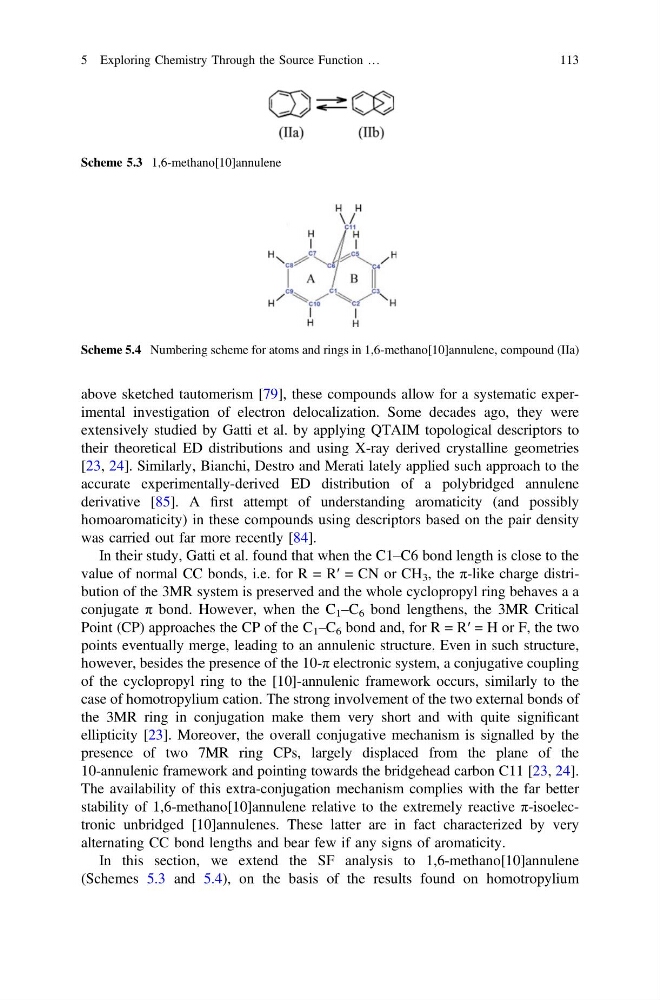
(Schemes 5.3 and 5.4), on the basis of the results found on homotropylium
Scheme 5.3 1,6-methano[10]annulene
Scheme 5.4 Numbering scheme for atoms and rings in 1,6-methano[10]annulene, compound (IIa)
5 Exploring Chemistry Through the Source Function …
113
extensively studied by Gatti et al. by applying QTAIM topological descriptors to
their theoretical ED distributions and using X-ray derived crystalline geometries
[23, 24]. Similarly, Bianchi, Destro and Merati lately applied such approach to the
accurate experimentally-derived ED distribution of a polybridged annulene
derivative [85]. A first attempt of understanding aromaticity (and possibly
homoaromaticity) in these compounds using descriptors based on the pair density
was carried out far more recently [84].
In their study, Gatti et al. found that when the C1–C6 bond length is close to the
value of normal CC bonds, i.e. for R = R′ = CN or CH 3 , the π-like charge distribution of the 3MR system is preserved and the whole cyclopropyl ring behaves a a
conjugate π bond. However, when the C 1 –C 6 bond lengthens, the 3MR Critical
Point (CP) approaches the CP of the C 1 –C 6 bond and, for R = R′ = H or F, the two
points eventually merge, leading to an annulenic structure. Even in such structure,
however, besides the presence of the 10-π electronic system, a conjugative coupling
of the cyclopropyl ring to the [10]-annulenic framework occurs, similarly to the
case of homotropylium cation. The strong involvement of the two external bonds of
the 3MR ring in conjugation make them very short and with quite significant
ellipticity [23]. Moreover, the overall conjugative mechanism is signalled by the
presence of two 7MR ring CPs, largely displaced from the plane of the
10-annulenic framework and pointing towards the bridgehead carbon C11 [23, 24].
The availability of this extra-conjugation mechanism complies with the far better
stability of 1,6-methano[10]annulene relative to the extremely reactive π-isoelectronic unbridged [10]annulenes. These latter are in fact characterized by very
alternating CC bond lengths and bear few if any signs of aromaticity.
In this section, we extend the SF analysis to 1,6-methano[10]annulene
(Schemes 5.3 and 5.4), on the basis of the results found on homotropylium
Scheme 5.3 1,6-methano[10]annulene
Scheme 5.4 Numbering scheme for atoms and rings in 1,6-methano[10]annulene, compound (IIa)
5 Exploring Chemistry Through the Source Function …
113