

to atoms or group of atoms (“functional groups”). In other words, the SF tool brings
quantitative chemical insight [2, 6], as it allows to quantify the extent to which the
various functional groups or atoms in a system contribute to determine the amount of
electron density at a given rp. This property holds whether such chemical moieties are
or are not linked through a bond path (BP) to the nucleus of the basin hosting the rp.
The SF is so able to highlight, in the real space, nonlocal quantum effects, provided
they have some influence on the ground-state ED and are properly modelled within
the adopted computational model.
One relevant feature of the SF descriptor is that its evaluation requires only the
knowledge of the ED distribution and it is so also experimentally accessible from
single-crystal or powder X-ray diffraction intensity data through the so-called
multipole models [7–9]. As a matter of fact, the SF tool provides a true bridge
between theory and experiment, allowing one to compare either results on the same
grounds [2, 3, 10]. Since the seminal work by Bader and Gatti, the SF descriptor has
been extensively and successfully applied to study non-local bonding effects in
molecules and crystals [2, 3, 6, 11–17].
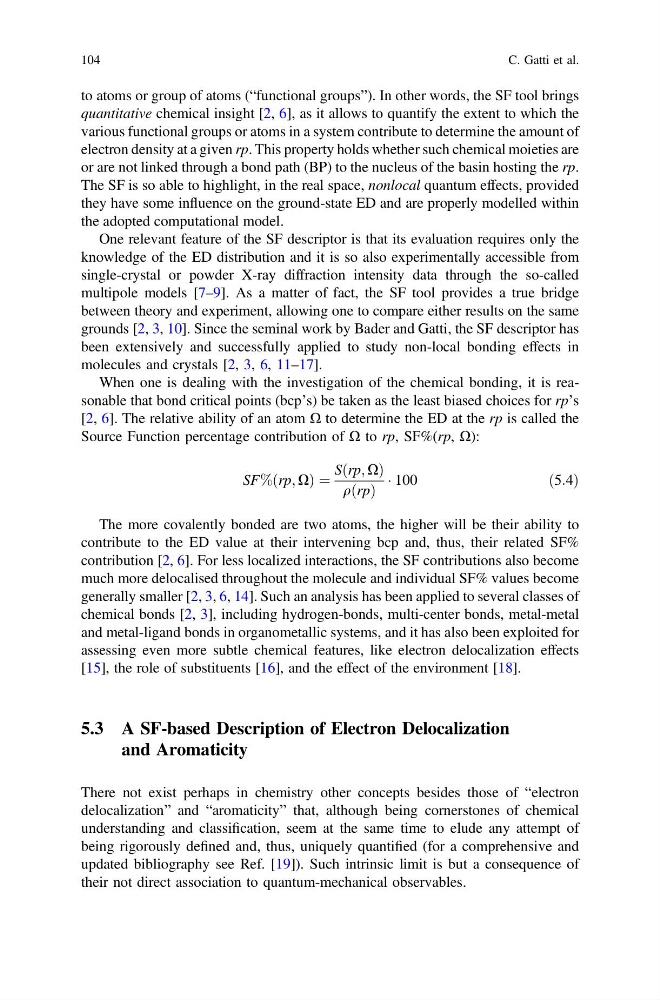
When one is dealing with the investigation of the chemical bonding, it is reasonable that bond critical points (bcp’s) be taken as the least biased choices for rp’s
[2, 6]. The relative ability of an atom Ω to determine the ED at the rp is called the
Source Function percentage contribution of Ω to rp, SF%(rp, Ω):
SF% rp; X
ð
Þ¼
S rp; X
ð
Þ
q rp
ð Þ
Á 100
ð5:4Þ
The more covalently bonded are two atoms, the higher will be their ability to
contribute to the ED value at their intervening bcp and, thus, their related SF%
contribution [2, 6]. For less localized interactions, the SF contributions also become
much more delocalised throughout the molecule and individual SF% values become
generally smaller [2, 3, 6, 14]. Such an analysis has been applied to several classes of
chemical bonds [2, 3], including hydrogen-bonds, multi-center bonds, metal-metal
and metal-ligand bonds in organometallic systems, and it has also been exploited for
assessing even more subtle chemical features, like electron delocalization effects
[15], the role of substituents [16], and the effect of the environment [18].
5.3 A SF-based Description of Electron Delocalization
and Aromaticity
There not exist perhaps in chemistry other concepts besides those of “electron
delocalization” and “aromaticity” that, although being cornerstones of chemical
understanding and classification, seem at the same time to elude any attempt of
being rigorously defined and, thus, uniquely quantified (for a comprehensive and
updated bibliography see Ref. [19]). Such intrinsic limit is but a consequence of
their not direct association to quantum-mechanical observables.
104
C. Gatti et al.
quantitative chemical insight [2, 6], as it allows to quantify the extent to which the
various functional groups or atoms in a system contribute to determine the amount of
electron density at a given rp. This property holds whether such chemical moieties are
or are not linked through a bond path (BP) to the nucleus of the basin hosting the rp.
The SF is so able to highlight, in the real space, nonlocal quantum effects, provided
they have some influence on the ground-state ED and are properly modelled within
the adopted computational model.
One relevant feature of the SF descriptor is that its evaluation requires only the
knowledge of the ED distribution and it is so also experimentally accessible from
single-crystal or powder X-ray diffraction intensity data through the so-called
multipole models [7–9]. As a matter of fact, the SF tool provides a true bridge
between theory and experiment, allowing one to compare either results on the same
grounds [2, 3, 10]. Since the seminal work by Bader and Gatti, the SF descriptor has
been extensively and successfully applied to study non-local bonding effects in
molecules and crystals [2, 3, 6, 11–17].
When one is dealing with the investigation of the chemical bonding, it is reasonable that bond critical points (bcp’s) be taken as the least biased choices for rp’s
[2, 6]. The relative ability of an atom Ω to determine the ED at the rp is called the
Source Function percentage contribution of Ω to rp, SF%(rp, Ω):
SF% rp; X
ð
Þ¼
S rp; X
ð
Þ
q rp
ð Þ
Á 100
ð5:4Þ
The more covalently bonded are two atoms, the higher will be their ability to
contribute to the ED value at their intervening bcp and, thus, their related SF%
contribution [2, 6]. For less localized interactions, the SF contributions also become
much more delocalised throughout the molecule and individual SF% values become
generally smaller [2, 3, 6, 14]. Such an analysis has been applied to several classes of
chemical bonds [2, 3], including hydrogen-bonds, multi-center bonds, metal-metal
and metal-ligand bonds in organometallic systems, and it has also been exploited for
assessing even more subtle chemical features, like electron delocalization effects
[15], the role of substituents [16], and the effect of the environment [18].
5.3 A SF-based Description of Electron Delocalization
and Aromaticity
There not exist perhaps in chemistry other concepts besides those of “electron
delocalization” and “aromaticity” that, although being cornerstones of chemical
understanding and classification, seem at the same time to elude any attempt of
being rigorously defined and, thus, uniquely quantified (for a comprehensive and
updated bibliography see Ref. [19]). Such intrinsic limit is but a consequence of
their not direct association to quantum-mechanical observables.
104
C. Gatti et al.