

of two τóποι can be clearly considered as a topological method. Following a general
presentation of the SF tool (Sect. 5.2), the present chapter reviews two recent SF
developments, specifically its use to detect subtle electron conjugation effects
(Sect. 5.3) and its extension to the electron spin density (Sect. 5.4). It is shown that
the sources and thus the kind of link existing between two τóποι may largely
depend on the function being analysed (electron or electron spin density). The two
reviewed developments are then each followed by the presentation of an original
application. Namely, the SF analysis of the electron conjugation in non planar
systems (Sects. 5.3.1–5.3.3), where σ/π separation is disabled, and the study,
through the eye of the SF, of the electron spin density transferability in n-alkyl
radicals (Sect. 5.4.1). Section 5.5 concludes.
5.2 The Source Function Descriptor
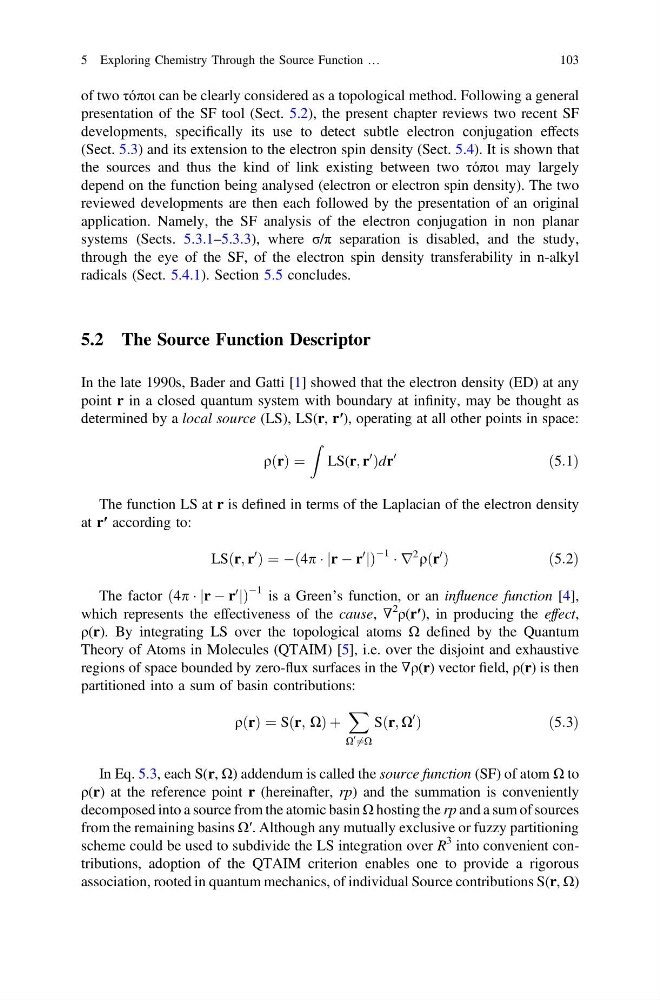
In the late 1990s, Bader and Gatti [1] showed that the electron density (ED) at any
point r in a closed quantum system with boundary at infinity, may be thought as
determined by a local source (LS), LS(r, r′), operating at all other points in space:
qðrÞ ¼
Z
LS(r; r
0
Þdr
0
ð5:1Þ
The function LS at r is defined in terms of the Laplacian of the electron density
at r′ according to:
LSðr; r
0
Þ ¼ Àð4p Á r À r
0
j
jÞ
À1 Á r
2
qðr
0
Þ
ð 5:2Þ
The factor ð4p Á r À r
0
j
jÞ
À1 is a Green’s function, or an influence function [4],
which represents the effectiveness of the cause, ∇
2
ρ(r′), in producing the effect,
ρ(r). By integrating LS over the topological atoms Ω defined by the Quantum
Theory of Atoms in Molecules (QTAIM) [5], i.e. over the disjoint and exhaustive
regions of space bounded by zero-flux surfaces in the ∇ρ(r) vector field, ρ(r) is then
partitioned into a sum of basin contributions:
qðrÞ ¼ Sðr; XÞ þ
X
X
0 6 ¼X
Sðr; X
0
Þ
ð 5:3Þ
In Eq. 5.3, each S(r, Ω) addendum is called the source function (SF) of atom Ω to
ρ(r) at the reference point r (hereinafter, rp) and the summation is conveniently
decomposed into a source from the atomic basin Ω hosting the rp and a sum of sources
from the remaining basins Ω′. Although any mutually exclusive or fuzzy partitioning
scheme could be used to subdivide the LS integration over R
3 into convenient contributions, adoption of the QTAIM criterion enables one to provide a rigorous
association, rooted in quantum mechanics, of individual Source contributions S(r, Ω)
5 Exploring Chemistry Through the Source Function …
103
presentation of the SF tool (Sect. 5.2), the present chapter reviews two recent SF
developments, specifically its use to detect subtle electron conjugation effects
(Sect. 5.3) and its extension to the electron spin density (Sect. 5.4). It is shown that
the sources and thus the kind of link existing between two τóποι may largely
depend on the function being analysed (electron or electron spin density). The two
reviewed developments are then each followed by the presentation of an original
application. Namely, the SF analysis of the electron conjugation in non planar
systems (Sects. 5.3.1–5.3.3), where σ/π separation is disabled, and the study,
through the eye of the SF, of the electron spin density transferability in n-alkyl
radicals (Sect. 5.4.1). Section 5.5 concludes.
5.2 The Source Function Descriptor
In the late 1990s, Bader and Gatti [1] showed that the electron density (ED) at any
point r in a closed quantum system with boundary at infinity, may be thought as
determined by a local source (LS), LS(r, r′), operating at all other points in space:
qðrÞ ¼
Z
LS(r; r
0
Þdr
0
ð5:1Þ
The function LS at r is defined in terms of the Laplacian of the electron density
at r′ according to:
LSðr; r
0
Þ ¼ Àð4p Á r À r
0
j
jÞ
À1 Á r
2
qðr
0
Þ
ð 5:2Þ
The factor ð4p Á r À r
0
j
jÞ
À1 is a Green’s function, or an influence function [4],
which represents the effectiveness of the cause, ∇
2
ρ(r′), in producing the effect,
ρ(r). By integrating LS over the topological atoms Ω defined by the Quantum
Theory of Atoms in Molecules (QTAIM) [5], i.e. over the disjoint and exhaustive
regions of space bounded by zero-flux surfaces in the ∇ρ(r) vector field, ρ(r) is then
partitioned into a sum of basin contributions:
qðrÞ ¼ Sðr; XÞ þ
X
X
0 6 ¼X
Sðr; X
0
Þ
ð 5:3Þ
In Eq. 5.3, each S(r, Ω) addendum is called the source function (SF) of atom Ω to
ρ(r) at the reference point r (hereinafter, rp) and the summation is conveniently
decomposed into a source from the atomic basin Ω hosting the rp and a sum of sources
from the remaining basins Ω′. Although any mutually exclusive or fuzzy partitioning
scheme could be used to subdivide the LS integration over R
3 into convenient contributions, adoption of the QTAIM criterion enables one to provide a rigorous
association, rooted in quantum mechanics, of individual Source contributions S(r, Ω)
5 Exploring Chemistry Through the Source Function …
103